In a slab on ground, the steel mesh is usually there to hold shrinkage and temperature cracks tight, not to carry load. So the real fiber vs wire mesh question is simple: which one will actually do that job in your slab? Mesh works only if it stays at the right height, and on many sites it doesn't. A designed dose of macro synthetic fiber can take over from crack-control mesh and temperature steel where the designer permits. Micro fiber cannot, however, and no fiber replaces rebar that carries load.
What the mesh in a slab on ground is for
Concrete shrinks as it dries, and it moves with temperature. Because it is weak in tension, a slab that the base or a wall holds back will crack. The mesh does not stop that. Instead, it crosses the crack and keeps the two faces close, so the crack stays a hairline and does not grow into a defect.
The American Concrete Institute lists three tools for this job. In its note on crack-width control, ACI names steel bars, wire mesh and macrofibers, all for cracks from shrinkage, thermal stress and other nonstructural causes. That list is the right starting point. Both options aim at crack width, and neither one prevents cracks. So the slab still needs its joints, as our post on control joints in fiber reinforced slabs explains.
Where the mesh really ends up
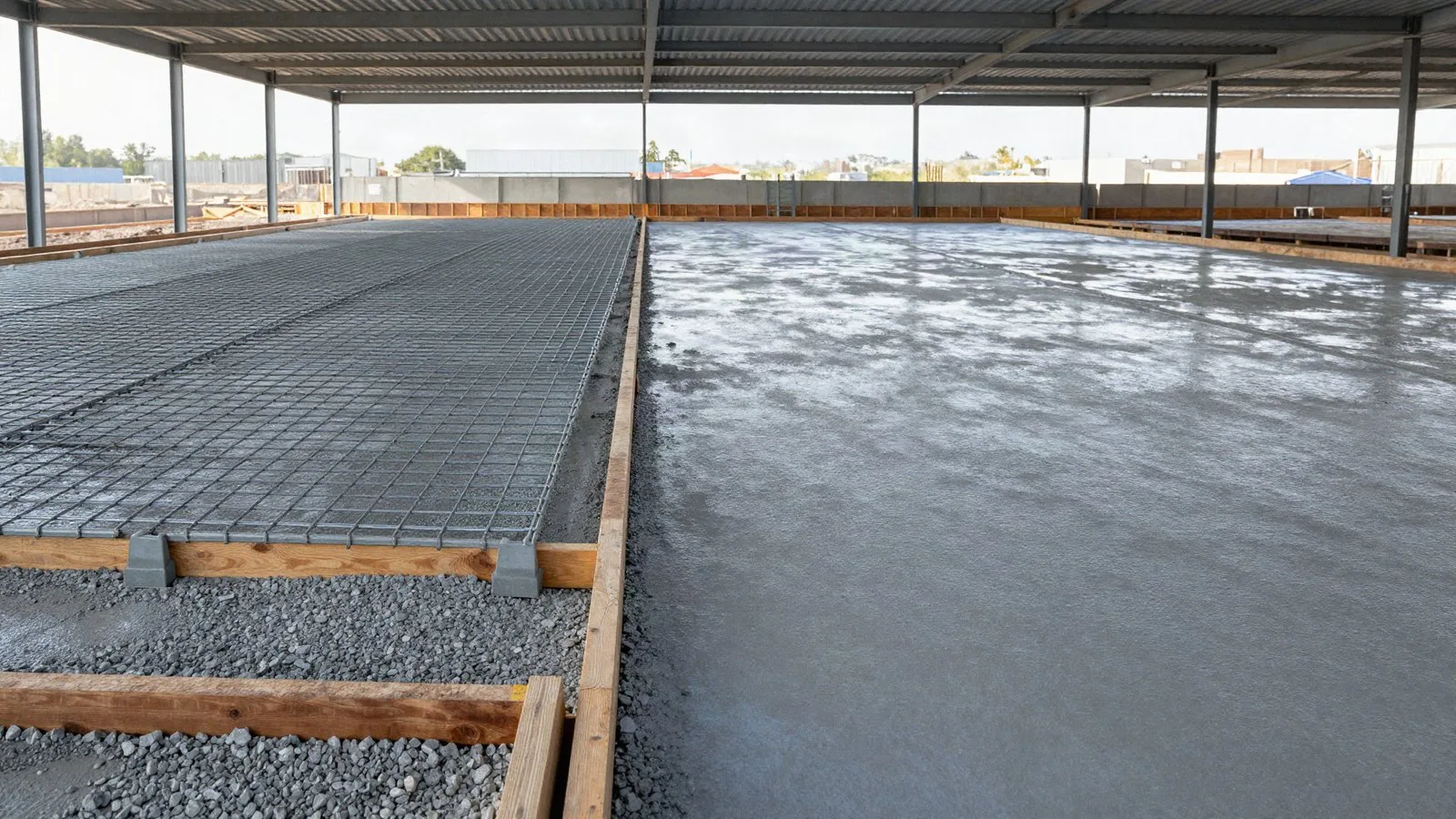
Mesh has one big weakness. It works only in the plane where it sits, and the drawing gives that plane a height. If the sheet drifts down during the pour, it is no longer where the designer put it. As a result, it does much less than the design assumed.
ACI's answer on placing welded wire reinforcement rules out two common habits. First, ACI 302.1R says crews should not lay the mesh on the ground and pull it up into the fresh concrete. Second, they should not walk the mats in after placing the concrete either. ACI also asks for supports close enough that foot traffic cannot push the mesh out of place.
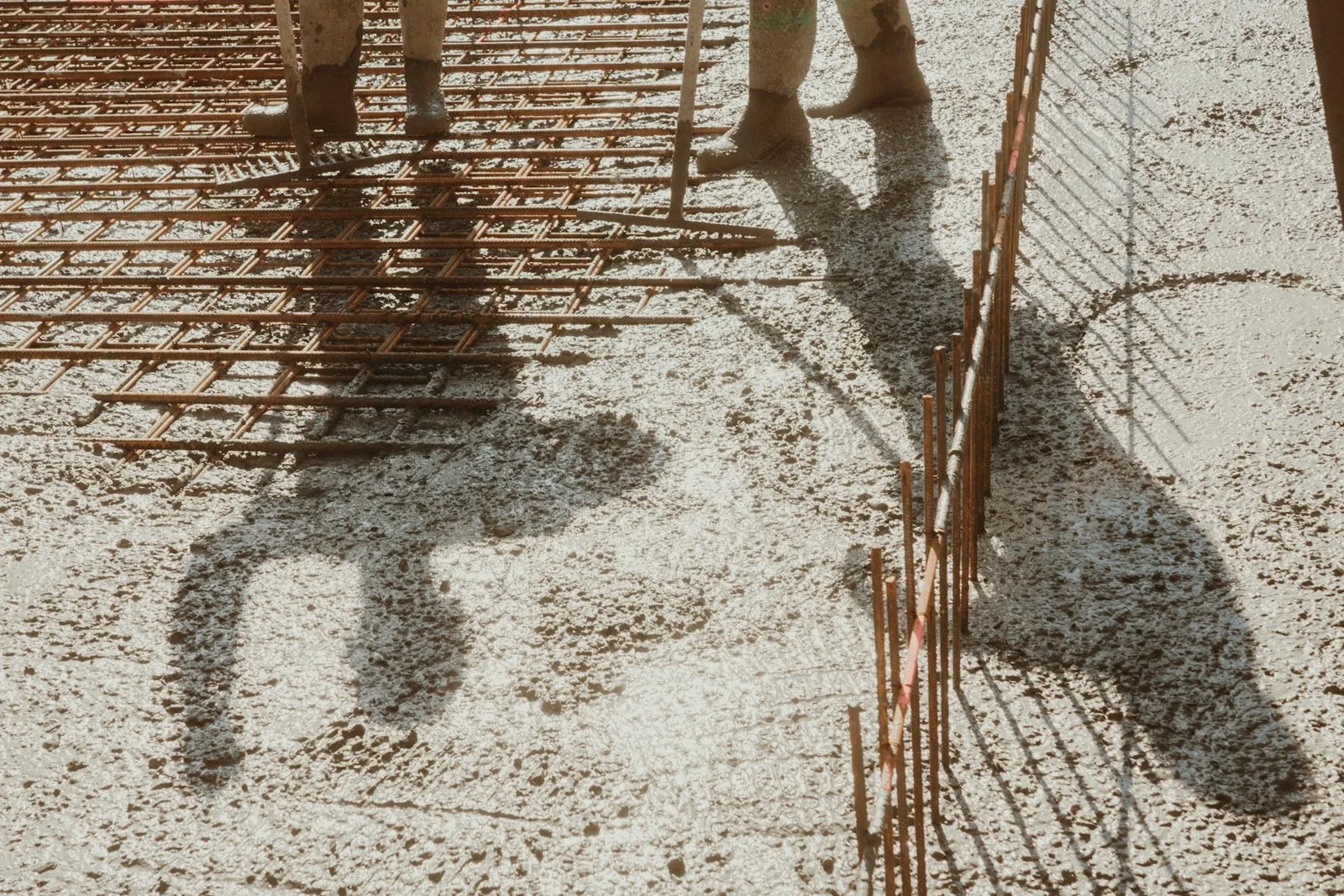
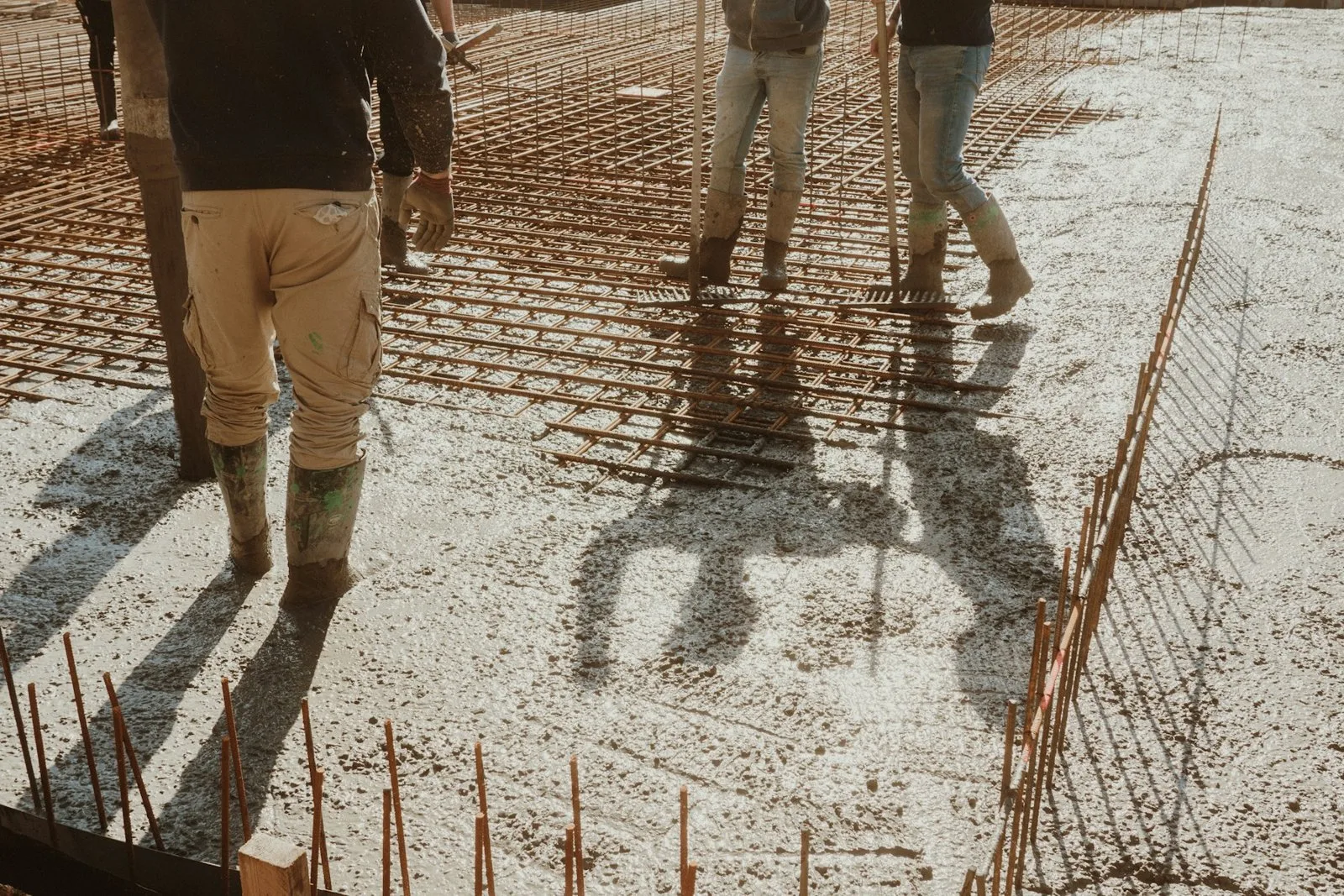
Anyone who has watched a slab pour knows why this matters. People walk on the mesh, the pump hose drags across it, and light sheets sag between supports. If a sheet ends up lying on the base, nobody can see it once the concrete is down. Yet the slab will crack as if the mesh were not there.
Fiber vs wire mesh for crack control
Fiber removes the placement step. Instead of one sheet in one plane, the fibers spread through the full depth of the slab. Because of that, they cross a crack wherever it forms, near the top or near the bottom. There is no height to hold, and there is no spacer for a boot to knock over.
The comparison is not one-sided, though. Mesh puts a known area of continuous steel across every crack, and engineers have long experience designing with it. Fiber, by contrast, works through a great many short pieces, so a test measures its effect, not a bar area. The table sums up the fiber vs wire mesh trade-off.
| Point | Wire mesh | Macro synthetic fiber |
| Where it works | One plane, and only if it stays there | Through the full depth |
| Site work | Cut, carry, lay on spacers, keep up during the pour | Added at the plant or into the truck mixer |
| Corrosion | Steel relies on concrete cover | Polypropylene does not corrode |
| How you specify it | Bar size and spacing | Grade, dose in kg/m³ and a residual strength test |
| What it never does | Stop cracks or replace joints | Stop cracks, replace joints or replace rebar |
Micro fiber is not a mesh replacement
This is the most common mix-up. ACI describes synthetic microfibers as mainly a control for plastic shrinkage cracks, and it says they add little to the hardened concrete. Fine monofilament polypropylene concrete fibers, such as our PG MS-12 at 0.6 to 1.2 kg/m³, protect the surface in its first hours. However, they do not take over the mesh's job in the hardened slab.
Macro fiber at a designed dose
Macrofibers improve the hardened concrete, especially after it cracks. ACI's note on minimum fiber dosages gives about 1.8 kg/m³ for synthetic macrofibers in slab-on-ground work. Below that, there is too little fiber, and the concrete behaves like plain concrete. ACI also notes that higher doses add bending capacity and toughness after cracking. So the dose that replaces a mesh comes from the design, not from the minimum.
In our range, PG EC-45 runs at 2 to 4 kg/m³ for crack control, but it is not a full reinforcement replacement. PG MF-54, at 3 to 7 kg/m³, is the grade for industrial floors and slabs on ground. Our page on macro synthetic fibers for concrete compares the grades in more detail.
Installed cost: compare the whole job
The price of a mesh sheet next to the price of a fiber bag tells you nothing. Compare what each one costs once it sits in the slab. For the mesh, list every line: the sheets, cutting, transport, spacers, labour to lay and tie them, and the time the crew spends before the pour can start. Then list the fiber: the dose times the volume, plus any change in admixture or mixing time.
Run both lists with your own rates, since labour and steel costs vary by job and by region. Our guide to concrete fiber cost per cubic metre sets out the method, and the cost calculators take your own numbers. One rule holds everywhere, though. If the drawings keep the mesh and add fiber too, the fiber is an extra line, not a saving.
When a designed macro dose may replace the mesh
Swapping mesh for fiber is a design decision. The plant or the site crew should never make it on their own. In general, the switch makes sense only when all of these hold:
The slab sits on the ground, and the mesh is there for shrinkage and temperature crack control.
Your engineer of record agrees and sets the grade and the dose.
The specification names a residual strength test, such as ASTM C1609, at the dose you plan to use.
Joint layout, base preparation and curing stay as the design requires.
If all four hold, fiber vs wire mesh becomes a choice about cost and site logistics. Iran's Code 120-4 for polyolefin fiber concrete points the same way. It lists flexural tests such as ASTM C1609, and it asks for fiber concrete that arrives free of balled fibers. Finally, prove the mix in a trial batch with your own materials before the first pour.
When the steel stays
Fiber does not replace steel that carries calculated load. Suppose an engineer sized the bars from a bending moment, as in a suspended slab, a beam or a raft designed in bending. That steel stays, and no dose changes this. Likewise, if the drawings call for mesh for a reason other than crack control, ask the designer before you remove it. For more on the term itself, see our note on fiber mesh concrete.
What to send before you decide
A good answer to the fiber vs wire mesh question starts with a few facts about the slab: thickness, base, loading, exposure and joint layout. A concrete fiber supplier should turn those into a grade, a dose and a test plan, in writing. Polyguard's technical team designs the dose free from section, loading and exposure. It also issues the data sheet and a QC certificate for every production batch, and it sends a free sample for trial batching. On request, the team attends the first pour on industrial floors. If you are new to the material, start with how concrete fiber works.
Frequently Asked Questions
Is fiber better than wire mesh in a slab on ground?
For shrinkage and temperature crack control, a designed dose of macro synthetic fiber can do the mesh's job without any placement step, because it spreads through the full depth. Mesh puts a known area of continuous steel across each crack, but only if it stays at the height the drawing shows. The engineer of record decides which one the slab uses.
Can micro fiber replace wire mesh?
No. ACI describes synthetic microfibers as mainly a control for plastic shrinkage cracks, and they add little to the hardened concrete. Only macro fiber at a designed dose can take over from crack-control mesh.
Do I still need control joints if I use fiber instead of mesh?
Yes. Both mesh and fiber control crack width; neither stops concrete from shrinking. The slab still needs the joints, base preparation and curing its design calls for.
Can fiber replace rebar as well as mesh?
No. Fiber can replace crack-control mesh and temperature steel where the designer permits. Steel sized from a bending moment, as in a suspended slab, a beam or a raft designed in bending, stays.
How should I compare the cost of fiber and wire mesh?
Compare the installed cost, not the price of a sheet against a bag. For mesh, count the sheets, cutting, transport, spacers, labour and crew time before the pour; for fiber, the dose times the volume plus any admixture or mixing change, all at your own rates.