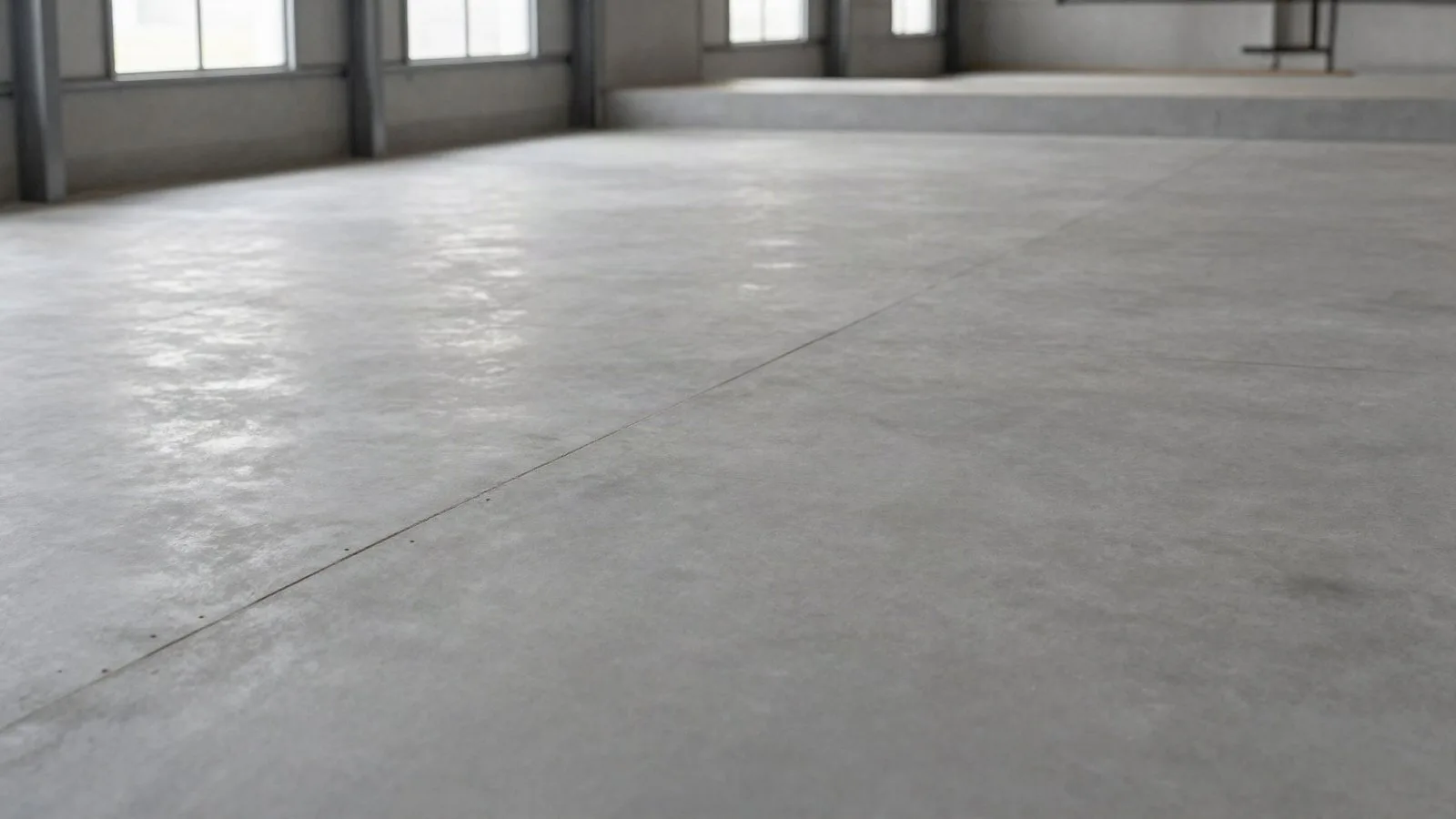
Yes, you still need control joints in fiber reinforced slabs. Fiber does not stop concrete from shrinking, so the slab will crack somewhere, and a saw cut decides where. The one exception is a large-panel floor that an engineer designs around macro fiber at a set dose, with the base, thickness, curing and joints worked out together. Micro fiber, at its normal dose, gives you no reason to move a single joint.
Why every slab needs a planned place to crack
Concrete moves with moisture and temperature, and overall it shrinks. NRMCA's CIP 6 sheet on joints in slabs on grade puts it simply: joints are planned cracks. Concrete is weak in tension. So when the base, a wall or a column holds a shrinking slab back, it cracks.
The cracking also comes in stages. Early cracks come mostly from temperature change and the slight contraction as concrete sets. Later, as the slab dries, it shrinks further, so new cracks form or old ones get wider. Even ACI 360R, the ACI guide to slab design, says it is unrealistic to expect floors free of cracks and curl. CIP 6 names three kinds of joint:
- Contraction joints, also called control joints: weak lines that set where the shrinkage crack forms.
- Isolation joints: they free the slab from walls, footings and columns.
- Construction joints: the line where one pour meets the next.
What micro fiber changes, and what it leaves alone
Micro fiber is the fine monofilament most people picture when they hear polypropylene concrete fibers. ACI describes synthetic microfibers as mainly a control for plastic shrinkage cracks, and says they add very little to the hardened concrete.
That timing matters. Plastic shrinkage cracks open in the first hours, while the surface is still soft. However, the cracks a control joint handles come later, from drying and temperature, when the concrete is hard. So a micro fiber at its normal dose, such as our PG MS-12 at 0.6 to 1.2 kg/m³, helps the surface through those first hours. Still, keep the same joint spacing, cut depth and saw timing you would use without it. Our post on why concrete cracks and how fiber helps covers the early-age side.
Macro fiber at a designed dose
Macro fiber is a different tool. ACI lists macrofibers next to bars and wire mesh as reinforcement for crack-width control in slabs. It gives about 1.8 to 2.4 kg/m³ as the minimum synthetic macro dose for shrinkage and thermal cracks. Note the words: crack width. The fiber holds a crack tight once it forms, but it does not stop the crack.
ACI 360R points the same way. It says reinforcement in a slab on ground may be provided to limit crack widths from shrinkage and temperature restraint. Its contents also list distributed reinforcement as a way to reduce the number of joints. But limiting crack width is not the same as preventing cracks.
So longer joint spacing is possible, but only as the output of a design. The engineer picks the thickness, the dose and the joint grid together.
Large-panel floors do exist. However, they are whole systems, not something you add at the plant. ACI 360R gives fiber reinforced slabs their own chapter. Industrial floors also have a UK guide, Concrete Society TR34, with an appendix on fiber reinforced concrete.
If your drawings call for such a floor, macro synthetic fibers for concrete go into the design as one input. Our PG MF-54 runs at 3 to 7 kg/m³ for industrial floors. PG EC-45, at 2 to 4 kg/m³, is a crack-control grade, not full reinforcement. Either way, fiber takes the place of crack-control mesh and temperature steel only where the designer allows it, and never rebar.
| Slab | What the fiber controls | Joint spacing |
|---|---|---|
| Plain concrete | Nothing; joints do it all | Normal rule for the thickness |
| Micro fiber | Surface cracks in the first hours | Same as plain concrete |
| Macro fiber, designed dose | Crack width after cracking | Set by the engineer's design |
Saw-cut timing and depth
Timing matters as much as layout. CIP 6 counts these windows from the end of finishing:
- Early-entry dry cut: generally 1 to 4 hours, depending on how fast the concrete sets. The cut is shallower, but at least 25 mm deep.
- Conventional saw cut: within 4 to 12 hours.
- Depth: at least a quarter of the slab thickness, and never less than 25 mm.
If the edges ravel as you cut, CIP 6 says to wait. But wait too long and the slab may crack on its own first. If fibers show along a cut edge, treat them like any other fibers sticking out of the surface.
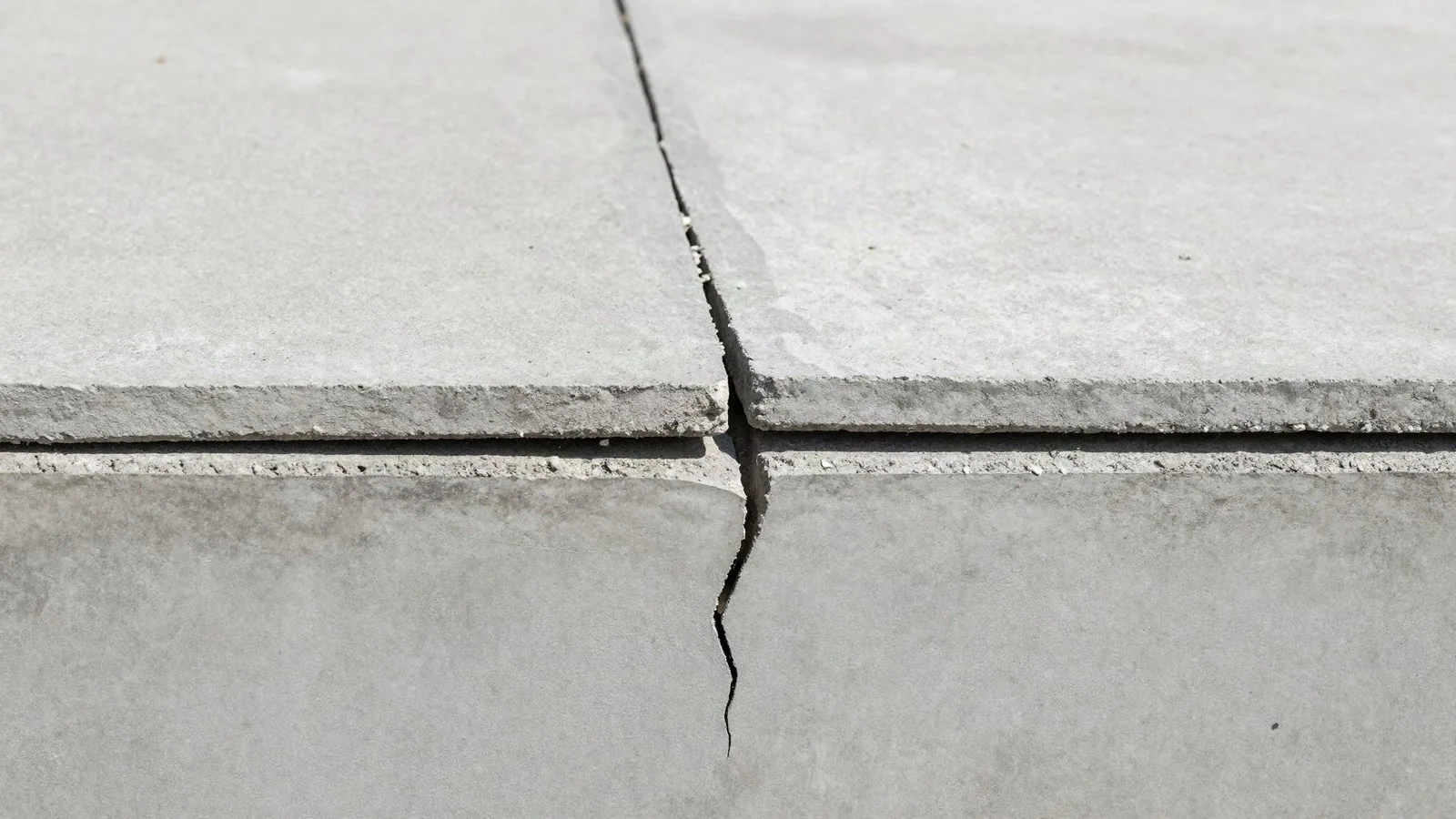
Treat the quarter depth as a minimum. Fiber still crosses the plane under the cut, so the cut must weaken the section enough for the crack to follow it. If the designer asks for a deeper cut, the drawing wins.
Laying out control joints in fiber reinforced slabs
CIP 6 gives a rule of thumb for slabs on grade: a maximum joint spacing of 24 to 36 times the slab thickness. That is about 3 m for a 100 mm slab, with a cap of 4.5 m. Those figures describe ordinary slabs. With micro fiber they stay the same. With macro fiber, only an engineered design moves them.
Panel shape counts as much as size:
- Keep panels square or nearly so. CIP 6 limits the length to 1.5 times the width.
- Avoid L-shaped panels. If the slab has an inside corner, run a joint from it so each panel stays a rectangle.
- Box out columns with isolation joints. CIP 6 suggests a round or square opening, filled after the floor hardens. Turn a square box 45 degrees so the contraction joints meet its points.
- Separate the slab from walls and footings with premolded joint filler.
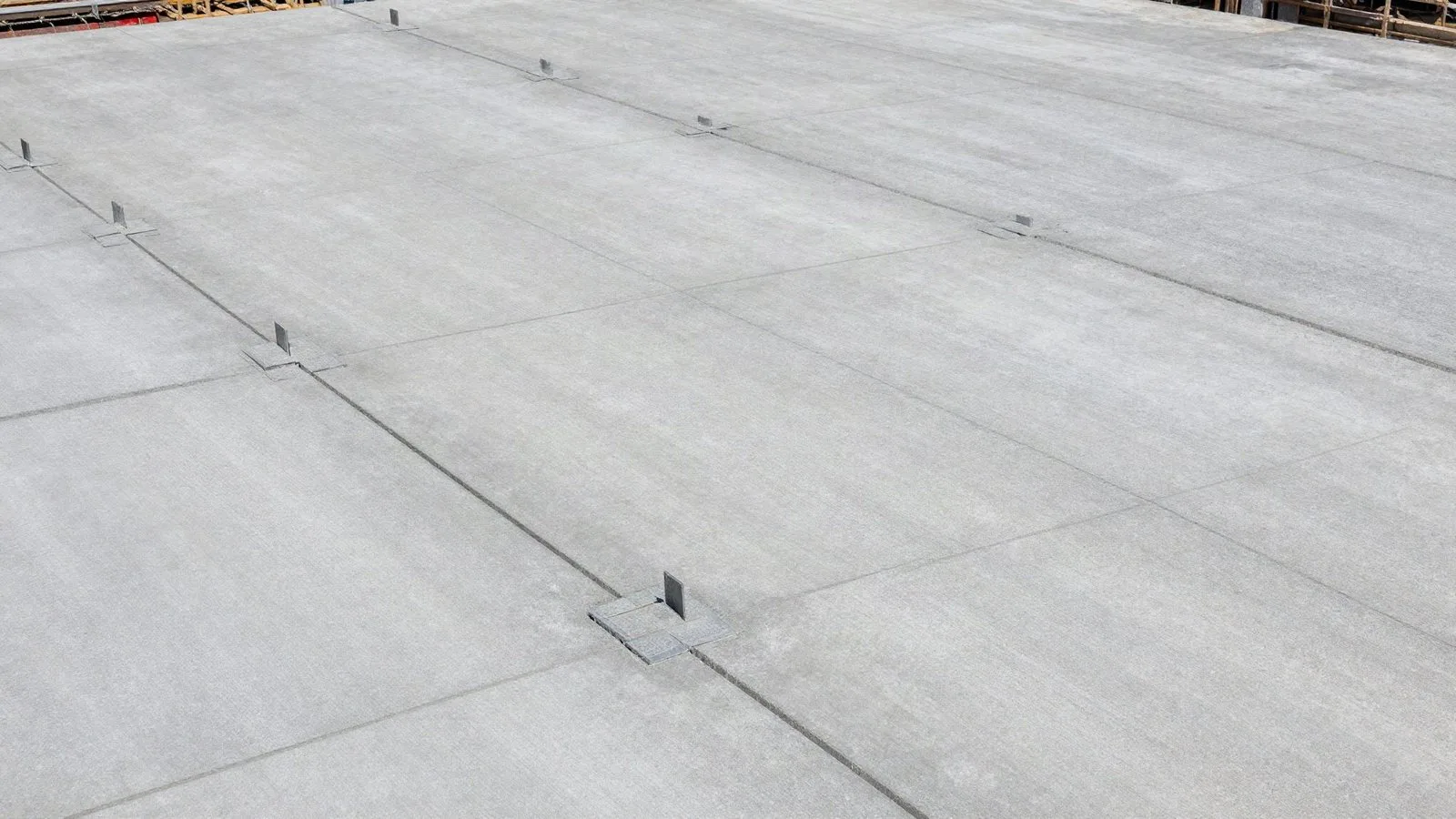
One more line in CIP 6 shows why fiber does not remove the cut. With wire mesh, CIP 6 says to cut every other wire across contraction joints, or better, stop the mesh there. Fiber cannot stop at a joint line, because it runs through the whole slab. That is why the cut and its timing steer the crack.
Construction joints and load transfer
Construction joints go where one pour ends, often at the end of the day, and CIP 6 says to plan where. Fibers do not bridge this joint, because the two sides come from different pours. As a result, load transfer has to come from the joint detail.
CIP 6 lists two details. A keyed joint suits slabs at least 125 mm thick, but CIP 6 does not recommend keys for industrial floors. For slabs that carry heavy loads, it calls for metal dowels. Line them up straight and parallel, because dowels that bind hold the slab back and can cause random cracks at their ends. Joints under heavy traffic need a filler that supports the edges. Our industrial flooring page covers these floors.
Before you drop a saw cut from the drawings
"Can we skip the saw cuts if we add fiber?" comes up often on contractor forums. Leaving out control joints in fiber reinforced slabs is a design call, not a site one. So before anyone says yes, check:
- Who designed the joint layout, and does it name the fiber, grade and dose?
- What test data backs that dose? ACI links macro fiber dosage to performance tests such as ASTM C1609 and C1550.
- Is the fiber macro? If it is micro, the joint grid stays as it was.
- Does the design also cover restraint, curing and curl?
- If a panel is larger than the normal rule, who signs off on it?
Our technical team designs the dose free from the slab section, the loading and the exposure. On industrial floors it can attend the first pour on request. A free sample also lets you run a trial batch first. To talk a slab through with a concrete fiber supplier, send us the drawings and the joint plan.
Frequently Asked Questions
Do fiber reinforced slabs still need control joints?
Yes. Fiber does not stop concrete from shrinking, so the slab will still crack, and the joint decides where. Only a floor that an engineer designs around macro fiber at a set dose can use fewer or larger panels.
Does micro fiber let me space joints further apart?
No. ACI describes synthetic microfibers as mainly a control for plastic shrinkage cracks in the first hours. Keep the same joint spacing, cut depth and saw timing you would use without fiber.
When should I saw cut a fiber reinforced slab?
NRMCA CIP 6 gives 1 to 4 hours after finishing for early-entry dry cuts and 4 to 12 hours for conventional saw cuts. The cut should be at least a quarter of the slab thickness and never less than 25 mm, unless the designer asks for more.
Can macro fiber make a slab jointless?
Only as part of an engineered design that sets the thickness, the dose, the panel size and the details together, backed by test data for that fiber. Macro fiber controls crack width; it does not stop the slab from cracking.
Do fibers replace dowels at construction joints?
No. The two sides of a construction joint come from different pours, so fibers do not bridge it. Load transfer comes from the joint detail, and CIP 6 calls for metal dowels in slabs that carry heavy loads.