The fiber reinforced concrete vs rebar question has a short answer. Fiber does not replace rebar that carries load. It can take over from crack-control mesh and temperature steel, but only where the designer allows it. So the real task is to tell those two kinds of steel apart on your drawing. This guide does that element by element, with a table you can check against your own project.
What rebar does that fiber cannot
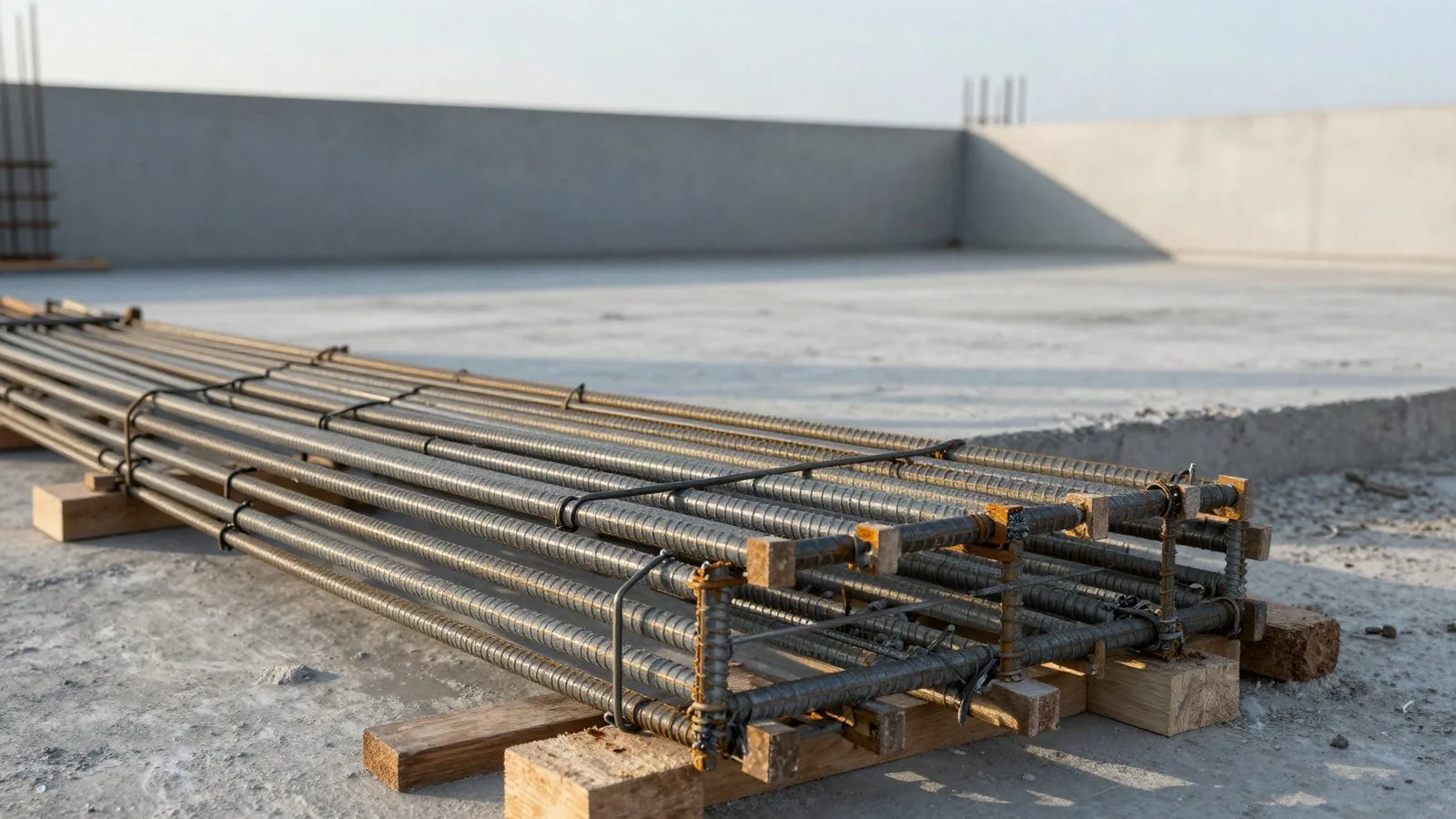
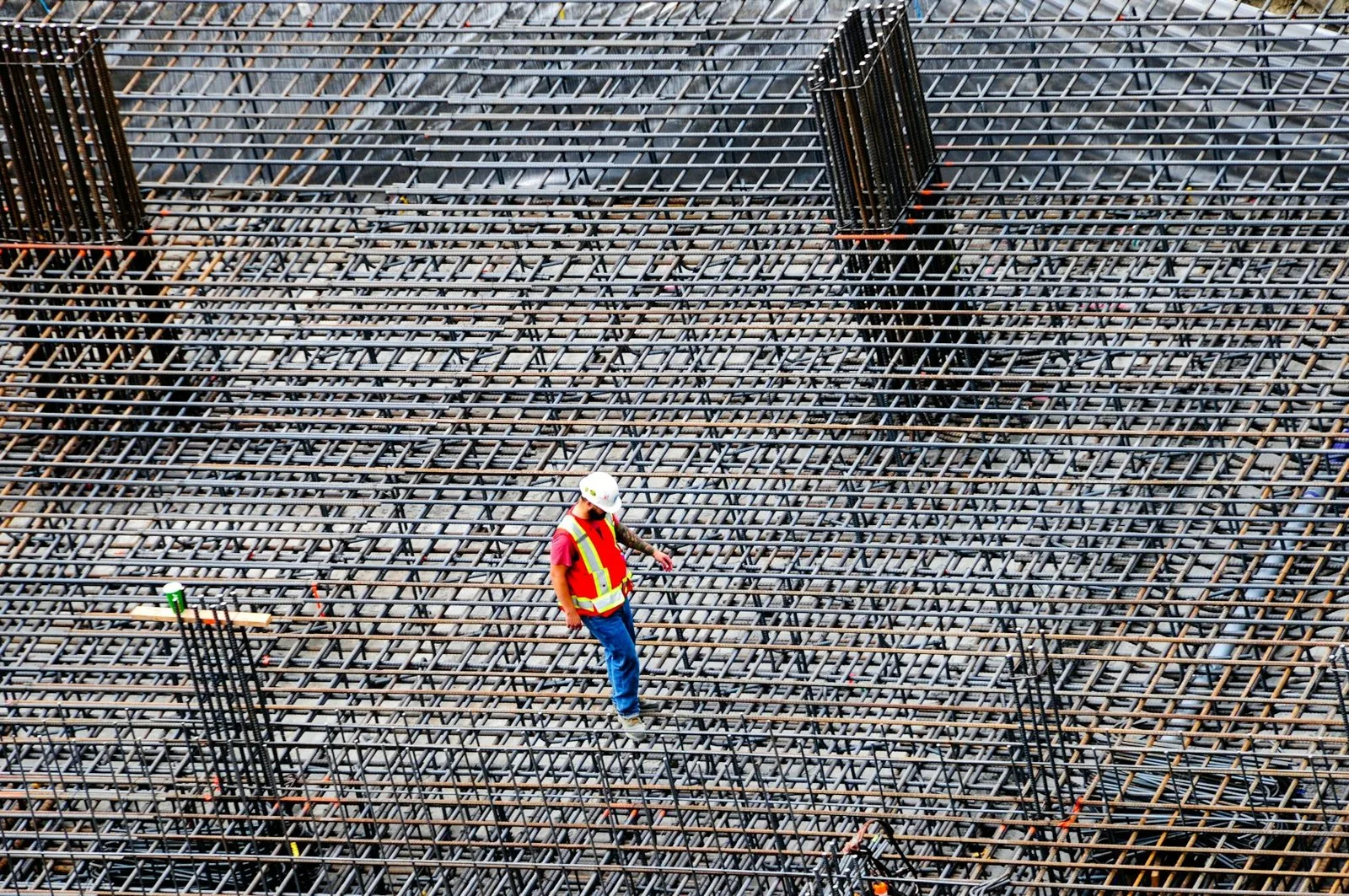
Rebar is continuous steel that the designer puts exactly where the section needs it. In a beam it sits near the bottom, where bending pulls the concrete apart. In a column, ties hold the bars and the core together. Each bar's size and spacing come from a load calculation. As a result, the steel starts working before the concrete cracks and keeps a known capacity after it cracks.
Fiber works in a different way. The pieces are short, they point in every direction, and they spread through the whole volume. At normal doses they add very little before the first crack. For example, ACI calls the effect of fibers on compressive strength marginal to negligible at typical doses, and Iran's Code 120-4 says the same. After a crack opens, macro fibers bridge it and carry some load across. That residual capacity is real and you can measure it. However, it does not stand in for a bar that the designer sized for bending, shear or axial load.
What fiber does that rebar cannot
Steel bars sit in one or two layers. The concrete above and below them gets no help. Fiber, by contrast, is everywhere in the depth, including the top few millimetres where early cracks start. For instance, fine micro fibers resist plastic shrinkage cracks in the first hours, while the concrete is still soft. ACI notes that synthetic microfibers mainly do this job and add little to hardened concrete.
Synthetic fiber also cannot rust. It needs no cover to protect it, and it leaves no rust stains on the surface. Nobody can walk it down to the bottom of a slab, because there is no placing step at all. Finally, it goes in at the batching plant, so no crew has to cut, carry and tie steel before the pour. Those are site benefits, not structural ones. Still, they explain why fiber appeals wherever the steel is not doing structural work.
Two kinds of steel on one drawing
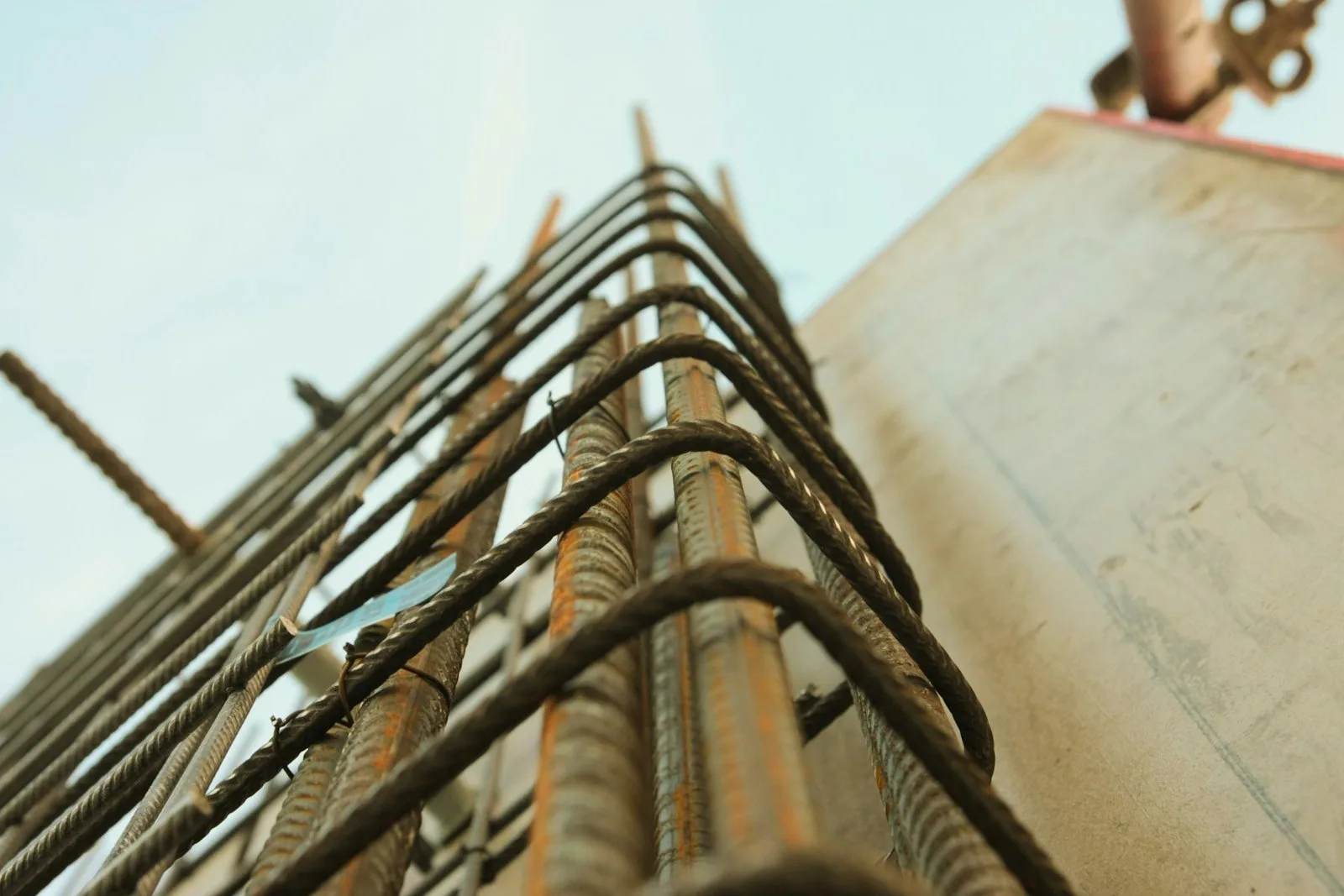
Most drawings carry two kinds of reinforcement. The first is structural steel, with bars sized from a load calculation. The second controls cracks. In slabs it is often a light mesh or a grid of thin bars, sometimes called temperature steel. Its job is to keep shrinkage and thermal cracks narrow, not to carry the floor's load.
ACI draws the same line. Its note on crack-width control lists steel bars, wire mesh or macrofibers as options for cracks from shrinkage, thermal stress and other nonstructural causes. So the test is simple. If an engineer worked out the steel area from a load, that steel stays. If the steel is there to hold cracks tight, fiber may replace it, as long as the designer agrees and sets the performance. Our article on fiber mesh concrete covers the mesh case in more depth.
Fiber reinforced concrete vs rebar, element by element
The table below sums up the usual answer for common elements. Treat it as a starting point for a talk with your designer, not as a design.
| Element | What the steel does | Can fiber take over? |
| Slab on ground: warehouse, yard, parking | Crack-control mesh or temperature steel | Yes, with macro fiber at a designed dose, where the designer allows |
| Pile-supported slab | Structural, spans between piles | No |
| Suspended slab or roof | Structural, carries bending | No; fiber can be added for surface cracking |
| Beams and columns | Structural | No |
| Footings and rafts designed in bending | Structural | No |
| Retaining walls | Structural | No |
| Screeds, toppings and renders | Usually no steel, or a light mesh | Micro fiber against plastic shrinkage cracks |
| Shotcrete linings | Mesh in the lining | Macro fiber, where the lining design permits and panel tests confirm it |
| Precast and facade panels | Crack control, sometimes structural | Macro fiber for crack control; structural steel stays |
Notice that "yes" only appears where the steel's job is crack control. In every structural row the honest answer is no, whatever the dose. Temperature steel in a suspended roof is a special case, because it is part of the roof design, so only the structural designer can change it. That pattern is the whole fiber reinforced concrete vs rebar debate in one look.
When the drawing calls for both
Fiber and rebar often work side by side. A suspended slab keeps every bar, yet a micro fiber can still reduce plastic shrinkage cracks on its top surface. In that case the fiber is an extra line in the budget, not a saving. Our guide to concrete fiber cost per cubic metre shows how to price that line honestly.
ACI also notes that higher fiber doses can add bending capacity after cracking, and it points designers to ACI 544.4R for that work. That is a structural decision for the engineer of record, backed by test data. It is never a swap made on site because a truck arrived without the steel.
Choosing the fiber where it is allowed
Once the designer approves fiber in place of mesh, the next trap is the wrong type. Micro fiber cannot do a macro job. Our polypropylene concrete fibers in the PG MS-12 grade come in 6, 12 or 18 mm, at 0.6 to 1.2 kg/m³. They target plastic shrinkage and do not replace mesh.
Mesh replacement needs macro synthetic fibers for concrete at a designed dose. For example, PG MF-54 for industrial floors and slabs on ground runs at 3 to 7 kg/m³. In contrast, PG EC-45 at 2 to 4 kg/m³ is for crack control and is not meant as a full mesh replacement. Also respect the floor value. ACI gives a minimum dosage of 1.8 kg/m³ for synthetic macrofibers in slabs on ground, and below it the concrete behaves like plain concrete. The dose itself should come from the residual strength the design needs, measured in a beam test such as ASTM C1609.
Signs a quote is overselling fiber
Some sales material blurs the line on purpose. Be careful if a quote says fiber replaces all rebar, with no mention of the element or the designer. Also be wary of doses given as a percentage of cement weight, because fiber is dosed per cubic metre of concrete. Finally, distrust any promise of a large jump in compressive strength, since ACI and Code 120-4 both say normal doses barely change it.
A sound offer names the grade, the dose band and the test behind the dose. It also says plainly where fiber is the wrong answer. If the fiber reinforced concrete vs rebar section of a proposal skips that last part, ask for it.
Questions to settle before you drop the steel
Is this steel structural, or is it there for crack control? Get the designer's answer in writing.
What residual strength does the design need, and which test method proves it?
Which grade and which dose band meet that value?
Are the joints still drawn at the right spacing? Fiber does not remove them, as our note on control joints in fiber reinforced slabs explains.
Who checks the delivered concrete for even fiber spread and no fiber balls?
Settle those five points and the fiber reinforced concrete vs rebar choice becomes a design decision, not a sales pitch. A good concrete fiber supplier helps with the numbers but never tells you to remove structural bars. Polyguard's technical team designs the dose free from your section, loading and exposure, and sends a free sample for a trial batch. If fiber is new to you, start with how concrete fiber works.
Frequently Asked Questions
Can fiber replace rebar in concrete?
Not where the rebar carries load. Fiber can take over from crack-control mesh and temperature steel, and only where the designer allows it. Bars sized from a load calculation in beams, columns, suspended slabs, footings and retaining walls stay.
Do you need rebar with fiber in a slab on ground?
Often not, if the steel in that slab is crack-control mesh and the designer approves a macro fiber at a designed dose. A pile-supported slab is different: its steel is structural and stays.
Does fiber make concrete stronger than rebar?
No. At normal doses fiber barely changes compressive strength, as ACI and Iran's Code 120-4 both state. Macro fiber adds residual capacity after cracking, which is a different property from the capacity of designed bars.
Can I use fiber and rebar together?
Yes. A suspended slab keeps its bars while a micro fiber reduces plastic shrinkage cracks on the surface. In that case the fiber is an added cost, not a saving.