Fiber mesh concrete is a confusing term, because it is used for two different things: concrete containing dispersed fibers that take the place of a mesh layer, and concrete that contains an actual mesh made of fiber. This article separates them and answers the question people are really asking — can fiber replace the mesh in my slab?
The two meanings
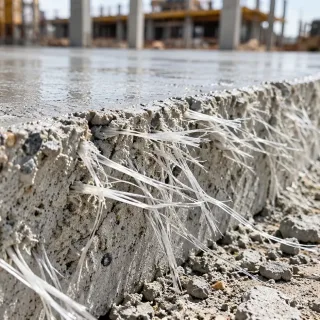
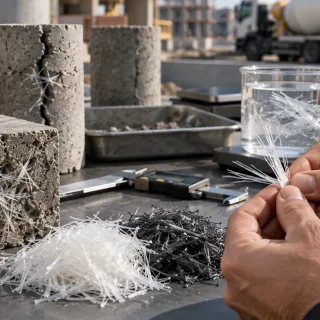
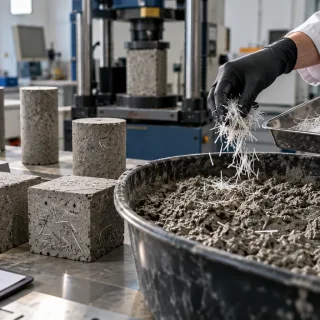
Dispersed fiber replacing mesh. Millions of short filaments mixed through the pour, so reinforcement exists in every part of the section instead of in one plane. This is what the term usually means in a slab context, and it is what the rest of this article covers.
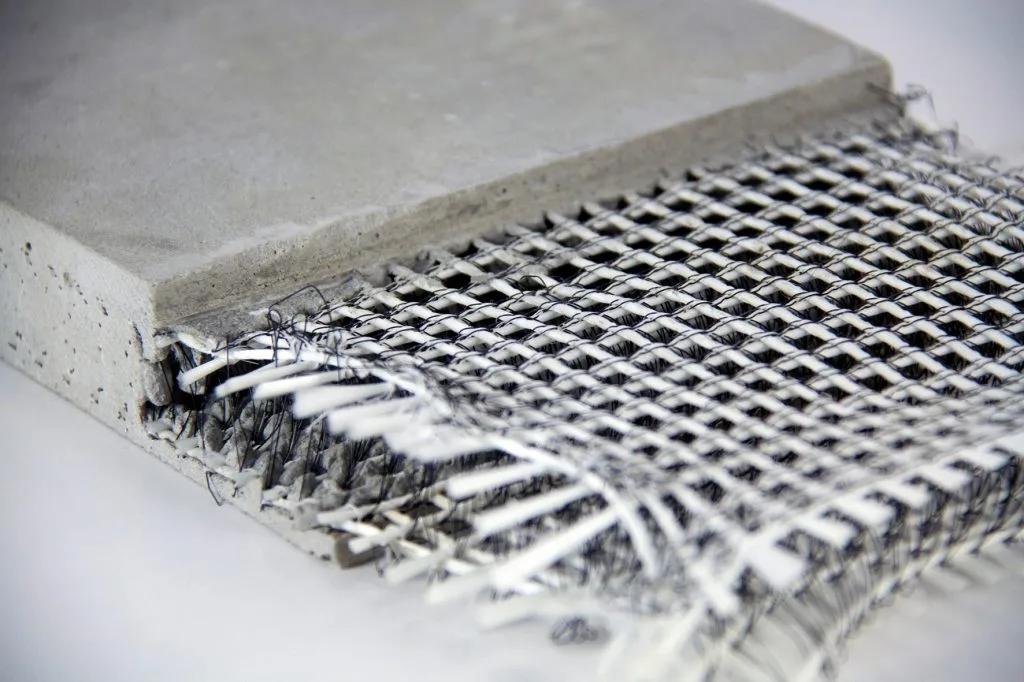
An actual fiber mesh. A woven glass or polymer grid embedded in a thin surface layer — render, screed, a repair mortar. That is a different product with a different job, covered in our article on fiberglass mesh for concrete.
What the steel mesh in a slab is actually for
This is the question that decides everything. In most slabs on grade, welded mesh is not carrying calculated structural load. It is crack-control reinforcement: it does not stop cracks forming, it holds them tight after they form, so they stay narrow and do not open into a defect.
Once that is clear, the comparison becomes straightforward. Both mesh and fiber do the same job — restraining crack width after cracking. They differ in how well they do it and what they cost installed.
Why a fiber dose usually wins
The case for fiber mesh concrete over a steel layer comes down to four things.
It is everywhere. Mesh sits in one plane and only works where it is. It is also routinely walked down during the pour and ends up near the bottom, doing very little. Fiber is distributed through the full depth and works wherever the crack happens to form.
It cannot be misplaced. There is no placement step to get wrong, no cover to protect, no chairs to kick over.
It does not corrode. Polypropylene is inert to chloride and sulfate, so there is no rust staining and no expansive corrosion forcing the cover off.
It comes off the critical path. Cutting, hauling, placing, tying and chairing all happen before the pour can start. Fiber goes in at the batching plant.
What a proper fiber mesh concrete dose looks like
For a slab on grade, macro synthetic fiber at 3 to 7 kg/m³, 40 to 54 mm long, embossed or shaped for anchorage, classified Class II under EN 14889-2. Not micro fiber — micro monofilament at under 1 kg/m³ controls plastic shrinkage but is not specified to provide structural post-crack residual capacity, and substituting it here is the most common and most expensive mistake in this area.
The performance is measured under ASTM C1609: a beam is loaded past first crack and the residual load at defined deflections is recorded. Ask for that curve at the dosage you intend to use.
When fiber must not replace the steel
If the reinforcement is carrying calculated structural load — a suspended slab, a beam, a raft designed in bending, a pile cap — it is not crack-control mesh and fiber does not replace it. The test is simple: if a structural engineer calculated the steel area from a bending moment, that steel stays.
Fiber also does not compensate for an unprepared subgrade, joints at the wrong spacing, a poor mix or inadequate curing.
Deciding on your slab
Send the slab thickness, the subgrade, the exposure class and the loading. We calculate the residual strength the design needs, return a dosage and grade, and send a free sample for trial batching. The cost calculators compare the installed cost of a fiber dose against a mesh layer with your own rates, and the industrial flooring page covers the application in detail.