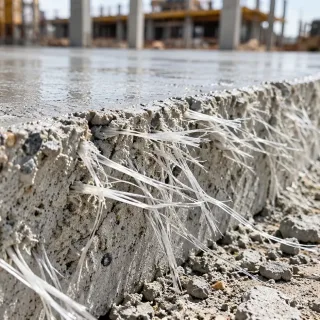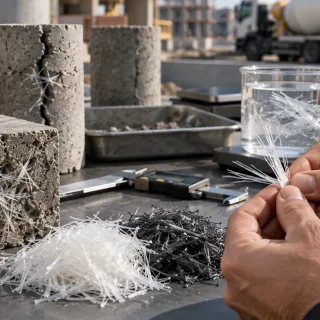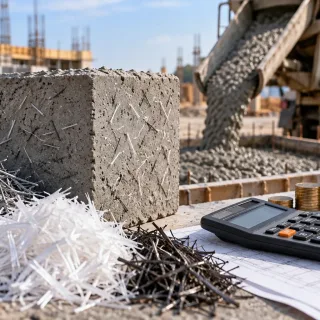
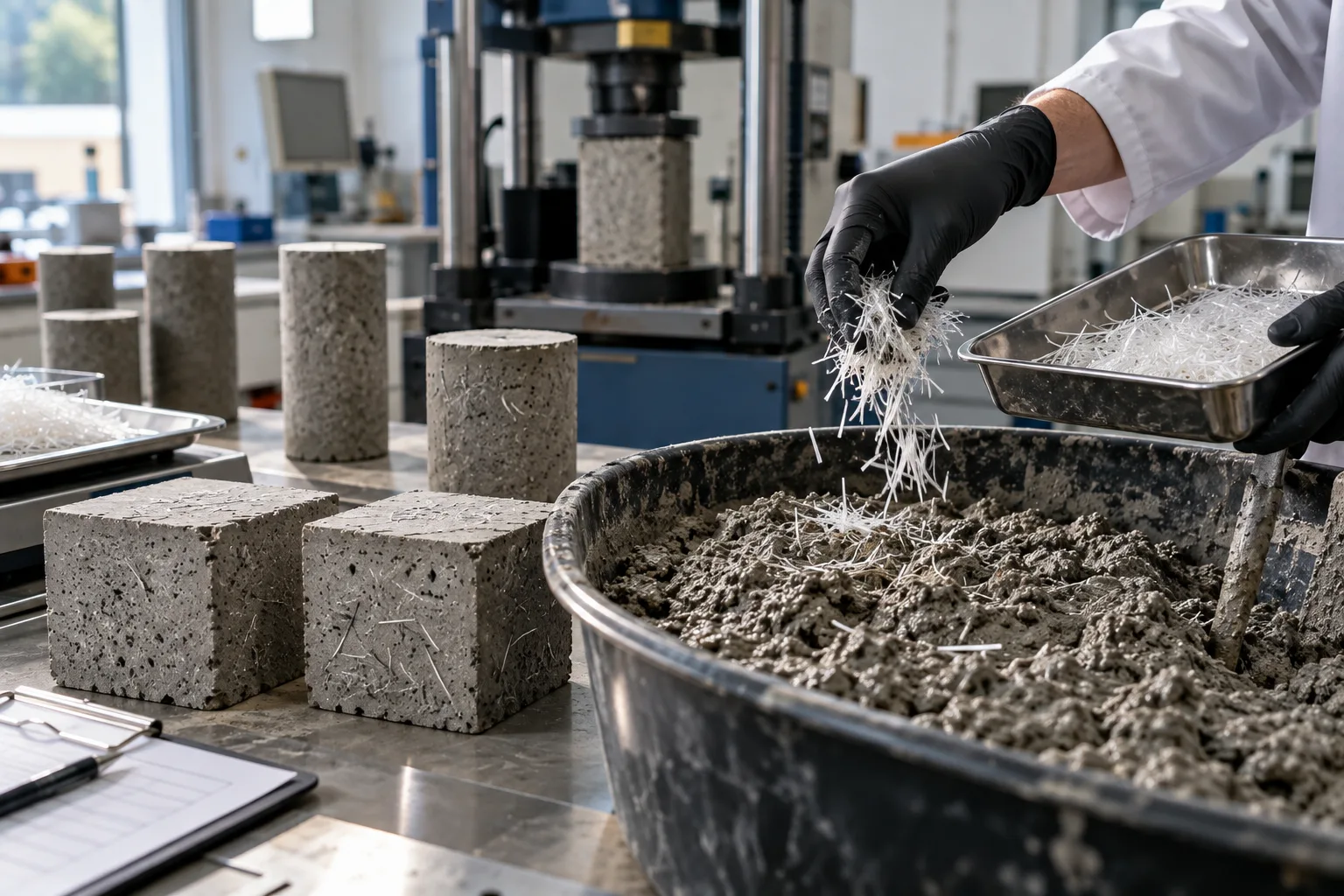
A data sheet tells you what a fiber is. It cannot tell you what that fiber will do with your sand, your cement and the admixture your plant has used for ten years. A fiber reinforced concrete trial mix can, and it rarely takes more than a morning at the plant and a few beams in the curing tank. Most trials are wasted, though, because nobody decides in advance what they are trying to find out. This is a practical plan for getting a real answer out of a free sample before you commit a project to it.
Decide what the fiber has to prove
Start with the job the fiber is being bought for, because that decides what the trial measures.
Micro fibers are the fine monofilament form of polypropylene concrete fibers, dosed at around a kilogram per cubic metre, and they are there to control plastic shrinkage and settlement cracking in the first hours. Their trial is mostly about fresh concrete: does the mix still pump, place and finish, and does the surface crack less than the same mix without fiber.
Macro fibers are a different purchase. Macro synthetic fibers for concrete are specified for the load a section can still carry after it has cracked, and that is measured, not observed. If the drawing or the specification names a residual strength or an energy class, the trial has to end with test specimens, otherwise it has not answered the question anyone will ask later.
Write the target down before anything goes into a mixer. Something as short as "slump 120 mm at the pump after 60 minutes, no fiber balls, residual strength as per the specification at 28 days" is enough. It stops the trial from turning into a vague impression.
Set up a fiber reinforced concrete trial mix you can trust
Use production materials. The cement from the silo, the sand from the stockpile you will actually use, the admixture from the plant tank. A trial run on fresh lab materials proves something about a concrete you will never pour.
Batch a control. Mix the same recipe without fiber, on the same day, with the same operator. Almost every judgement in this plan is a comparison, and without a control you are comparing against memory.
Choose the dose deliberately. Each grade has a band, from 0.6–1.2 kg/m³ for a micro fiber up to 4–9 kg/m³ for a shotcrete fiber, and the full table is on the product range page. Trial the dose the designer expects to use. If that dose sits near the top of the band, trial it there, because workability problems show up at the top, not in the middle.
Match the scale to the question. A lab pan mixer is fine for casting beams and comparing slump. It tells you nothing about fiber balling in a truck, how the load discharges or how a pump behaves. If the job is a large floor or a tunnel, put one load of a few cubic metres through a real truck as well.
Add the fiber the way the job will add it
How fiber enters the mix changes the result more than most people expect, so the trial should copy the production method rather than the easiest one.
Added at the plant with the coarse aggregate, fiber disperses best, because the stone does the work of separating it. Added into the truck after batching, it needs more drum revolutions. Added on site, it is where most fiber balls come from. The Texas Department of Transportation's fiber reinforced concrete tip sheet (DMS-4550) advises against jobsite addition altogether and, where there is no other option, asks for at least 100 revolutions at mixing speed before discharge. The three usual batching methods are described in more detail in our dosage guide.
Polyguard fiber is packed in 3 kg and 5 kg water-soluble bags, and the bag can go into the mixer whole. That is convenient on a trial and it also keeps the dose honest, provided whoever counts the bags writes the number down.
What to measure while the concrete is fresh
Slump, twice. Measure it straight after mixing and again after the time the concrete will really spend in the truck. Expect a drop. The same Texas guidance puts the loss for polymer fibers at roughly 25 mm for every 1.2 to 1.8 kg/m³ of fiber, and it describes that loss as "apparent": a fiber mix can look stiff in the cone and still move freely under a vibrator. Judge workability the way the concrete will be placed, with a poker, a screed or the pump, and not with the cone alone.
Never correct it with water. Water brings the slump back and quietly takes away strength and adds shrinkage, which is the opposite of what the fiber was bought for. Correct workability with the plasticiser, and record the dose you needed.
Look for fiber balls. Watch the first and last part of the discharge, where balls usually appear. One or two clumps usually point to the addition sequence or the mixing time, not to the fiber, so change those first.
Check the dose with a washout. Fill a container of known volume, at least 7 litres (the unit-weight bucket works), compacting it as you would for the density test. Wash the concrete through a No. 8 (2.36 mm) sieve, pick out the fiber, dry it and weigh it. The arithmetic is kind: grams of dry fiber divided by litres of container gives kilograms per cubic metre. From a 10-litre bucket of concrete dosed at 4 kg/m³ you should recover close to 40 g. Micro fibers float and escape more easily, so treat the washout mainly as a check on macro doses.
Record air and density if the specification controls them. Fiber rarely moves them much, and if it does, you want to know on the trial and not on the pour.
What to measure once it has hardened
Compressive strength from both batches. Synthetic fiber at normal doses should not change compressive strength much. A clear drop in the fiber batch almost always means water went in to fix the slump.
Crack control for micro fiber. The laboratory way to compare plastic shrinkage cracking is ASTM C1579, which casts restrained panels with and without fiber under drying conditions. The site way is cruder but still useful: cast two small slabs side by side on a warm, windy afternoon and compare them the next morning.
Residual strength for macro fiber. Cast beams for the test your specification names, usually ASTM C1609 (150 × 150 × 500 mm beams in four-point bending) or EN 14651 (notched beams in three-point bending), and test them at 28 days. For sprayed concrete, the reference is a panel test: ASTM C1550 round panels or EN 14488-5 square panels. Cast a set, not a single specimen, because fiber concrete scatters more than plain concrete and one beam proves very little.
Finish a panel. If the job is a floor, power-float a trial panel with the crew who will do the real one. Macro fiber can show at the surface if finishing starts at the wrong moment, and it is far cheaper to learn the timing on a trial panel than on 5,000 m² of warehouse floor.
Reading the result, and what to ask the supplier
What you saw | What it usually means | What to ask for |
Slump fell further than the mix can tolerate | Dose near the top of the band, or a fiber geometry that stiffens this particular mix | A dose check and advice on the plasticiser |
Fiber balls at discharge | Addition sequence or too few revolutions | The recommended addition point for your plant type |
Washout well below the target dose | Bags miscounted or fiber added late | Nothing yet; fix the batching and repeat |
Beams below the specified residual strength | The dose is too low for this concrete | A test report at the higher dose you now need |
Everything within target | The dose is proven for your materials | The documents below, in writing |
A good fiber reinforced concrete trial mix is only half of what you need. The other half is paper that ties the trial to what will be delivered. From any concrete fiber supplier, ask for the grade and dose confirmed in writing, the data sheet, the test report for the method your specification names at the dose you trialled, and a quality control certificate for the actual production batch you receive, not a generic certificate. The standards page lists what each of those documents should contain. Once the dose is fixed, the cost per cubic metre follows from it with simple arithmetic.
A one-page trial record
Keep one sheet for every batch of the fiber reinforced concrete trial mix, control included. It is the record a checking engineer will ask for, and the reference you will want the day a production load behaves differently from the trial.
Date, plant, mixer type and batch volume
Cement, aggregates and admixture, with their sources
Fiber grade, dose in kg/m³, number of bags and when they went in
Drum revolutions or mixing time after the fiber was added
Slump or flow at 0 and 60 minutes, and the plasticiser dose used
Air content and density, if specified
Washout: grams recovered, container volume, calculated dose
Fiber balls: yes or no, and where in the discharge
Finishing notes, if a panel was floated
Specimens cast, their test method and the 28-day results
Common questions about trial mixes
Is a lab mixer enough?
For comparing slump and casting beams, yes. For balling, discharge and pumping, no. A floor or a tunnel lining deserves at least one full truck load before the first production pour.
Do I need beam tests for micro polypropylene fiber?
Usually not. Micro fiber is not specified for post-crack capacity, so a fresh-concrete comparison and, where the specification asks for it, a plastic shrinkage test are the relevant checks.
How much fiber does a trial need?
Dose multiplied by trial volume, plus a margin. A 3 m³ truck at 4 kg/m³ needs 12 kg, which is four 3 kg bags. A lab batch needs a few hundred grams.
Can the supplier help design the trial?
A serious one should. Polyguard sizes the dose from the section, the loading and the exposure, issues the data sheet and ships a free sample for exactly this kind of trial.