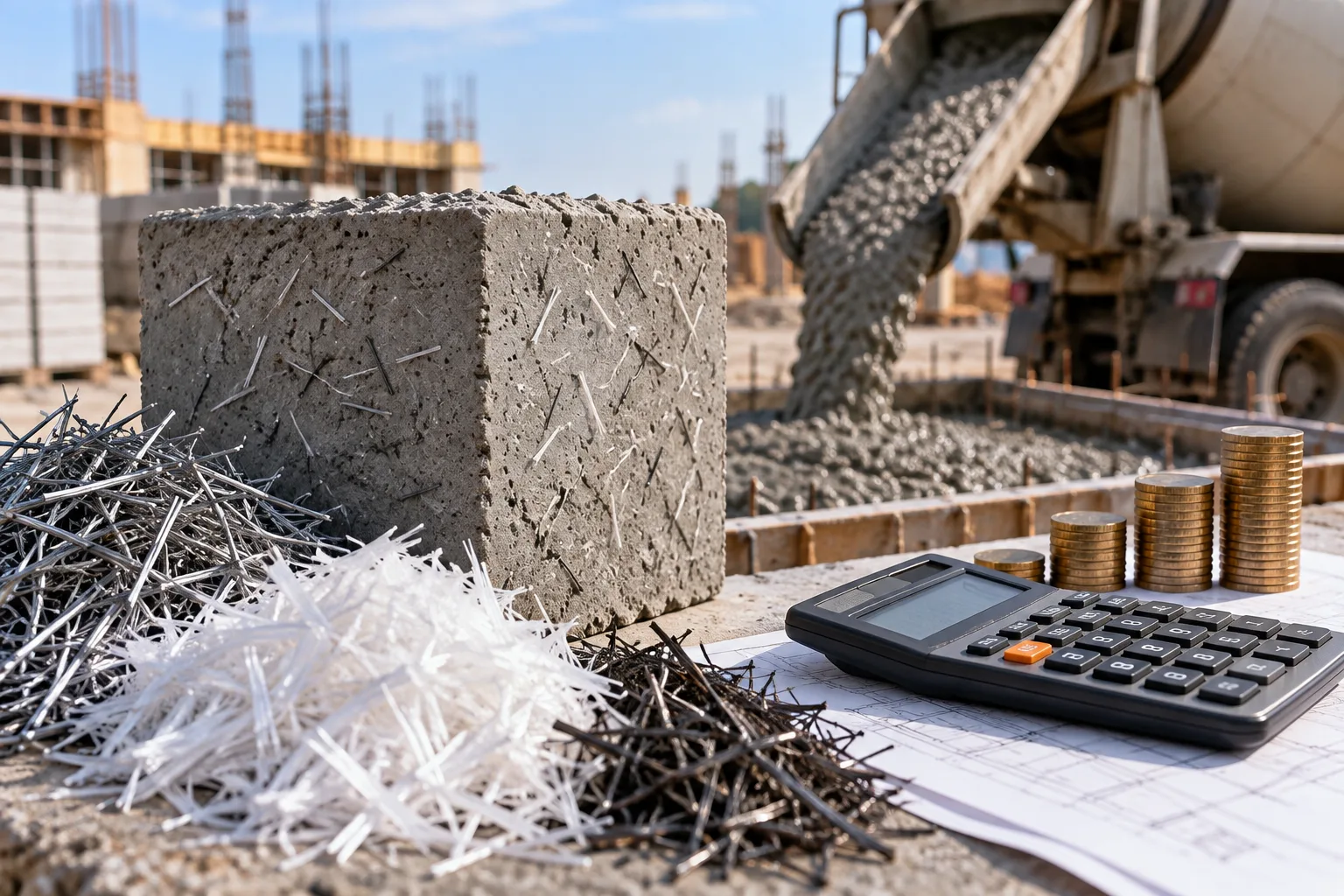
Ask three suppliers what fiber costs and you will get three prices per kilogram — and none of them answers the question you actually have. Concrete fiber cost only becomes a real number when it is expressed per cubic metre of concrete, because that is the unit your mix is batched in, your slab is poured in, and your budget is written in. This guide shows how to convert any quotation into that number in about five minutes, and what to put on the other side of the comparison so the answer means something.
Price per kilogram is not a cost, it is an input
Three different fibers can be quoted at the same price per kilogram and still land at three different costs in your slab, because each one is dosed differently. A monofilament micro fiber for shrinkage cracking is dosed in hundreds of grams. A structural macro fiber for an industrial floor is dosed in kilograms. The price per kilogram is the same kind of number in both cases; the concrete fiber cost inside the slab is not.
So the working unit is cost per cubic metre of concrete:
Cost per m³ = dose (kg/m³) × price per kg
Everything else in this article is either how to get the dose right, or what to compare that figure against.
The dose comes from the job, not from the invoice
The dose is a design decision. It follows from what the fiber has to do — hold plastic shrinkage cracks closed, carry load after the concrete has cracked, survive a shotcrete rebound test — and it is set before anyone talks about money. Our own six grades sit in these bands:
Grade | Type | Typical dose | Dose design needed? |
PG MS-12 | Micro (class Ia) | 0.6–1.2 kg/m³ | No, standard dose |
PG EC-45 | Macro (class II) | 2–4 kg/m³ | Yes |
PG PC-40 | Macro (class II) | 2–5 kg/m³ | Yes |
PG MF-54 | Macro (class II) | 3–7 kg/m³ | Yes |
PG SC-48 | Macro (class II) | 4–9 kg/m³ | Yes |
PG AS-20 | Asphalt fiber | 0.05–0.3% by mix weight | Yes, with the mix design |
Two readings of the same table matter for costing. First, the spread inside one grade is wide: an industrial floor dosed at 3 kg/m³ and the same floor dosed at 7 kg/m³ differ by more than a factor of two in fiber cost, and the difference is decided by the slab, the sub-base and the load — not by the supplier. Second, micro and macro fibers are not interchangeable line items. Quoting a micro dose against a macro requirement produces a cheap number and a floor that does not do what the drawing says.
From cubic metres to square metres, which is how slabs are priced
Most people buying a floor think in square metres, so convert once more. For a slab of uniform thickness:
Cost per m² = dose (kg/m³) × price per kg × thickness (m)
A 150 mm slab consumes 0.15 m³ of concrete per square metre. At 4 kg/m³, that is 0.6 kg of fiber in every square metre of floor. Double the thickness and the fiber cost per square metre doubles with it, which is why a thin screed and a heavy ground-bearing slab are never comparable on a per-square-metre fiber price, even when the grade is identical.
If you would rather not do the arithmetic by hand, the site has four dosage calculators that take your own thickness, area and rates and return the same figures.
The other side of the comparison: the whole reinforcement package
The mistake that makes concrete fiber cost look expensive is comparing a bag of fiber with a roll of mesh. The honest comparison is the delivered, installed, finished package. On the mesh side, count:
the mesh itself, measured as the area you buy rather than the area you cover, because sheets are lapped;
chairs or spacers, and the labour that sets them;
cutting, placing and tying, in crew-hours at your own rate;
offloading, storage and crane or telehandler time;
offcuts and damaged sheets;
the pour-day cost of a crew walking a mesh mat and re-lifting it into position;
the days the mesh occupies in the programme before the pour can start.
On the fiber side the same list is short: the fiber, the batching time, and any dose verification you specify. That asymmetry, not the price per kilogram, is where the commercial argument for fiber actually lives — and it is also why the answer is project-specific. A small pour with idle labour on site and a crane already standing there closes the gap; a large floor pour on a tight programme widens it.
Two honest caveats belong in the same paragraph. Fiber substitutes for crack-control mesh and temperature steel where the design permits it. It does not substitute for rebar or for structural reinforcement, and no costing exercise changes that. Where a designer has specified both, the fiber cost is an addition, not a replacement, and it should be presented that way in the budget.
Five things that quietly change the number
1. Fiber count per kilogram. Two macro fibers at the same dose can deliver very different numbers of individual fibers to the crack surface, because length, cross-section and denier differ. Fiber count, not weight, is what crosses a crack.
2. Declared performance. A fiber with a declared residual strength — tested to ASTM C1609, ASTM C1550 or EN 14845 — can often reach a target performance at a lower dose than an undeclared one, which shows up directly in the concrete fiber cost per cubic metre. A fiber with no declared values cannot be dose-optimised at all; it can only be over-dosed to be safe.
3. Batching method. Fiber added to the aggregate belt, at the plant, or on site at the truck all work, but they do not cost the same in mixing time. Longer mixing on a hot day is a real cost, and so is a load rejected for poor dispersion.
4. Packaging. Bag size decides how much fiber is left in a part-used bag at the end of a pour, and whether the batcher is counting bags or weighing them. Small mistakes here are worth more than the price difference people negotiate over.
5. Storage and handling. Fiber is light, bulky and easy to damage with a forklift. Waste is cheap to prevent and annoying to pay for twice.
A five-minute costing you can defend
Write down what the fiber must do, and take the dose band from the grade that does it.
Multiply dose by your quoted price per kilogram. That is your concrete fiber cost per cubic metre.
Multiply by slab thickness for a cost per square metre.
Build the mesh package on the other side, with your own labour rates and your own lap allowance.
Compare the two totals, and write down the assumptions next to the numbers so the comparison survives the next meeting.
If the dose band is the part you are least sure about, that is the part to get help with. Polyguard supplies macro synthetic fibers for concrete and micro polypropylene fiber with the declared values the calculation depends on, and quotes per project rather than from a list, because the dose is what makes the number — ask a concrete fiber supplier for a price without telling them the job and the answer cannot be right.
Questions buyers ask about concrete fiber cost
Is fiber cheaper than mesh?
Sometimes, and the honest answer depends on the package, not on the material. Where mesh is doing crack control and the design permits fiber to do that job, fiber usually removes more labour and programme than it adds in material. Where the steel is structural, the question does not arise.
Why do suppliers not publish a price list?
Because a price per kilogram without a dose is not usable, and a dose without a project is not responsible. A quotation that names the grade, the dose and the volume can be checked by the buyer; a list price cannot.
Does a higher dose mean better concrete?
Up to the design requirement, more fiber buys more post-crack performance. Past it, you are paying for workability problems rather than performance. The dose that meets the specified residual strength is the one to buy.
How do I check I received what I paid for?
Ask for the declared values and the test standard on the technical data sheet, and specify a washout check on fresh concrete if the dose matters to the design. Both are normal requests, and both are cheap next to a floor that has to be replaced.