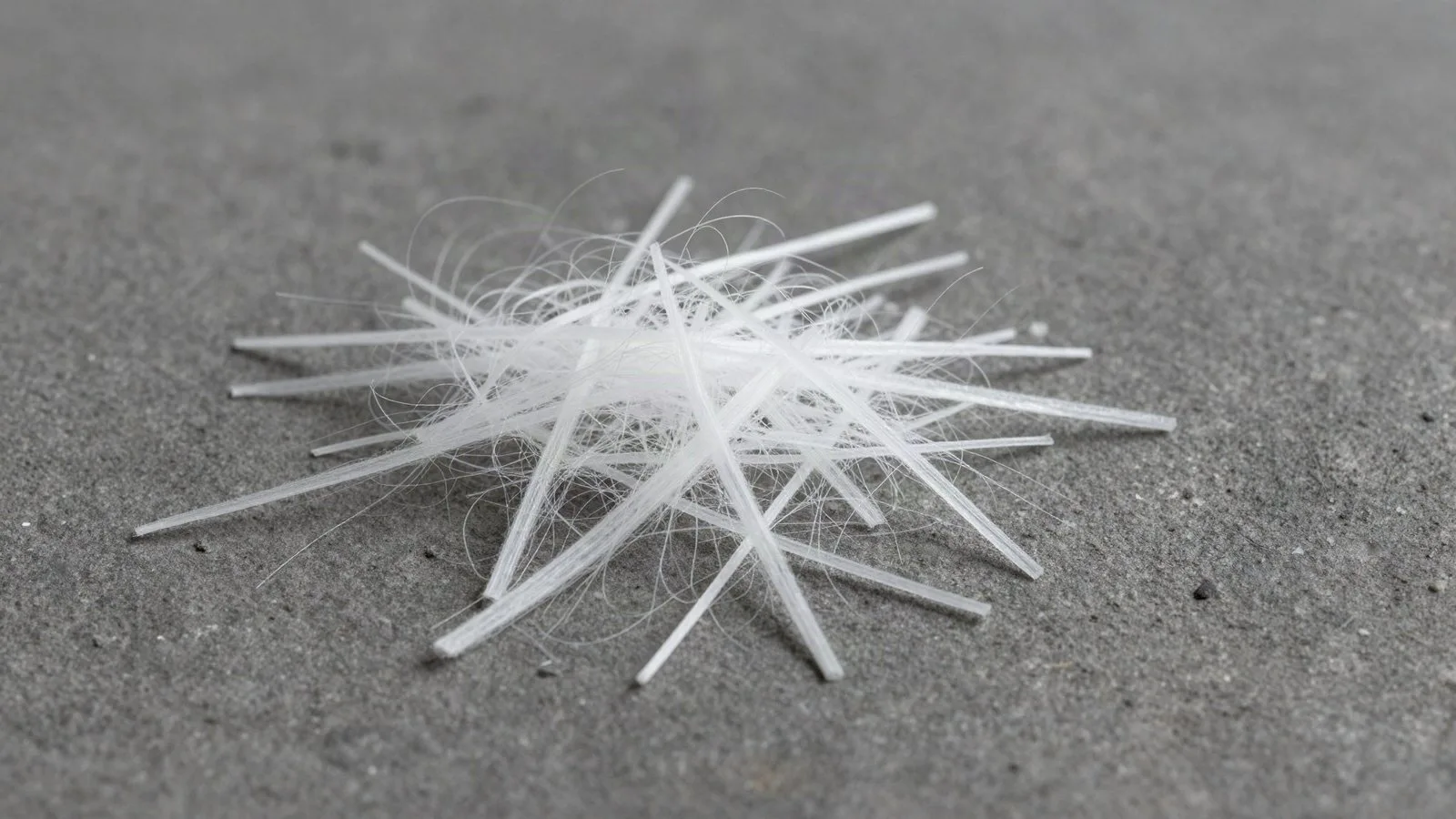
Polypropylene fiber length should follow the job, not habit. Micro fiber at 6, 12 or 18 mm is there to control early cracking while the concrete is still plastic, and the choice between those three follows the thickness of the layer, the size of the stone and the finish. Macro fiber at 40 to 54 mm is a different tool. You pick it when the design needs the concrete to keep carrying load after it cracks, and you pick the grade by performance, not by the number on the bag.
Why "6 or 12 mm?" gets contradictory answers
Buyers ask this again and again online, and the replies contradict each other. Yet few of them show a source.
The references themselves leave room for it. ACI puts micro fibers anywhere from 3 to 50 mm long. It also gives one dose range for monofilament micro fiber, without tying it to length. In other words, the guidance treats length as a choice for the job, not a fixed rule.
So what does polypropylene fiber length actually change? First, the fiber count. At the same diameter and the same dose, half the length means twice as many fibers. That is arithmetic, not a test result. Second, how each fiber sits. A short fiber turns freely in a thin coat, while a longer one reaches across more paste between stones. Third, the finish. A short fiber is easier to bury under a trowel in a thin layer. The last two points are reasoning from geometry, not rules.
What the references say about micro and macro lengths
ACI's answer on micro versus macro synthetic fibers gives the ranges. Micro fibers run from 3 to 50 mm long, with diameters of 0.01 to 0.3 mm. Their main job is plastic shrinkage cracking, and ACI says they add very little to the hardened concrete. Macro fibers run from 12 to 65 mm, with diameters of 0.3 to 1.0 mm, and they improve behavior after cracking.
Notice the overlap: a 40 mm fiber could be either on length alone. So length does not decide the class; thickness does. Iran's quality control code for polyolefin fiber concrete, Code 120-4, draws that line by linear density: micro fibers are 580 denier or less, and macro fibers are 581 denier or more. The same code covers fiber lengths from 6 to 64 mm.
Monofilament, fibrillated and macro forms
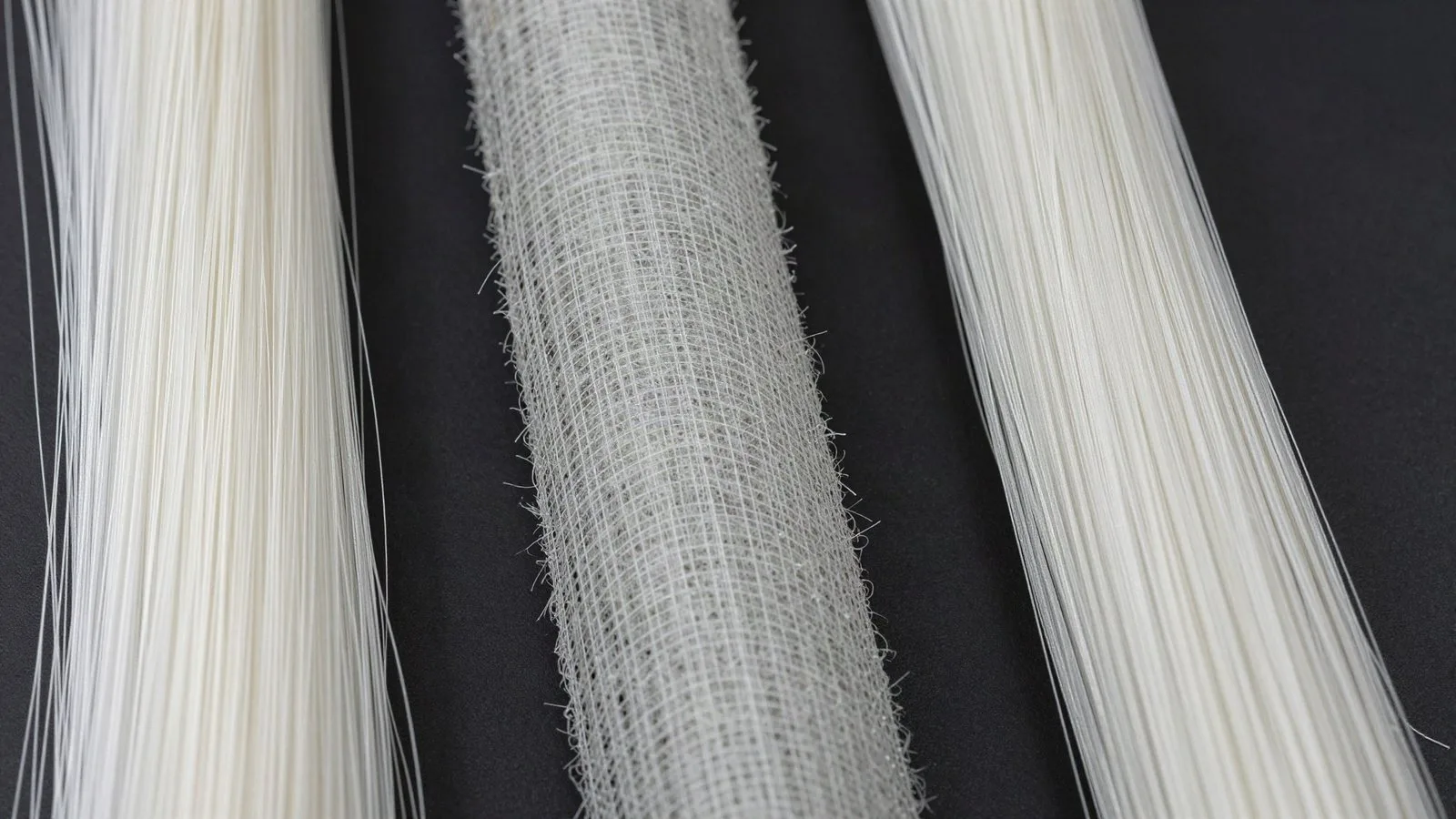
Monofilament micro fibers are single, separate strands. PG MS-12 is this kind of fiber, declared Class Ia, and it comes in 6, 12 and 18 mm.
A fibrillated micro fiber starts life as a thin polypropylene film. A university chapter on fibrillated fibers describes the process. The film is cut into narrow tapes, then a needle roller splits them into a net. Mixing then opens the net into linked strands. A laboratory study on fiber opening found it opens more easily in a workable mix and a high-intensity mixer. ACI also gives fibrillated fiber a higher floor: at least 0.9 kg/m³, against 0.3 to 0.9 kg/m³ for monofilament.
Macro fibers, however, are thick and stiff. ACI describes stick, rope and tape shapes, often embossed to grip better, with a bond that comes mainly from friction. Polyguard's grades of macro synthetic fibers for concrete run from 40 to 54 mm.
Matching polypropylene fiber length to the job
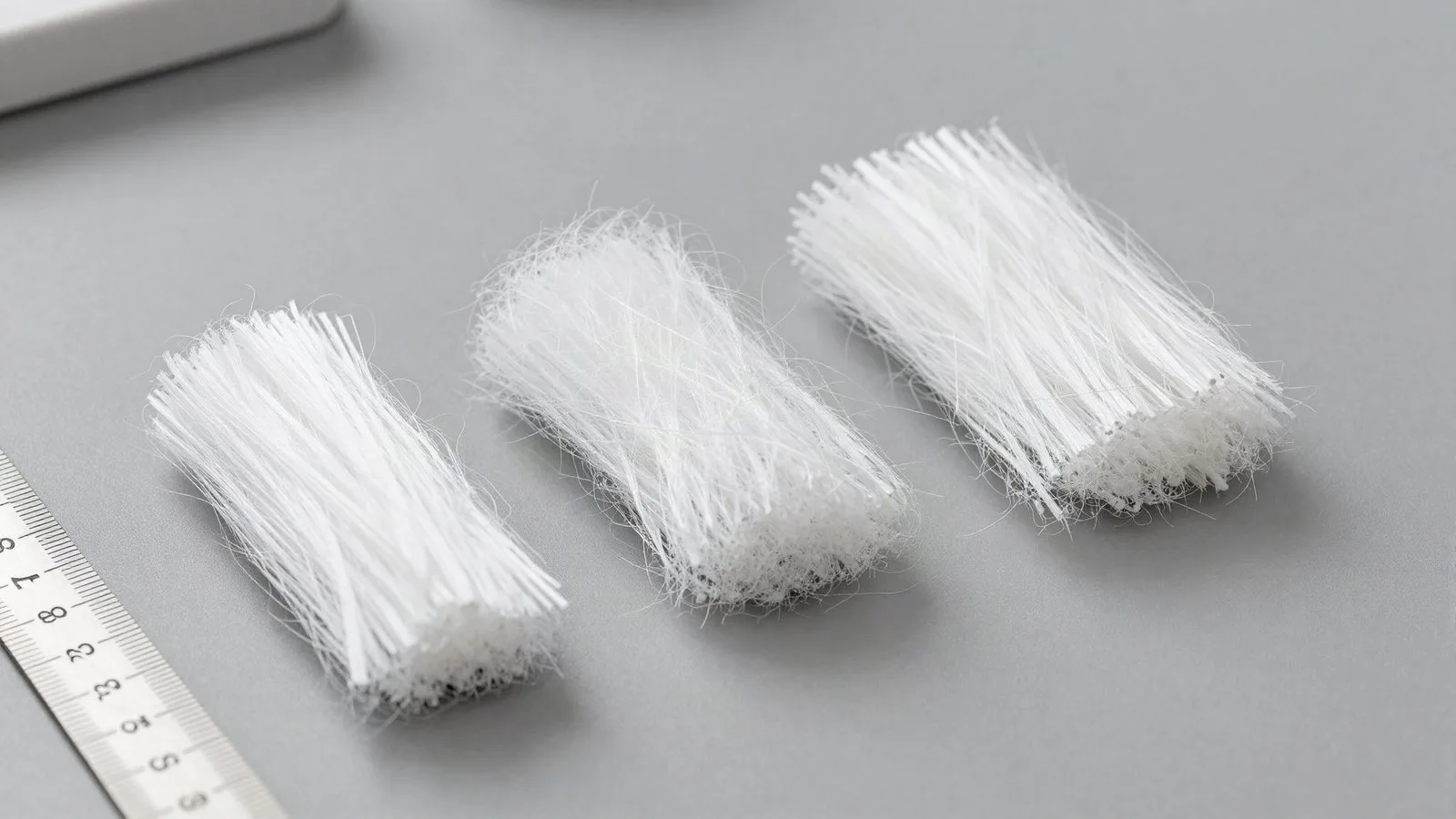
What follows is reasoning from geometry and the references above, not a clause from a standard. Your trial batch has the final word.
Mortar, render and thin sections
In a render coat or thin topping, the layer may be barely thicker than the fiber is long. A 6 mm fiber can still point in any direction there. But a longer fiber is more likely to lie flat or show at the surface. That is why 6 mm is the natural first trial for mortar, render and thin repair layers. Still, 12 mm is a fair second option there.
Screeds and general concrete
For sand and cement screeds and ordinary slabs, either length can work. If the screed has only fine sand and gets a power-trowel finish, start with the shorter fiber. With gravel in the mix, however, lean toward 12 mm, because each fiber then reaches across more of the mortar between stones.
Concrete with coarse aggregate
Once the stone reaches 19 or 25 mm, a 6 mm fiber is shorter than a single piece of aggregate. It still has work to do, because plastic shrinkage happens in the paste near the surface. However, 12 and 18 mm fibers span more of the gaps between stones. Following that logic, 18 mm suits the largest stone and surfaces without a hard trowel finish, but test it first. Also keep in mind that micro fiber of any length is for early cracking; it does not give residual strength after the concrete cracks.
Shotcrete
In shotcrete, micro fiber does the same job as anywhere else: it helps against plastic cracking. But when the specification asks for energy absorption on round panels to ASTM C1550, you are in macro fiber territory. PG SC-48 is a 48 mm macro grade for shotcrete and tunnels.
Polyguard grades by length
The technical team sets the actual dose from section, loading and exposure.
| Grade | Length | Form | Typical job | Dose, kg/m³ |
|---|---|---|---|---|
| MS-12 | 6, 12 or 18 mm | Micro monofilament, Class Ia | Plastic cracking in mortar, screed and concrete | 0.6–1.2 |
| EC-45 | 45 mm | Macro, Class II | Crack control, not full replacement of reinforcement | 2–4 |
| PC-40 | 40 mm | Macro | Precast and facade | 2–5 |
| MF-54 | 54 mm | Macro | Industrial floors, slabs on ground | 3–7 |
| SC-48 | 48 mm | Macro | Shotcrete and tunnels, ASTM C1550 | 4–9 |
All of these polypropylene concrete fibers replace crack-control mesh and temperature steel only where the design permits. None of them replaces rebar.
Pumping and finishing
ACI notes that fibers often cause an apparent slump loss, yet the mix needs no more energy to place. It also says fibers do not need extra water. If the slump drops, use a water-reducing admixture instead of the hose, so the water-cement ratio stays where the design put it.
Pumping, though, is a question for the real pump and line. If your job pumps, run the trial through the same pump.
Finishing is where buyers notice fiber first. ACI explains that a hairy surface comes from poor distribution or poor finishing, and that some fiber types stick out more than others. A vibrating float before troweling and a small mock-up both help. Our guide to fibers sticking out of concrete covers causes and fixes.
Why polypropylene fiber length tolerance matters
A bag that says 12 mm should hold 12 mm fibers, but no cutter is perfect. Code 120-4 sets the check. Take 30 fibers, 10 from each of three samples, and measure them. The mean must fall within 10% of the stated length, and 95% of the fibers must fall inside the declared range. For a 12 mm fiber, that 10% window puts the mean between 10.8 and 13.2 mm.
Why care? If the cut drifts, the fiber you tried in the lab is not the fiber on site. The same code also says delivered fiber concrete must be free of balled fibers. A ruler and a few minutes give you a rough version of the check. Every Polyguard production batch also has its own QC certificate, and test reports for the method a specification names are available on request. For the other checks, see six checks before you buy virgin polypropylene fiber.
How to settle the length on your project
First, write down four things: section thickness, maximum aggregate size, placement method and finish. Then match them to the reasoning above and pick one or two lengths. Next, ask for a free sample and batch them side by side at the same dose; the trial mix test plan lists what to record. The guide to PP fiber dosage explains the dose, and the technical team can design it for you. So the polypropylene fiber length you finally order comes from your own mix, not from a forum reply.
Frequently Asked Questions
Should I use 6 mm or 12 mm polypropylene fiber?
For many jobs either works, because ACI gives micro fiber a wide 3 to 50 mm length range and does not tie the dose to length. Start with 6 mm for mortar, render and thin layers, lean toward 12 mm when the mix carries gravel, and confirm the choice in a trial batch.
How long are macro synthetic fibers?
ACI gives macro synthetic fibers lengths of 12 to 65 mm and diameters of 0.3 to 1.0 mm. Polyguard's macro grades are 40, 45, 48 and 54 mm long, and you choose between them by the performance the design needs.
What is the difference between monofilament and fibrillated fiber?
Monofilament fiber is single, separate strands. Fibrillated fiber is a slit polypropylene film that opens into a net of linked strands during mixing, and ACI gives fibrillated micro fiber a minimum dose of 0.9 kg/m³.
How can I check the fiber length in a bag?
Code 120-4 measures 30 fibers, 10 from each of three samples. The mean must fall within 10% of the stated length, and 95% of the fibers must fall inside the declared range.