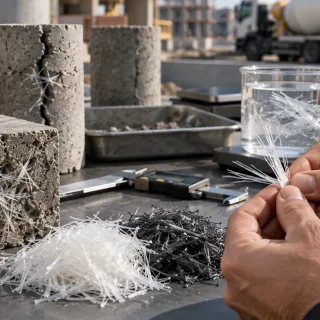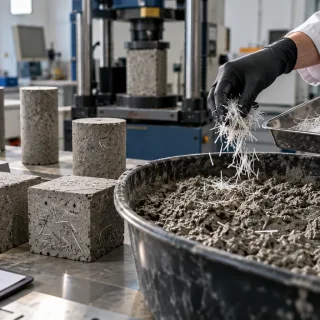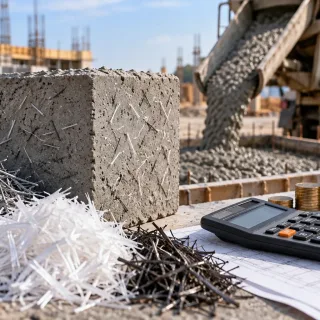
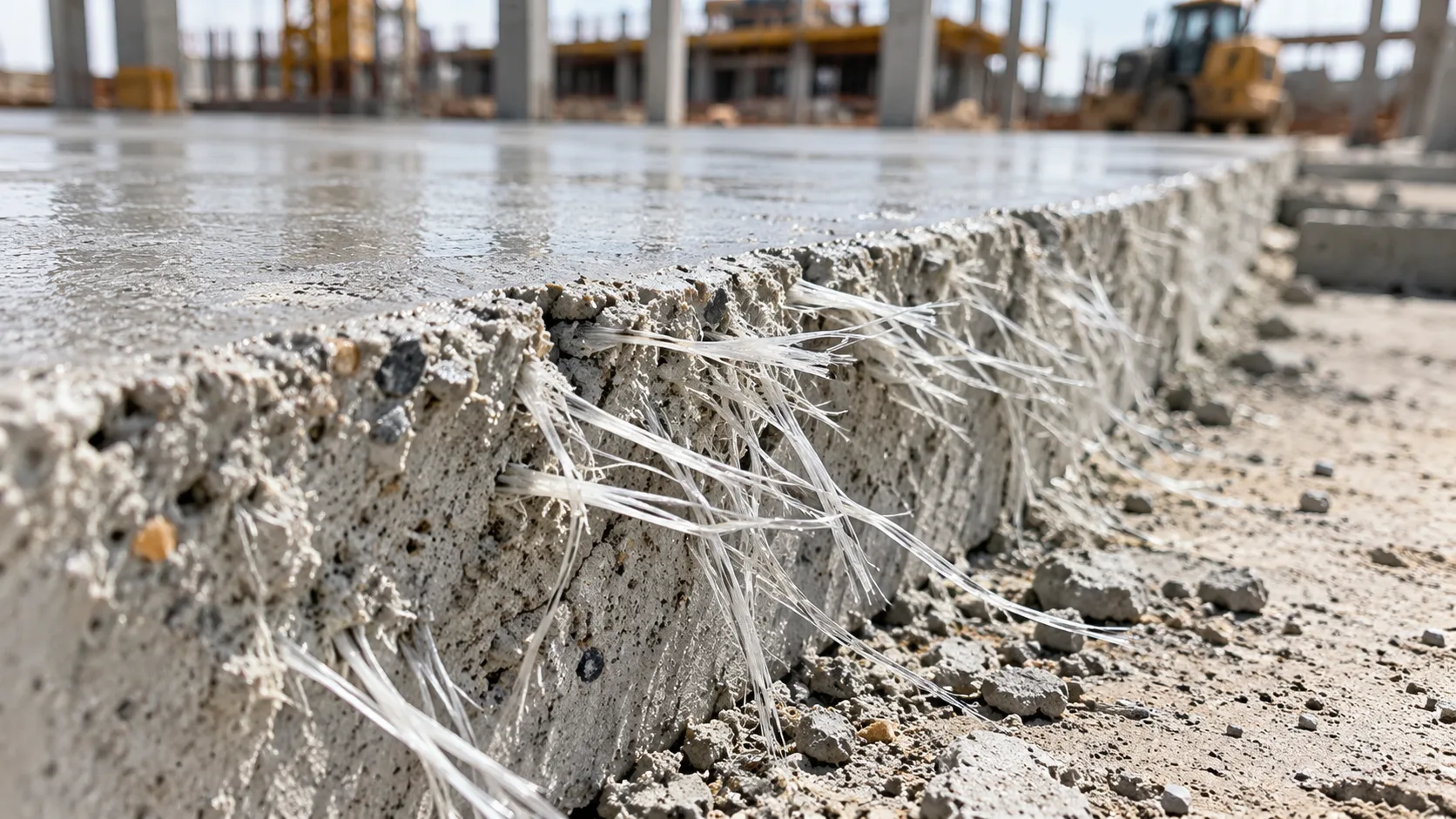
The slab was poured yesterday and today it looks furry. Short white strands stand up from the surface, catch the light and feel rough under a bare hand. Fibers sticking out of concrete are one of the most common complaints about fiber-reinforced slabs, and also one of the most avoidable. A few strands on a fresh surface are normal. A hairy floor is almost always a finishing or mixing problem, and it can be prevented without giving up the fiber. This guide explains why it happens, what to do on the day of the pour, and how to deal with fibers that are already there.
Is it a real problem or just cosmetic?
Usually cosmetic. A handful of strands at the surface does not change how the slab performs, because the fiber that matters is the fiber inside the section. Synthetic fiber also does not stain: the American Concrete Institute points out that exposed steel fibers can rust, but polypropylene has nothing to rust.
It stops being cosmetic in three situations. On floors that people walk on barefoot or touch, such as patios and pool surrounds, exposed fibers feel rough. On floors that will be epoxy-coated or polished, fibers that stand up get trapped in the coating or show through it. And on any surface where appearance is part of the specification, a fuzzy finish is simply a defect. In those cases it pays to plan for it before the truck arrives.
The type of fiber changes the picture. Fine micro fibers, the monofilament form of polypropylene concrete fibers, are soft and tend to wear away under foot and wheel traffic. Thicker macro synthetic fibers for concrete, 40 to 54 mm long, are stiffer, so they are better dealt with during finishing than left to wear.
Why fibers end up on the surface
Uneven distribution. The American Concrete Institute's guidance on hairy fiber concrete starts here: fibers that are not spread evenly through the mix are far more likely to show. Clumps that reach the surface stay there.
Finishing too early. This is the cause crews meet most often. Fiber concrete bleeds more evenly and with less bleed water than plain concrete, so it can look ready before it is. The National Precast Concrete Association's best-practice note (TN0420) warns that premature troweling pulls fibers to the surface, because the blade strips away the paste that was covering them.
The wrong tools. Burlap drags catch fibers and lift them, and so does a broom pulled back and forth. Both finishing guides cited here steer crews to magnesium floats rather than wood, because magnesium closes the small tears that open around fibers.
Overworking the surface. Too many passes on stiffening concrete bring fines to the top, cause fine surface cracking known as crazing and drag fibers up with them.
A harsh mix or too much fiber. A mix short of paste, or a dose above what the design called for, makes the fibers harder to bury. Adding water on site to "help" finishing only makes the surface weaker.
The pattern on the surface usually tells you which of these happened:
What you see | Likely cause | Next time |
Fibers in patches or small clumps | Poor dispersion or fiber balls | Check the addition point and the mixing time |
Fibers across the whole slab after troweling | Troweling started too early | Finish later, keep blades flat |
Small tears in the surface around fibers | Wooden float or burlap drag | Magnesium float, no burlap |
Fine surface cracks together with fibers | Overworking a stiffening surface | Fewer passes, no added water |
A few fibers on a broomed finish | Normal | Broom in one direction at a low angle |
How to prevent fibers sticking out of concrete
Before the pour. Get the dispersion right first: add the fiber at the point and for the mixing time the supplier gives, and correct workability with a water reducer rather than water. If the surface matters, cast a small mockup panel with the same crew, as ACI recommends. Our trial mix test plan shows how to fit a finishing panel into a trial.
During placing. Vibratory or laser-guided screeds bring paste to the surface and reduce exposed fibers. Do not over-vibrate, though: too much vibration can make fibers sink to the bottom of the slab, which is worse than a few at the top. Use magnesium bullfloats rather than wood. Chryso's macro-fiber bulletin TB-1204 also recommends a jitterbug or roller tamper to push exposed fibers under the surface before finishing starts.
During finishing.
Wait. Final finishing should be done as late as possible, when footprints barely mark the surface.
Power float first, then power trowel, with more light passes rather than fewer heavy ones.
Keep the blades as flat as possible for as long as possible before increasing the angle.
If fibers start appearing while you trowel, stop for about fifteen minutes and let the surface firm up, as the precast association's note advises.
For a textured finish, pull the broom in one direction only, holding it at a low angle. Some fibers will show on a broomed surface; that is expected.
Skip the burlap drag on fiber concrete.
Chryso's bulletin is candid about what to expect: plenty of fibers can remain visible after screeding and bullfloating, and most disappear during power floating and troweling. Crews who panic at the first stage and start troweling early are the ones who end up with a hairy floor.
What to do about fibers that are already there
On an exterior slab with micro fiber, the most practical answer is often patience. Fine strands wear away with traffic and weather.
On a floor that will be coated, coating installers usually apply a thin primer coat first. It locks the fibers upright and stiff, and they can then be sanded off with a floor sander before the final coat goes on. One coatings supplier's guide to fiber-reinforced slabs describes this sequence.
On a polished floor, the grinding steps remove fibers at the surface along with the paste, but fibers just below can be exposed by deeper grinding. Tell the polishing contractor about the fiber before the slab is poured, not after.
About the propane torch. Burning fibers off with a torch is a common site trick, but results are uneven, it is a fire and burn risk, and indoors it may be ruled out by the site's safety rules. Treat it as a last resort for small outdoor areas, not a finishing method.
A pour-day checklist
Give this to the foreman. It covers most of the reasons for fibers sticking out of concrete.
Fiber added at the agreed point, with the agreed mixing time, and no fiber balls in the discharge
Workability adjusted with admixture, not with water
Vibratory or laser screed, without over-vibrating
Magnesium bullfloat; jitterbug or roller tamper if fibers show
Finishing started late, blades kept flat, a fifteen-minute pause if fibers appear
Broom in one direction only; no burlap drag
Coating or polishing contractor told in advance
The fiber itself still matters
Good technique cannot rescue a poor product. Fiber with inconsistent cut lengths, fused filaments or the wrong surface finish disperses badly, and badly dispersed fiber is the fiber that ends up on top. Our guide to checking virgin polypropylene fiber includes a two-minute dispersion test you can run on a sample before you order.
For industrial floors, Polyguard's PG MF-54 macro grade is placed with ordinary equipment and the normal power-float sequence, and on request we attend the first pour to go through the finishing sequence with the crew. If you are comparing a concrete fiber supplier for a floor, ask whether they will do the same. More about how concrete fiber works in floors is on our industrial flooring page.
Common questions
Will the fibers wear off on their own?
Micro fibers on a trafficked surface usually do. Macro fibers are stiffer and last longer, which is why they should be handled during finishing.
Are fibers sticking out of concrete a sign of bad fiber?
Not on their own. A few strands on any fiber slab are normal. A dense, hairy surface across the whole pour points to dispersion, finishing timing or tools, and sometimes to a fiber that does not separate well.
Can I sprinkle water to help the fibers lie down?
No. Extra water on the surface weakens the top layer and makes crazing more likely. Timing and flat blades do the job; water does not.
Does a broom finish always show fibers?
Some, yes. Pulling the broom in one direction at a low angle keeps it to a minimum.