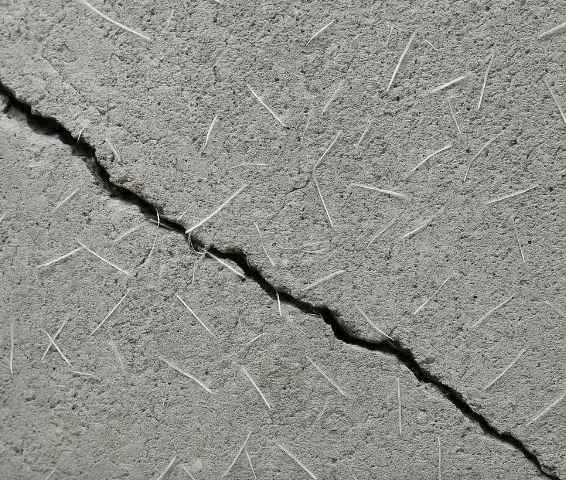
Polypropylene fibers in concrete answer a weakness the material has always had. Despite its high strength and widespread use across a wide range of structures, concrete cracks. One of the most significant issues is cracking over time, especially when exposed to environmental factors. For this reason, various methods—such as adding polypropylene (PP) fibers—are used to reinforce concrete and improve its tensile performance. If you are considering strengthening the concrete used in your small or large construction projects, the following guide will be helpful. Synthetic fibre for concrete is classified in ASTM C1116.
Why Use PP Fibers in Concrete?
Rapid evaporation of water from the concrete surface causes a phenomenon known as plastic shrinkage, which ultimately leads to surface cracking. The primary reason for using PP fibers in concrete is to prevent this issue and enhance structural resistance. When polypropylene fibers are mixed into concrete, they act as micro-reinforcement. If a crack forms during the drying process, the fibers function like a “bandage,” bridging the crack and holding both sides together.
As a result, the early-age strength of concrete increases, and surface cracks that reduce the service life of structures are effectively controlled. Over time, PP fibers also have a significant impact on the overall quality and durability of concrete. One notable benefit is improved resistance to fire, as polypropylene fibers help relieve internal vapor pressure at elevated temperatures.
Methods of Using Polypropylene Fibers in Concrete
To achieve the best results, it is essential to follow the correct application method. In general, there are three main methods for adding PP fibers to concrete:
1. Adding to Dry Aggregates
In this method, the fibers are added to dry materials such as sand and gravel before cement, water, and other admixtures are introduced. This is considered the most reliable method for ensuring uniform fiber dispersion. When added to dry aggregates, fibers separate easily from each other and, if the dosage is correct, mix evenly throughout the concrete.
2. Adding at the Batching Plant
Here, fibers are gradually and slowly added to the concrete mixer at the batching plant or transit mixer. Each addition stage should be mixed for several minutes. Proper and sufficient mixing is critical; otherwise, fibers may clump together and remain unevenly distributed within the concrete.
3. Adding On-Site
This method is similar to the batching plant approach but uses mixers available at the construction site. Fibers are added gradually and mixed thoroughly with the concrete. This method is typically suitable for small-scale projects or sites requiring limited amounts of concrete.
Recommended Dosage of Polypropylene Fibers in Concrete
Polypropylene fiber is dosed in two entirely different regimes, and quoting one range across both is the most common specification error in this area.
Micro monofilament — 6 to 18 mm, Class Ia under EN 14889-2 — is dosed at roughly 0.6 to 1.2 kg per cubic metre. It controls plastic shrinkage cracking in the first hours after placing and can reduce the risk of explosive spalling in fire. It is not specified to provide structural post-crack residual capacity.
Macro structural fiber — 40 to 54 mm, Class II — is dosed far heavier, typically 2 to 9 kg per cubic metre depending on grade and application: 3–7 for slabs on grade, 4–9 for shotcrete, 2–5 for precast. This is the regime that delivers measurable residual strength under ASTM C1609, and it is what may allow a fiber dose to reduce or replace crack-control mesh where the design and required residual performance permit.
There is no universal polypropylene dosage. A macro dose is designed from the residual strength the element needs, the concrete mix, the fiber geometry and the governing test method — not read off a general range. The factors below are what move it, and the type of concrete and its intended application are the first two.
Fiber dosage cannot be read off fiber length or the concrete supply method alone. For macro synthetic fiber, the dose is established from the required residual performance, the fiber geometry, the concrete matrix, the section geometry, the loading and the applicable test and design method — which is why the two regimes below are separated rather than averaged into a single range.
For all projects—especially critical structural applications—it is strongly recommended to consult an experienced engineer when determining the appropriate fiber dosage. Improper fiber use can negatively affect concrete performance, reduce structural lifespan, and increase overall costs.
Key Considerations When Using PP Fibers in Concrete
As mentioned, accurate estimation of fiber dosage should be performed by a qualified engineer. However, the following factors can help provide a general guideline:
Type and application of concrete
Water-to-cement ratio
Thickness of the concrete layer
Type of structure
Additionally, the type and dimensions of the fibers themselves play an important role in determining the appropriate dosage and mixing ratio. When purchasing polypropylene fibers for concrete reinforcement, always follow the manufacturer’s technical guidelines and recommendations.
Final Remarks
There are several effective methods for reinforcing concrete and preventing cracking, one of which is the use of polypropylene fibers. To achieve optimal results and extend the service life of a structure, it is essential to understand both the correct application method and proper dosage.
This article provided an overview of how to use polypropylene fibers and how to estimate their required amount. However, factors such as concrete type, thickness, and fiber geometry are equally important. For structural applications, all measurements and mix designs should comply with supplier standards and be carried out under professional engineering supervision.
For purchasing polypropylene fibers and receiving technical consultation, please contact our experts at Polyguard Fibers.
Dosage is never a fixed number — it is designed around section thickness, loading and exposure. The applications and dosage guide walks through mix design, placing and curing, and our technical team will size a dose for your project and send a free sample.