Two bags of white fiber can look identical on a pallet and behave nothing alike in a slab. One is virgin polypropylene fiber made to a declared length, diameter and strength. The other might be recycled polypropylene with a mineral filler, polyester sold under a polypropylene label, or the right polymer cut so carelessly that it balls in the truck. You cannot see the difference from across the yard, and the price list will not tell you either. This guide gives you six checks you can run with a glass of water, a lighter and a ruler, explains what only a laboratory can confirm, and lists the documents worth asking for before you sign an order.
What "genuine" means for a concrete fiber
When buyers ask whether a fiber is genuine, they are usually worried about one of three different problems, and each one is caught by a different check.
The wrong polymer. Polyester or nylon fiber sold as polypropylene. These are real fibers, but they are not what was specified and they do not behave the same way in concrete.
The right polymer, unknown quality. Recycled or heavily filled polypropylene whose strength and diameter vary from batch to batch, so nobody can say what dose will deliver what result.
The right material, poor manufacture. Inconsistent cut length, too little or too much surface finish, fibers fused into clumps. These cause balling and uneven dispersion even when the polymer is perfect.
The standards describe what a good fiber has to be. ASTM D7508 is the specification for polyolefin chopped strands for use in concrete, EN 14889-2 classifies polymer fibers into micro (Class Ia and Ib) and macro (Class II), and Iran's quality-control code for polyolefin fiber concrete, Code 120-4, sets acceptance limits that are useful anywhere. The standards page explains how these documents fit together.
Six checks you can do before the lab
None of these replaces a test report, but together they will catch most of the problems that cost money on site.
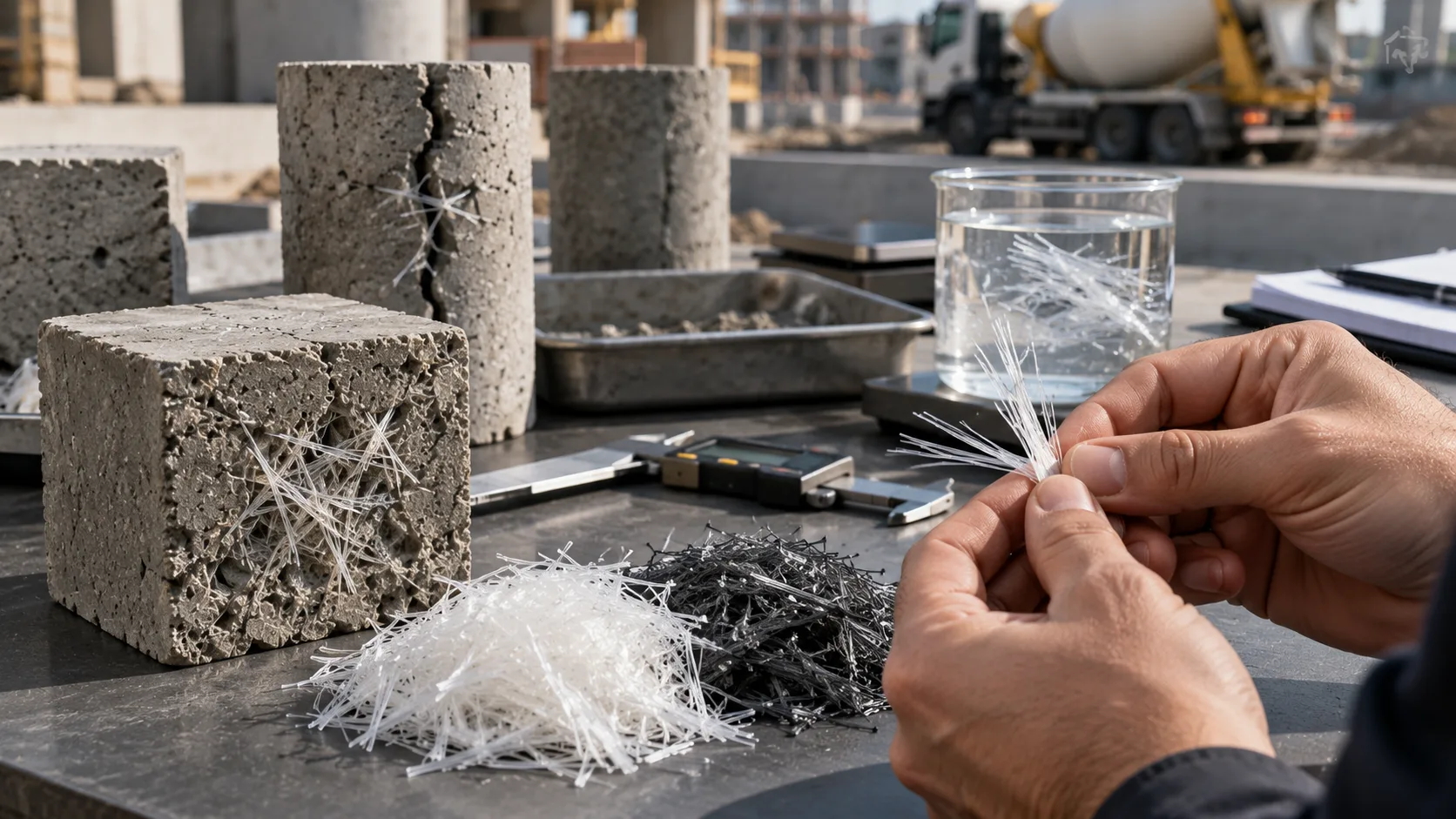
1. The float test. Drop a pinch of fiber into a glass of water and stir. Polypropylene has a density of about 0.90 g/cm³, so it floats. Polyester (PET) is about 1.38 g/cm³ and sinks, and so do nylon and glass. If a fiber sold as polypropylene sinks, it is not pure polypropylene: it is another polymer, or it carries enough mineral filler to make it heavier than water. The University of Akron publishes a simple density table for common polymers if you want the numbers side by side.
2. The burn test. Hold a few strands with tweezers, outdoors and away from anything flammable, and touch them to a small flame. Polypropylene shrinks from the flame, melts, gives off a faint paraffin smell, like a candle, and leaves a hard, light brown bead. Polyester burns with black smoke and a sweetish chemical smell. Textile labs have used this test for decades; FabricLink's burn test guide describes the reactions of each fiber type. Be clear about its limit: it tells polypropylene from polyester, but it cannot tell virgin polypropylene from recycled.
3. The ruler test. Take ten fibers from different parts of the bag and measure them. A 12 mm micro fiber should measure close to 12 mm every time. Code 120-4 does the formal version with 30 fibers, ten from each of three samples: the average length must be within 10% of the stated length, and 95% of the fibers measured must fall inside the range the manufacturer declares. A bag with fibers of every length is a bag from a cutter nobody is watching.
4. The dispersion test. Put a small pinch into a jar of water, close it and shake for half a minute. Monofilament fiber should open into separate strands. Clumps that will not separate point to a surface finish problem or fused filaments, and those are the fibers that ball in a truck mixer. The surface treatment that helps fibers separate is called spin finish, and Code 120-4 caps it at 1.5% by weight for micro fibers and 1% for macro fibers, so more is not better either.
5. The look test. Colour should be uniform through the bag and the cut ends clean. Specks, mixed shades or an odd smell are not proof of anything on their own, but they are good reasons to ask more questions. Do not judge by whiteness: some grades are pigmented on purpose.
6. The bag and its label. Weigh a bag. Check that it names the grade, the fiber length, the net weight and, most importantly, a batch or lot number. Without a batch number, a quality certificate cannot be tied to the material you are holding. Code 120-4 also asks for an opened or left-over bag to be weighed again before use, which is sensible practice on any site.
What only a lab can confirm about virgin polypropylene fiber
The home checks catch the wrong polymer and careless manufacture. Telling virgin polypropylene fiber from good recycled material needs measured properties, and these are the ones that matter:
Property | Why it matters | Reference |
Tensile strength | Weak fiber pulls apart at a crack instead of holding it. Code 120-4 requires more than 345 MPa for macro fiber. | Code 120-4; supplier test report |
Linear density (denier) | Separates micro from macro: 580 denier or less for micro, 581 or more for macro in Code 120-4. | ASTM D1577 or D1907 |
Melting point by DSC | Confirms the polymer. Polypropylene melts at about 160–170 °C; polyester melts much higher. | ASTM D7138 |
Spin finish content | Controls dispersion; too little or too much causes trouble. | Code 120-4 limits |
Residual strength of the concrete (macro fiber) | The property a structural engineer actually designs with. | ASTM C1609, or ASTM C1550 for shotcrete |
You do not need to commission these tests yourself. A serious manufacturer has them for every grade and can issue them for the batch you receive. If the documents are generic, undated or describe a different product, that is the answer to your question.
Why the wrong fiber costs more than it saves
Polyester does not last in concrete the way polypropylene does. Cement paste is strongly alkaline, and polyester (PET) is vulnerable to it. A study in Cement and Concrete Research found progressive degradation of recycled PET fibers in Portland cement paste, worse than in a sodium hydroxide solution of higher pH. Polypropylene is chemically stable in the same environment. Our article on polypropylene versus polyester fiber goes further into the difference.
Weak or variable fiber needs a higher dose. If the fiber carries less load at a crack, the only way to reach the residual strength the designer asked for is more kilograms per cubic metre. A cheaper price per kilogram then turns into a higher cost per cubic metre, which is the number that matters, as our guide to concrete fiber cost per cubic metre explains.
Poor manufacture shows up on the day of the pour. Balls of fiber in the discharge, uneven dispersion and a rough finish are the visible costs. The invisible one is a section where the fiber is not where the engineer assumed it would be.
Red flags in an advert or a quotation
"Replaces rebar", with no condition attached. Fiber can replace crack-control mesh and temperature steel where the design permits it, and it does not replace structural reinforcement.
A dose given as a percentage of cement weight. Five percent of 350 kg of cement would be 17.5 kg of fiber in every cubic metre, about twice the top of the macro fiber range and more than ten times a typical micro fiber dose.
Claims that fiber multiplies compressive strength. Fiber at normal doses changes compressive strength very little, a point both the American Concrete Institute and Code 120-4 make plainly.
One certificate offered for every batch, or none at all.
A price far below the market for something sold as virgin polypropylene fiber.
What to ask any concrete fiber supplier
Before you order, ask any concrete fiber supplier for four things: the data sheet for the grade, a quality control certificate tied to the batch number on your bags, the test report for the method your specification names, and a sample you can put through your own float, burn, ruler and dispersion checks. If the fiber is going into a structural or industrial application, add a trial mix with your own materials, as described in our trial mix test plan.
Polyguard makes polypropylene concrete fibers from 100% virgin polypropylene; no grade contains recycled polymer. Production runs under an ISO 9001 quality system with an in-house laboratory, every production batch carries its own quality control certificate, and test reports for the method your project names are issued on request, together with a free sample. The six grades, including the macro synthetic fibers for concrete, are listed on the product range page.
Common questions
Is recycled polypropylene fiber always bad?
Not necessarily. Researchers have studied recycled fibers seriously, and some perform reasonably. The problem in the market is not recycling itself; it is fiber sold without declared, tested properties, so nobody can design a dose around it. Buy on documented properties, whatever the source.
Can I tell virgin from recycled polypropylene at home?
No. The float and burn tests confirm that the fiber is polypropylene. Whether it is virgin polypropylene fiber needs tensile, DSC and dimensional results from a laboratory, plus a supplier who will put the batch number on the certificate.
Does a different colour mean the fiber is fake?
No. Some grades are pigmented deliberately. What should worry you is colour that changes within one bag, specks of other material, or a colour that does not match the data sheet.
Is the burn test safe?
With care. Use tweezers, burn only a few strands, work outdoors and keep water nearby. Melting polymer drips and sticks, so keep your hands clear.