The right fiber for industrial floors depends on what the slab has to do. If you only need to stop surface cracks in the first hours, a micro fiber at a low dose is enough. However, if the design asks the fiber to control cracks in the hardened slab, or to take the place of crack-control mesh, you need a macro fiber at a dose an engineer has worked out. That dose comes from the loads, the thickness and the joint layout. It never comes from a rule of thumb or a bag count.
Start with what the floor has to carry
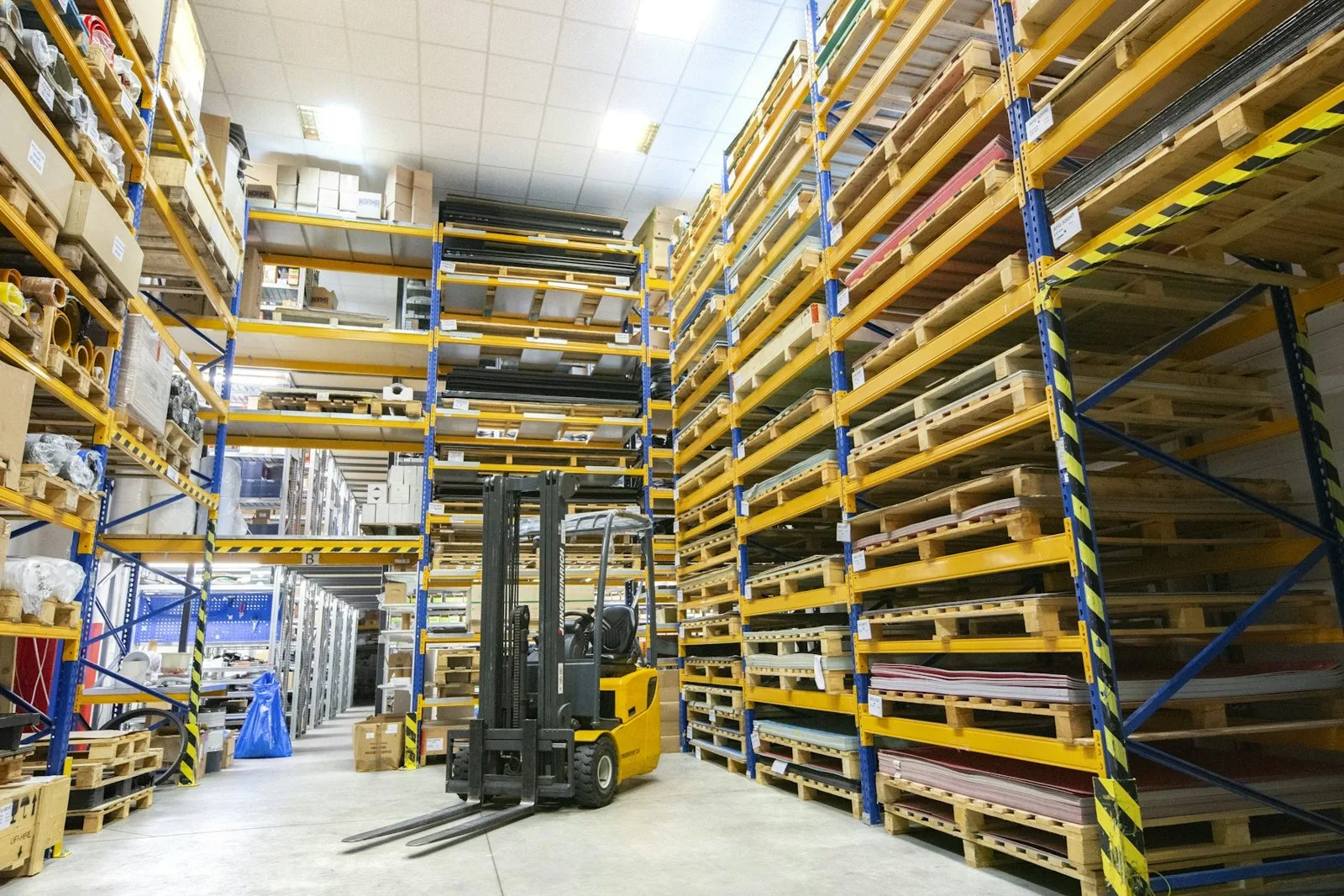
A warehouse floor is not a driveway. It carries forklift wheels, pallet racking and sometimes heavy machines bolted straight to the concrete. So before anyone talks about fiber, the designer needs a clear picture of the loads. Ask the client for the truck type, the wheel loads and the racking layout. Also ask whether any machines will sit on their own bases.
Those answers set the slab thickness, the sub-base and the concrete class first. Fiber is one input to that design, not a way around it. Next, the designer decides what the fiber should do. It may only protect the fresh surface. Otherwise, it may control the width of shrinkage cracks, or add bending capacity after the slab cracks. Each of those jobs needs a different product and a different dose.
Micro or macro fiber for industrial floors
The two families do different jobs. The American Concrete Institute describes synthetic microfibers as mainly a control for plastic shrinkage cracking. They add little to the hardened concrete. Macrofibers are thicker, 0.3 mm or more, and they improve the concrete after it cracks.
Fine polypropylene concrete fibers therefore belong on a floor when the risk is early surface cracking. That happens, for example, in a hot, windy hall with open doors. In contrast, macro synthetic fibers for concrete are the choice when the design counts on the fiber in the hardened slab. Some floors use both, each at its own dose.
| Polyguard grade | What it does in a floor | Dose band |
| Micro: PG MS-12, 6 / 12 / 18 mm | Plastic shrinkage cracks in the first hours | 0.6 to 1.2 kg/m³ |
| Macro: PG EC-45, 45 mm | Crack control, not full reinforcement replacement | 2 to 4 kg/m³ |
| Macro: PG MF-54, 54 mm | Industrial floors and slabs on ground | 3 to 7 kg/m³ |
How the dose of fiber for industrial floors is set
Every fiber type has a minimum dose below which it stops working. ACI's note on minimum fiber dosages gives at least 1.8 kg/m³ for synthetic macrofibers in slabs on ground. Below that, the slab behaves much like plain concrete. Shaped or embossed fibers do not lower that minimum.
The minimum is only a starting line, though. ACI's note on crack-width control says minimum doses are enough to control shrinkage and thermal cracks. It also says higher doses can raise the bending capacity and toughness after cracking. A heavily loaded floor that relies on that capacity therefore needs a designed dose, not the minimum.
In practice the designer specifies a performance, such as a residual strength from a beam test. The supplier then proves which dose reaches it with the fiber on offer. Iran's Code 120-4 for polyolefin fiber concrete points to ASTM C1609, C1399 and C1550 for this kind of flexural test. Our technical team designs the dose free of charge from the section, the loading and the exposure.
What the fiber replaces, and what it does not
Macro fiber can take the place of crack-control mesh and temperature steel, but only where the design permits it. It does not replace rebar that the engineer placed to carry bending, for example over a pit or under a heavy machine. If the drawings show both, the fiber is an addition, not a swap.
Joints follow the same logic. Fiber does not stop concrete from shrinking, so the floor still needs a joint plan. Longer joint spacing is possible with macro fiber, but only as the output of a full design. Our guide to control joints in fiber reinforced slabs covers saw-cut timing, depth and panel layout.
Also, do not expect a jump in compressive strength. ACI puts the effect of fiber below 0.5% by volume at marginal to negligible, and Code 120-4 says much the same. The concrete class stays whatever the design specified.
Plan the finish with the fiber in mind
Floor crews often worry that fiber will show on the surface. It can, if the slab is troweled too early or with tilted blades. The fix is mostly timing. Wait until the bleed water has gone, start with flat blades and raise the pitch only late. If fibers appear, stop for a few minutes and let the surface firm up.
If the floor will get epoxy, a sealer or polishing, tell that contractor about the fiber before the pour. Then cast a mockup panel with the same mix, crew and tools. Our article on epoxy over fiber concrete explains the surface preparation steps. On request, our technical team also attends the first pour of an industrial floor and goes through the sequence with the crew.
Prove the mix before the first slab
A floor is a large pour, so a mistake repeats across thousands of square metres. Run a trial batch with your own cement, aggregates and admixtures first. Check the slump, how the fiber spreads, and how the surface finishes. Our trial mix test plan lists what to record.
On the day, follow the agreed mixing time and look at every truck before discharge. Code 120-4 asks for fiber concrete delivered free of balled fibers. It also sets sampling of hardened concrete at least once per 115 m³ from a batch plant, and at least once per class per day. Never add water to recover slump; adjust the admixture instead.
A short checklist for fiber for industrial floors
Loads, thickness and sub-base fixed by the designer first.
The fiber's job written down: surface only, crack control, or post-crack capacity.
Micro or macro grade chosen for that job, with a dose from its band.
Where the dose matters, a performance test named in the specification.
A joint plan, curing method and finishing sequence agreed before the pour.
Trial batch first and, for coated floors, a mockup panel.
A good concrete fiber supplier helps with every line of that list. Polyguard makes each grade from 100% virgin polypropylene under ISO 9001. Each production batch also ships with its own QC certificate. The fiber comes in 3 kg and 5 kg water-soluble bags that go straight into the mixer, and we send a free sample for your trial. See the industrial flooring page for the floor grade, or start with how concrete fiber works.
Frequently Asked Questions
Is micro fiber enough for a warehouse floor?
Only if its job is to control plastic shrinkage cracks in the first hours. If the design counts on the fiber in the hardened slab, or to replace crack-control mesh, the floor needs a macro fiber at a designed dose.
What is the minimum dose of macro synthetic fiber in a slab on ground?
ACI gives at least 1.8 kg/m³ for synthetic macrofibers in slabs on ground. That minimum controls shrinkage and thermal cracks; a heavily loaded floor that relies on post-crack capacity needs a higher, designed dose.
Can fiber replace rebar in an industrial floor?
Macro fiber can replace crack-control mesh and temperature steel where the design permits. It does not replace rebar placed to carry bending, for example over pits or under heavy machines.
Does fiber stop a floor from showing fibers on the surface?
Fibers show mainly when the slab is troweled too early or with tilted blades. Waiting for the bleed water to go, starting with flat blades and testing a mockup panel keeps them under the paste.