Every concrete element cracks. The question a designer actually faces is not whether cracking happens but whether the cracks stay narrow enough to be harmless. Concrete crack control is the discipline of keeping crack widths below the point where water, chloride and carbon dioxide can reach the reinforcement. This article explains the three mechanisms that crack concrete, and exactly where fiber helps.
Why concrete cracks in the first place
Concrete is strong in compression and weak in tension — roughly ten times weaker. Anything that puts the section into tension before it has the strength to resist will crack it. Three mechanisms account for almost all of what you see on site.
Plastic shrinkage. In the first hours after placing, water leaves the surface faster than bleed water rises to replace it. The surface contracts while the body below does not, and short random cracks open across the top. Wind, low humidity and high temperature all accelerate it.
Drying shrinkage. Over weeks and months the hardened concrete loses moisture and contracts. Where the element is restrained — by a subgrade, a wall, a column — the restraint converts that contraction into tension, and the section cracks.
Structural load. Bending, point loads and settlement put the tension face into tension by design. This is the crack type conventional reinforcement exists to control.
What fiber actually does about it
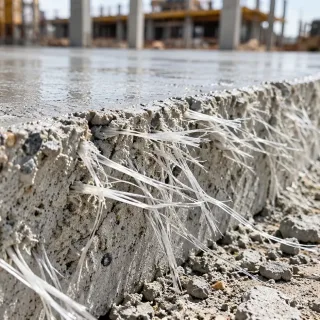
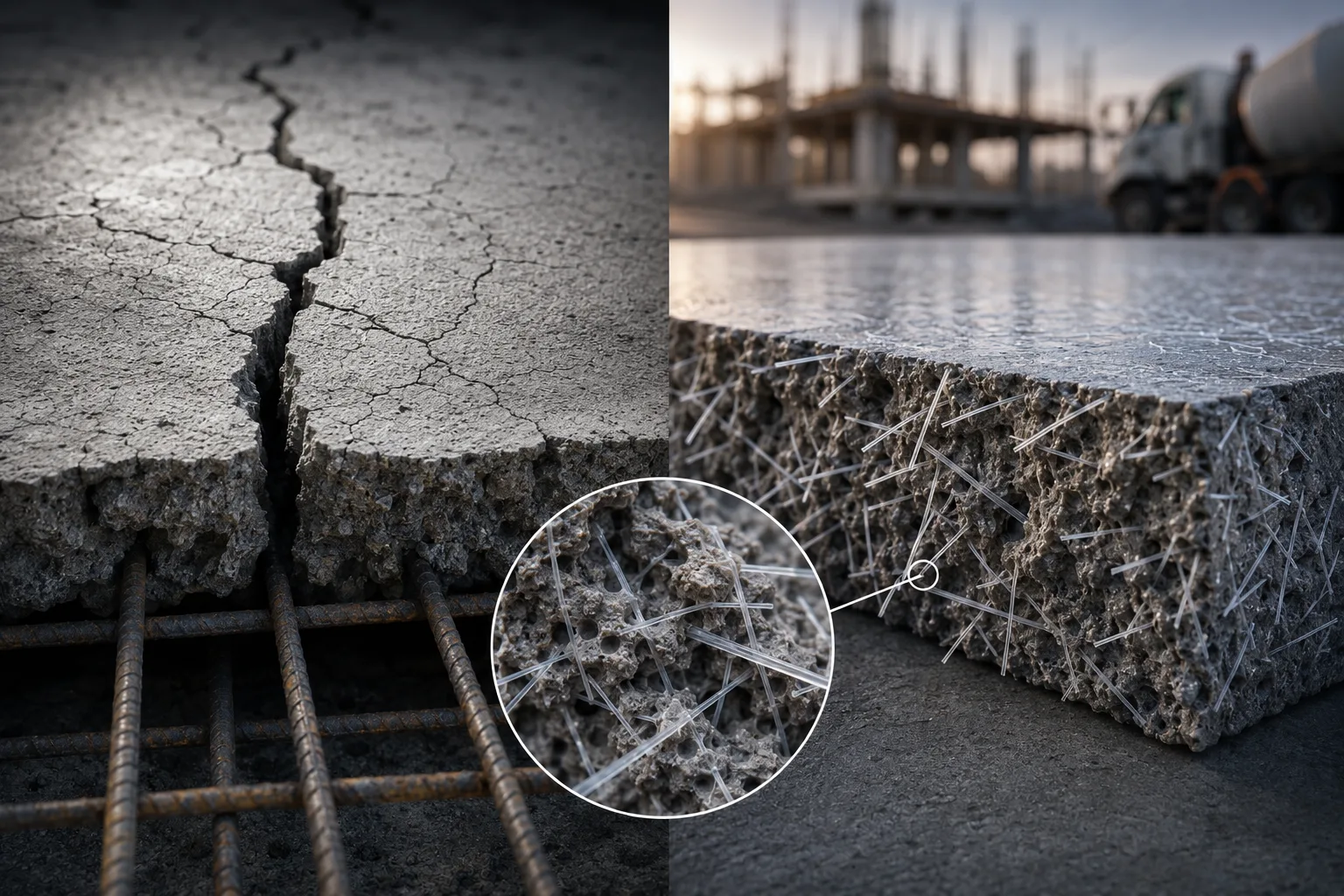
Fiber does not stop concrete from cracking. It changes what happens at the moment a crack forms. Once the matrix separates, fibers bridging the crack carry load across it, so the element keeps a measurable residual capacity instead of losing its section. That is the whole mechanism, and everything else follows from it.
Because the fibers are distributed through the full depth of the pour rather than sitting in one plane, they act wherever the crack happens to form — which is the practical advantage over a single layer of mesh placed at one level and frequently walked down during the pour.
Micro fiber for early-age concrete crack control
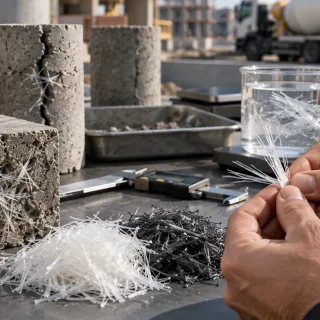
For plastic shrinkage, the effective tool is micro monofilament polypropylene, dosed at roughly 0.6 to 1.2 kg/m³. The fibers are fine and numerous, so they reinforce the surface during the hours when the concrete has almost no tensile strength. Used correctly they substantially reduce the random surface map cracking that otherwise appears on the first day.
Micro fiber does not contribute to load capacity and is not a substitute for reinforcement. It is early-age concrete crack control and nothing more — but that is a real defect it genuinely prevents.
Macro fiber for hardened concrete
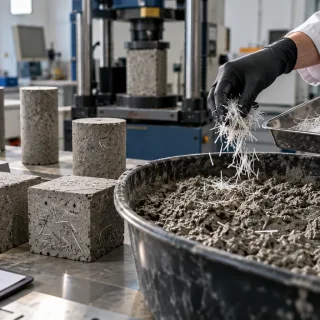
For drying shrinkage and load-induced cracking in slabs, the tool is macro synthetic fiber at 3 to 7 kg/m³. These are structural fibers: they are measured under ASTM C1609, which loads a beam past first crack and records the load it still carries at defined deflections. That residual strength is what allows a fiber dose to replace a crack-control mesh layer where the design permits.
Our standards page sets out how the classification and the test methods fit together, and the fiber range lists the grade and dosage for each application.
Where fiber is not the answer
Being plain about the limits is more useful than overselling. Synthetic fiber does not replace structural reinforcement in a beam, a suspended slab, a column or anything where the steel is carrying calculated bending moments. It does not compensate for a bad mix, an unprepared subgrade, or joints in the wrong place. And no dose of fiber rescues concrete that was finished too early or cured too little.
Good concrete crack control is a system: a sensible water-cement ratio, a prepared subgrade, joints at the right spacing, proper curing — and then fiber to handle what remains.
Specifying it on a real project
Name the performance rather than a product: the fiber class, the test method, and the residual strength required at a stated deflection. That keeps the clause enforceable and open to any compliant supplier. If you would like the arithmetic done against your own rates, the dosage and cost calculators compare a fiber dose with a mesh layer directly.
Send us the element thickness, the exposure class and the loading, and we will return a dosage, the matching grade and a free sample for trial batching before any production order.