ASTM C1116 is the American specification for fiber-reinforced concrete as it reaches the buyer. It sorts that concrete into four types by fiber material: Type I steel, Type II glass, Type III synthetic and Type IV natural. It also asks for concrete that arrives uniformly mixed and free of fiber balls. So when a quote says "Type III", it tells you the concrete holds synthetic fiber. However, it does not tell you whether that fiber is micro or macro, how much to add, or how the concrete behaves once it cracks.
What ASTM C1116 covers, and what it leaves out
The full title is Standard Specification for Fiber-Reinforced Concrete. The current edition is C1116/C1116M-23. According to ASTM's summary of the standard, it covers fiber-reinforced concrete that is delivered with all its ingredients uniformly mixed. That concrete is made under ASTM C94 or ASTM C685, as modified by C1116. Also, it may come from batch mixing or from continuous mixing.
Some sections also apply to dry-mix shotcrete, to zero-slump concrete and to precast elements. In those cases, however, the clauses on the batching plant, mixing, delivery, workability and air content drop out. Thin glass fiber panels made by the spray-up process are outside its scope altogether.
What the standard does not cover matters just as much. Placement, consolidation, curing and protection after delivery are not part of it. Those therefore stay with the project specification and the contractor. In other words, ASTM C1116 ends at the truck chute.
The four types of fiber-reinforced concrete
The standard classifies the concrete by the fiber inside it. That is the whole basis of the type number, as the table shows.
| Fiber in the concrete | ASTM C1116 type |
| Steel fibers: stainless, alloy or carbon steel | Type I |
| Alkali-resistant glass fibers | Type II |
| Synthetic fibers | Type III |
| Natural cellulose fibers | Type IV |
Polypropylene fiber is synthetic, so concrete made with it is Type III. That holds, for example, for a fine 6 mm monofilament and for a 54 mm macro fiber alike. Similarly, a steel fiber concrete is Type I whether the fibers are short or long.

What a Type III claim tells a buyer
A Type III label answers one question: what material is the fiber? But it does not answer the questions a designer actually asks. For example, a 12 mm micro monofilament and a 54 mm macro fiber both make Type III concrete. Yet they do very different jobs.
The American Concrete Institute draws that line clearly. Its note on synthetic microfibers and macrofibers says microfibers mainly control plastic shrinkage cracking and add little to hardened concrete. Macrofibers, in contrast, improve the hardened concrete, especially its behavior after cracking. A type number cannot tell those two apart.

There is also a wording trap. Strictly, Type III describes the concrete, not the bag. A fiber on its own is not "Type III"; it is a fiber for use in Type III concrete. The fiber therefore has its own specification. For polyolefin fibers in the US, that is ASTM D7508. Its summary requires compliance with C1116 Type III, plus limits on denier, finish content, tensile strength and cut length.
Questions to ask when a quote says "Type III"
Which fiber specification does the product meet, for example ASTM D7508 or EN 14889-2?
Is it a micro or a macro fiber, and which EN 14889-2 class is it?
Is there a test report in the method your specification names, such as ASTM C1609 for beams or ASTM C1550 for round panels?
Does each delivery come with a QC certificate for its own production batch?
What dose in kilograms per cubic metre does the design need, and on what basis?
If the answers are vague, the Type III claim is doing more work than it can carry. Our checklist for virgin polypropylene fiber adds six checks on the material itself.
ASTM C1116 next to EN 14889-2 and Code 120-4
The three documents look at the same material from different sides. ASTM C1116 classifies the delivered concrete. EN 14889-2, the European standard for polymer fibres, classifies the fiber itself. It splits them into Class Ia micro monofilament, Class Ib micro fibrillated and Class II macro fibres. Class II is the macro class meant for structural use.
Iran's Code 120-4, the quality-control instruction for concrete containing polyolefin fibers, covers both sides. For the fiber, it splits micro from macro by denier: 580 or finer is micro, and 581 or coarser is macro. It also asks macro fibers for a tensile strength above 345 MPa. For the concrete, it requires delivery free of balled fibers and sends mixing to ASTM C94 or Iranian standard 6043. It then names three flexural tests: ASTM C1609, C1399 and C1550. Our guide to Code 120-4 goes through it clause by clause.
| Question | ASTM C1116 | EN 14889-2 | Code 120-4 |
| What it classifies | The delivered concrete, by fiber material | The polymer fiber | Polyolefin fiber and the concrete that contains it |
| Micro or macro | No split by size | Class Ia and Ib micro, Class II macro | By denier: 580 or finer micro, 581 or coarser macro |
| Fiber balls at delivery | Concrete must be free of them | Outside its scope | Concrete must be free of them |
| Flexural tests named | Outside the type | Needed to declare Class II | ASTM C1609, C1399 or C1550 |
So the documents do not compete. A good specification uses each one for the part it does well.
What the delivered concrete has to meet
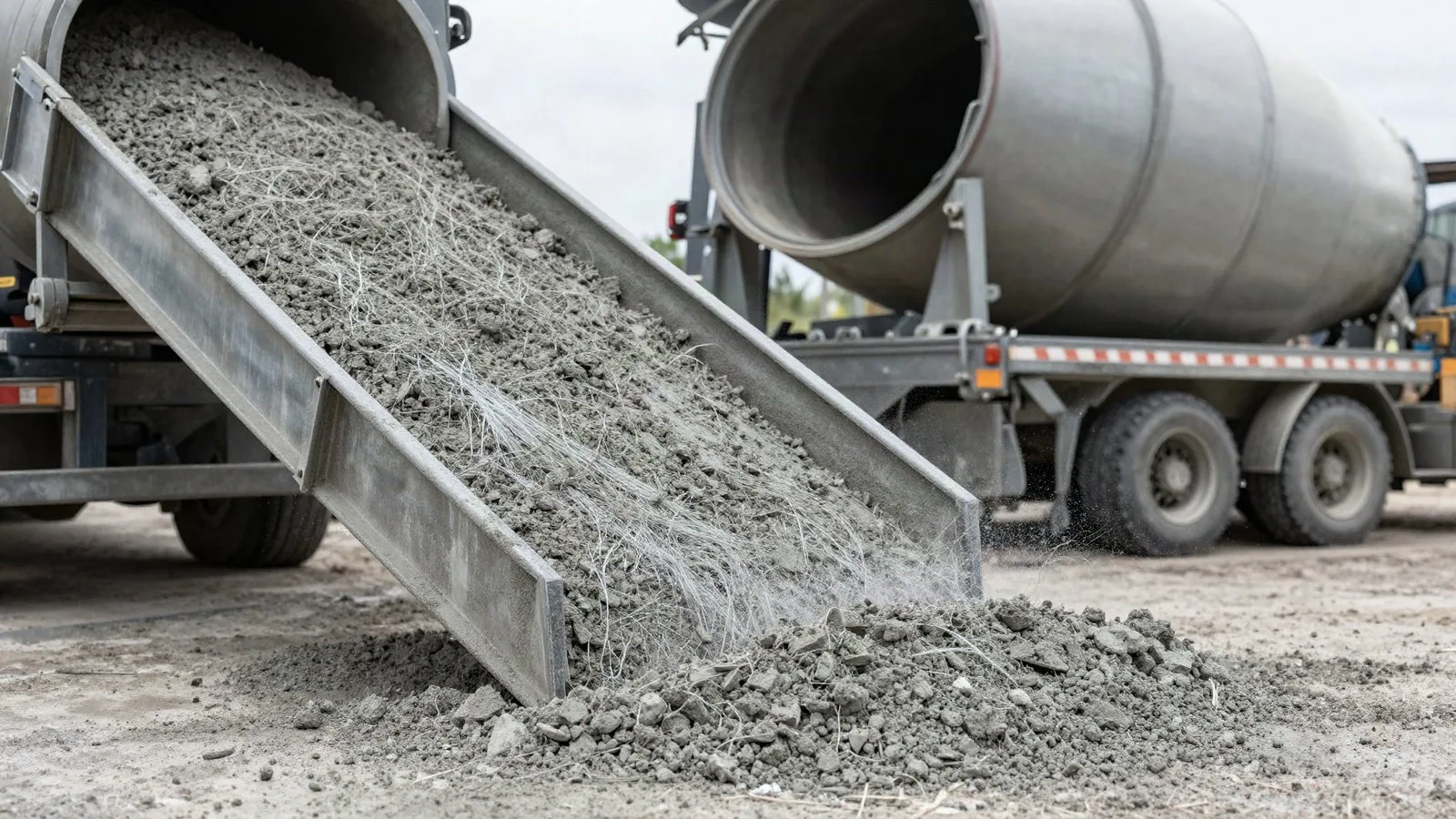
For the concrete in the truck, ASTM C1116 sets checks a site crew can carry out. First, the fiber-reinforced concrete must be free of fiber balls when it reaches the point the purchaser designates. Second, the standard sets tolerances, acceptance criteria and performance requirements for workability and air content.
In practice, watch the first discharge from the truck mixer. If clumps of fiber come out, stop and raise it with the plant before anyone places that load. Also expect a lower slump reading. ACI explains that fibers change how the mix flows, which gives an apparent slump loss, yet they do not need extra water. Therefore the fix is admixture agreed with the plant, never a hose on site. Our list of concrete fiber mistakes explains what extra water costs.
Writing ASTM C1116 into a specification or an order
A clause that names only "ASTM C1116 Type III" is easy to meet with the wrong fiber. So name four things together: the type, the fiber specification or class, the test method with its required value, and the dose per cubic metre. For early-age crack control, that points to polypropylene concrete fibers in the micro class. For post-crack capacity in a slab, it points to macro synthetic fibers for concrete at a designed dose. Even then, fiber replaces crack-control mesh and temperature steel only where the design permits. It never replaces structural rebar.
Polyguard makes every grade from 100% virgin polypropylene under an ISO 9001 quality system. Our PG MS-12 micro monofilament is a Class Ia fiber, while PG EC-45 is a Class II macro fiber for crack control. Every production batch has its own QC certificate, and test reports for the method your specification names are issued on request. Our standards and compliance page maps each grade to its test method. Before you order, ask for a free sample and run a trial mix with your own materials. Then send the clause to us as your concrete fiber supplier. Our technical team will design the dose from your section, loading and exposure.
Frequently Asked Questions
What are the four types in ASTM C1116?
Type I is steel fiber-reinforced concrete, Type II is glass fiber-reinforced concrete with alkali-resistant glass, Type III is synthetic fiber-reinforced concrete and Type IV is natural fiber-reinforced concrete with cellulose fibers. The type follows the fiber material only.
Does Type III mean the fiber is a macro or structural fiber?
No. A fine micro monofilament and a long macro fiber both make Type III concrete. Whether the fiber is micro or macro comes from its EN 14889-2 class or the Code 120-4 denier split, and its post-crack performance from a flexural test such as ASTM C1609 or ASTM C1550.
Is ASTM C1116 a specification for the fiber itself?
No. It specifies the delivered concrete. The fiber has its own specification, for example ASTM D7508 for polyolefin fibers or EN 14889-2 for polymer fibres.
Does ASTM C1116 cover placing and curing fiber concrete?
No. It does not cover placement, consolidation, curing or protection after delivery. Those stay with the project specification and the contractor.