
Code 120-4 is Iran's quality-control rulebook for concrete that contains polyolefin fibers, such as polypropylene. It tells you how to accept the fiber: its length, denier, tensile strength, spin finish and melting test. It also tells you how to accept the fiber concrete, from delivery without fiber balls to slump, sampling and bending tests. And it says plainly that fiber at normal doses will not change compressive strength much. So if you supervise, place or buy fiber concrete in Iran, this is the document the inspector will quote.
What Code 120-4 is and when it applies
The Persian title is «دستورالعمل کنترل کیفی بتن حاوی الیاف پلیاولفین». In English, that is a quality-control instruction for concrete containing polyolefin fibers. Iran's Plan and Budget Organization publishes it. Its last edition carries the date 1400/06/13, which is 4 September 2021.
A circular, number 1400/441320 dated 1400/09/08 (29 November 2021), then made it mandatory from 1 Farvardin 1401, or 21 March 2022. The rule applies where no better rules exist. So unless your contract documents set better rules, Code 120-4 is the baseline your supervisor checks against.
Because the definition rests on olefin content, polyester, glass and steel fibers are not polyolefin fibers in its sense. Polypropylene and polyethylene fibers are.
What the code requires of the fiber
Definitions: polyolefin, micro and macro
First, a polyolefin fiber is one made of at least 85% olefin by weight. Next, the code covers fibers from 6 to 64 mm long. It then splits them by denier, which is the weight in grams of 9,000 metres of one filament. A micro fiber is 580 denier or finer, while a macro fiber is 581 denier or coarser. The test methods for this are ASTM D1577 and ASTM D1907.
Micro fiber is for early-age cracking, but macro fiber is the one that carries load across a crack. If the drawing asks for macro fiber and the bag holds 500 denier fiber, it is the wrong product, whatever the label says.
Length acceptance
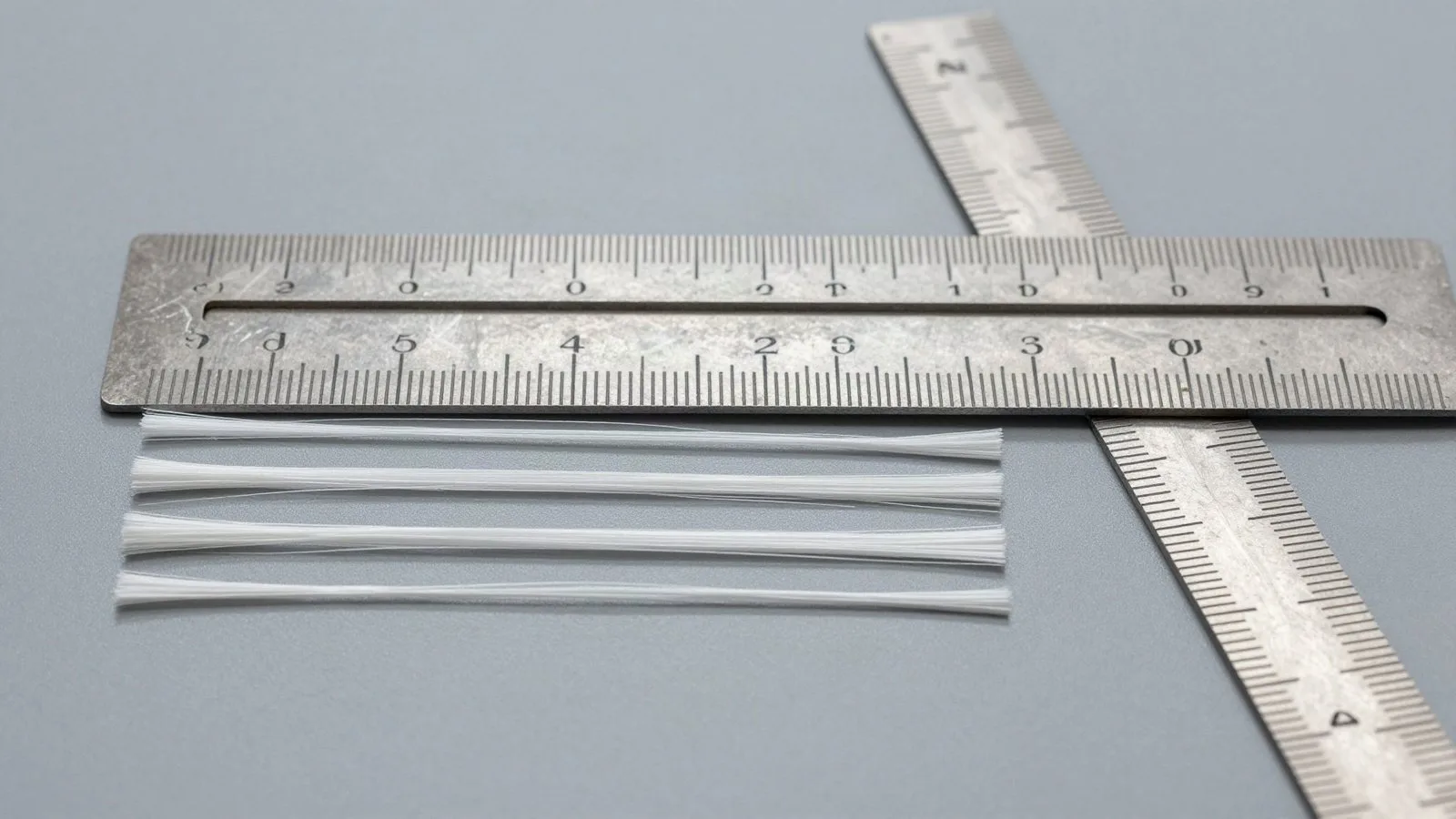
The length test uses 30 fibers, 10 from each of three samples. The mean length must sit within ±10% of the length the supplier states. Also, 95% of the fibers must fall inside the declared range.
For example, a 12 mm micro fiber passes the first condition if the 30 fibers average between 10.8 and 13.2 mm. Because the test needs only a ruler or a caliper, you can also repeat it on a delivered bag as a quick screen before formal testing.
| Requirement | Code 120-4 value | Test |
|---|---|---|
| Length tolerance | Mean within ±10%; 95% in range | 30 fibers, 3 samples |
| Micro or macro | Micro ≤ 580 denier; macro ≥ 581 | ASTM D1577 / D1907 |
| Macro tensile strength | Above 345 MPa | Lab test |
| Spin finish | Micro ≤ 1.5%; macro ≤ 1% | Lab test |
Tensile strength, spin finish and the DSC test
Macro fibers need a tensile strength above 345 MPa. Because a macro fiber holds a crack together, a weak one simply snaps.
Spin finish is the thin surface coating put on the fiber in production. The code caps it at 1.5% for micro fibers and 1% for macro fibers.
Finally, the code calls for a DSC melting test to ASTM D7138. DSC heats a tiny sample and records where it melts, so it tells you which polymer you really have. Polyguard's base polymer, for example, melts at 160 to 170 °C (a nominal value). Also note that ASTM D7508, the American specification for polyolefin fibers in concrete, checks the same family of properties: denier, finish content, tensile strength and cut length.
If your worry is whether a bag holds genuine virgin polypropylene at the point of sale, read our six checks before you buy virgin polypropylene fiber instead.
What it requires of the fiber concrete
Ordering, mixing and part bags
Code 120-4 sends mixing and delivery to ASTM C94 or Iranian national standard 6043. In other words, you order and batch fiber concrete like any ready-mixed concrete. In practice, put the fiber type, grade, length and dose on the order, so the plant and the supervisor check the same numbers.
The code also deals with part bags. If a bag is open or left over from an earlier load, weigh it again before it goes in. Our fibers come in 3 kg and 5 kg water-soluble bags that go into the mixer unopened, so the dose is easy to count.
Delivery: no fiber balls, standard slump
Fiber concrete must arrive free of balled fibers. A fiber ball is a clump that did not open up in the mixer. So watch the first discharge from the truck mixer. If you see clumps, do not place that concrete; raise it with the plant first.
Measure slump to ASTM C143, the normal cone test. Fibers can make the slump look lower than the mix really behaves. Still, ACI notes that fibers do not need extra water, so workability comes back with admixture, never with a hose.
How often to sample
Take samples of hardened fiber concrete at least once per 115 m³ for batch mixing. For continuous mixing, the rule is once per 19 m³. In addition, sample each concrete class at least once per day. Therefore a 300 m³ batch-mixed floor needs at least three sample sets, while a 20 m³ pour still needs one set for each class.
Flexural performance tests
The fiber's real job shows in bending, after the first crack. So the code names three test methods: ASTM C1609 for beams, ASTM C1399 for residual strength of beams, and ASTM C1550 for round panels, which suits shotcrete. Your specification should say which one applies and what value the concrete must reach. Then ask for reports in that method.
What Code 120-4 says about compressive strength
Do not judge fiber by cube or cylinder results. Code 120-4 says you should not expect a noticeable change in compressive strength or flexural modulus at low to moderate dosages. ACI says the same thing: at typical dosages below 0.5% by volume, the effect on compressive strength is marginal to negligible.
As a result, a low compressive result usually points to the mix, the water or the curing, not to bad fiber. Similarly, a high result does not prove the fiber works. For that, you need the flexural tests above.
A site acceptance checklist for supervisors
This list follows the Code 120-4 points in the order you meet them on a pour day. If a line fails, stop and record it before the concrete goes down.

- Delivery note matches the order for fiber type, grade, length and dose.
- Bags arrive sealed and labelled, with a batch number that matches the QC certificate.
- Opened or left-over bags go back on the scale before use.
- For a length screen, take 10 fibers from each of three samples and check the mean is within ±10%.
- First discharge shows no fiber balls in the chute.
- Slump test follows ASTM C143, and nobody adds water to recover it.
- Sample sets: one per 115 m³ (batch) or 19 m³ (continuous), and at least one per class per day.
- Bending specimens are cast for the method in the specification: C1609, C1399 or C1550.
- Compressive results tell you about the concrete, not about the fiber.
Documents to ask the supplier for
A good concrete fiber supplier sends these without a fight.
- A QC certificate for each production batch on site. Every Polyguard batch has its own.
- The data sheet for the grade you ordered.
- Test reports in the method your specification names, which we issue on request.
- An ISO 9001 certificate for the quality system.
- Also, a free sample for a trial mix with your own materials.
Our polypropylene concrete fibers start with PG MS-12, a micro fiber in 6, 12 and 18 mm lengths. Our macro synthetic fibers for concrete run from 40 to 54 mm. So every grade sits inside the code's 6 to 64 mm range. The base polymer's tensile strength is above 550 MPa, but that is a nominal value, not a batch guarantee; the batch certificate is what you file. Our standards and compliance page shows which standard and which governing test applies to each grade.
Frequently Asked Questions
Is Code 120-4 mandatory in Iran?
Yes. A Plan and Budget Organization circular, number 1400/441320 dated 1400/09/08, made it mandatory from 1 Farvardin 1401 (21 March 2022) wherever no better rules exist.
How does Code 120-4 tell micro fiber from macro fiber?
By denier. A micro fiber is 580 denier or finer and a macro fiber is 581 denier or coarser, tested to ASTM D1577 or D1907.
How is fiber length accepted under Code 120-4?
Thirty fibers are measured, ten from each of three samples. The mean must be within 10% of the stated length, and 95% of the fibers must fall inside the declared range.
How often should hardened fiber concrete be sampled?
At least once per 115 cubic metres for batch mixing or once per 19 cubic metres for continuous mixing, and at least once per concrete class per day.
Does fiber raise compressive strength under Code 120-4?
No noticeable change should be expected at low to moderate dosages. Judge the fiber by flexural performance tests such as ASTM C1609, C1399 or C1550 instead.