
Macro PP concrete fibers
Load-carrying reinforcement for slabs on grade, rafts and industrial floors. Dosed by kg/m³ and mixed straight into the batch.
View products
Concrete fiber manufacturer
Polyguard macro polypropylene fibers can reduce or replace conventional mesh and steel-fiber reinforcement in suitable slabs, shotcrete and precast sections, where the engineering design and the required residual performance permit — without corrosion, and with far less time spent on site.
The cost question
Compare the total installed cost of conventional reinforcement — not just the price of steel — with the Polyguard fiber solution.
A mesh layer arrives as a price per kilo and leaves as a price per square metre: transport, storage, cutting, lap waste, chairs and spacers, the crew that places it, the supervision that checks it, and the pour that waits for all of it. Fiber is dosed at the batching plant and none of that queue exists.
Steel purchaseTransport & storageCutting & lap wasteChairs & spacersPlacing labourSupervisionPlacement delayPolyguard fiber, dosed in the mix
Proportions are illustrative of how an installed reinforcement cost breaks down. Use the calculators with your own rates.
Product families
Three families, one material science. Pick by the job the concrete has to do.
Load-carrying reinforcement for slabs on grade, rafts and industrial floors. Dosed by kg/m³ and mixed straight into the batch.
View products
Purpose-shaped geometries for shotcrete, precast units and thin sections where placing steel mesh is impractical.
View products
Potentially lower installed reinforcement cost than mesh or rebar where the design permits: nothing to cut, place, tie or chair, and, where no steel remains in the section, no concrete cover needed to protect it from corrosion.
View productsWho we are
Polyguard is the concrete- and asphalt-fiber brand of Lavan Plast. Our fibers are made on our own extrusion lines at the Tafresh plant in Markazi Province, from a polypropylene formulation developed for mechanical performance rather than for price.
That matters most where steel struggles: humidity, chlorides, sulfates, sustained heat and freeze–thaw. Polyguard fibers do not corrode, removing reinforcement corrosion as one potential source of cover damage, surface staining and premature repair.

Selected products

Thin architectural panels without visible rust bleed, with improved crack control during handling, transport and lifting.
Details
Warehouse and factory floors with three-dimensional crack control and joint spacing that suits the traffic.
Details
Added at the mixer to resist rutting and reflective cracking on heavily loaded pavements.
DetailsWhy specify Polyguard
A specialist manufacturer of concrete fibers under the Polyguard brand — engineered to reduce or replace crack-control reinforcement in suitable applications, with faster installation, no corrosion and a competitive installed cost.

Where it is used
Warehouses, production halls, logistics yards.
Tunnel linings, slope stabilisation, underground works.
Panels, culverts, pipes, segments and street furniture.
Rafts, aprons, hardstandings and jointless floors.
Water, sulfates and chloride-rich ground conditions.
Heavy-duty pavements, bus lanes and port surfacing.
Where the money is
Each page follows the same structure: the expensive problem, the fiber solution, the cost lines that disappear, and the arithmetic.

Reduce total reinforcement cost by minimising or replacing conventional mesh where the engineering design permits.
Flooring economics
Less mesh handling, faster support cycles, lower labour requirement — more metres of tunnel completed per shift.
Cost per linear metre
Fewer cracked units, less handling damage, a lower rejection rate — and more saleable production from the same moulds.
Rejection-rate economics
Drain-down control, mixture stability, fatigue and rutting resistance — and longer intervals between lane closures.
Lifecycle economicsDo the arithmetic
Nothing is hard-coded. Put in your steel price, your labour rate and your dosage, and the comparison is yours to defend.
Steel avoided, chairs and spacers, placing labour and lap waste against a fiber dose — per m² and per project.
Mesh fixing hours, crew and equipment time, and the saving expressed per linear metre of tunnel.
Added cost per tonne against postponed resurfacing over an analysis period you choose.
Rejection losses, rework and handling claims against the annual fiber investment — including the rejection cut needed to break even.
Technical notes
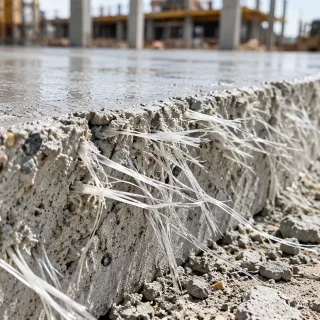
Why fibers show on a fiber-reinforced slab, the finishing sequence that keeps them down, and how coating and polishing crews deal with the ones that remain.
Read the note: Fibers Sticking Out of Concrete? Causes and Fixes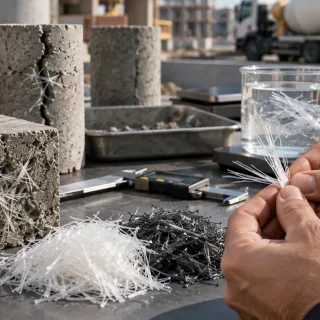
How to check concrete fiber before you buy: float, burn, ruler and dispersion tests, the lab results that matter, and the red flags in a quotation.
Read the note: Virgin Polypropylene Fiber: 6 Checks Before You Buy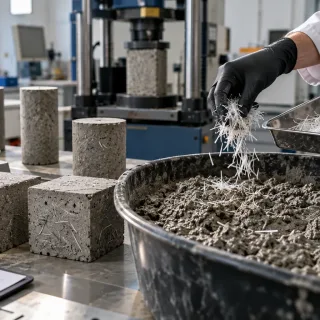
How to run a trial mix with a fiber sample, from the control batch and the washout check to the beams, and what to ask your supplier afterwards.
Read the note: Fiber Reinforced Concrete Trial Mix: A Buyer's Test PlanProduct range, technical specifications, dosage tables and typical applications — in one PDF.