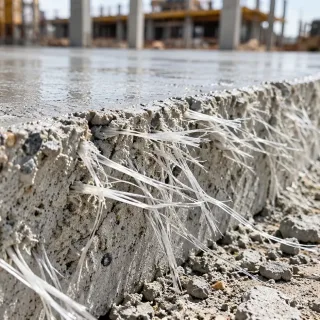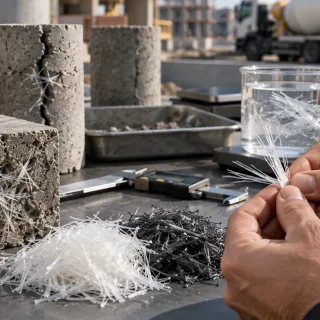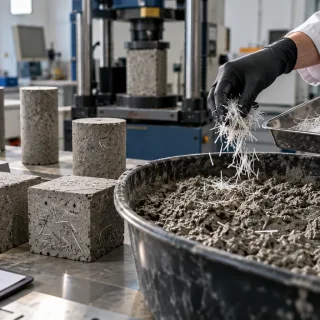
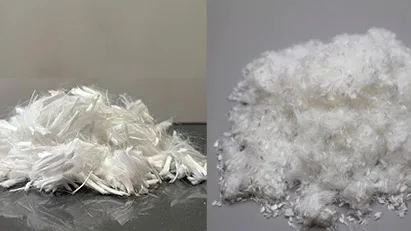
Both polypropylene and polyester appear in concrete fiber catalogues, often at similar prices, and the data sheets can look interchangeable. They are not. The polypropylene vs polyester fiber question has one decisive answer in cementitious systems, and it is about chemistry rather than mechanics.
The decisive difference: alkali resistance
Hardened concrete has a pore solution with a pH around 12.5 to 13.5. Polyester — polyethylene terephthalate — is a polyester, and polyesters hydrolyse in strongly alkaline conditions. The ester bonds in the polymer backbone are attacked, and over time the filament loses tensile strength.
Polypropylene is a polyolefin. It has no ester linkage to attack and is chemically inert in that environment. It does not hydrolyse, it does not embrittle in the pore solution, and its tensile properties at year twenty are essentially its properties at day one.
This is the whole of the polypropylene vs polyester fiber argument for permanent structural use. A short-term strength test on fresh specimens will not show it, which is exactly why it gets missed.
Polypropylene vs polyester fiber, side by side
Property | Polypropylene | Polyester (PET) |
|---|---|---|
Alkali resistance | Inert; no hydrolysis | Hydrolyses over time at high pH |
Specific gravity | ~0.91 — floats, disperses easily | ~1.38 — heavier per unit volume |
Melting point | ~160-170°C | ~250-260°C |
Fire spalling control | Melts and relieves vapour pressure | Melts too late to help |
Water absorption | Essentially nil | Slight; affects mix water |
Standard coverage | ASTM C1116, EN 14889-2 | Not the reference polymer |
Where polyester still appears
Cost is why the polypropylene vs polyester fiber question comes up at all. Polyester fiber is cheap and widely available, often as a by-product of textile production, and it turns up in low-cost fiber blends and in non-structural screeds and renders. In short-life, low-alkalinity or non-load-bearing applications it may cause no problem at all. The risk is specifying it for a permanent structural element on the basis of a fresh-specimen test.
Recycled polyester carries a second issue: inconsistent filament geometry and unknown additive history, which makes dispersion and bond unpredictable from batch to batch.
Dispersion and bond
Polypropylene's low specific gravity means more filaments per kilogram and easier dispersion at the mixer. Because it is hydrophobic it does not absorb mix water, so workability behaves predictably. Bond in polypropylene macro fiber comes from mechanical anchorage — embossing or a shaped profile — rather than from chemistry, and that anchorage does not degrade with age.
Fire behaviour
For explosive spalling protection the fiber must melt early enough to open capillary channels before vapour pressure damages the section. Polypropylene melts around 160-170°C, which is why it is the polymer named in fire specifications. Polyester's higher melting point means it is still intact when the damage occurs.
The recommendation
For permanent cementitious applications, virgin polypropylene is generally preferred where long-term alkali resistance, durability and predictable fiber properties are required, and its fire behaviour and dispersion are further advantages. Final material selection should follow the project specification, exposure conditions and required performance. If a supplier offers a polyester or a blended fiber at a lower price, ask for long-term alkali-resistance data in a cementitious environment rather than a fresh tensile figure.
Every grade in the Polyguard fiber range is 100% virgin polypropylene, with no recycled polymer in any grade. The standards page lists the classification and test method for each, and our technical desk will send test documentation for the grade your specification names.