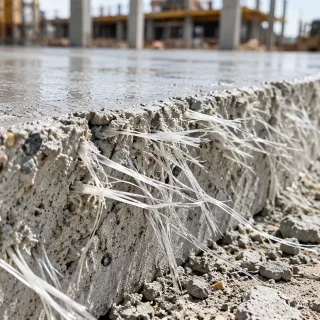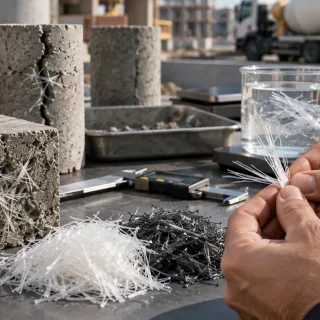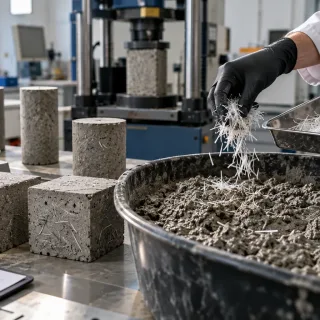
Fiberglass fibers are one of the oldest ways of putting tensile capacity into concrete, and one of the most often mis-specified. The reason is a single material distinction that decides whether the fiber survives in cement at all. This article explains what the fibers are, which grade belongs in concrete, what they measurably change, and where a macro synthetic fiber does the job better. Alkali-resistant glass fibre for concrete is specified in ASTM C1666.
Polyguard manufactures polypropylene concrete and asphalt fibers. Glass fiber is not part of our range; it is covered here because engineers routinely compare the two, and because the comparison usually decides the specification.
What fiberglass fibers are
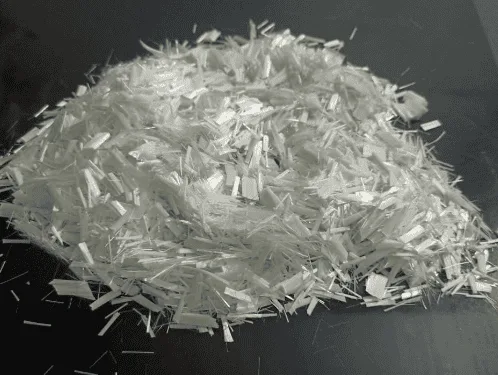
Fiberglass fibers are filaments drawn from molten glass, typically 10 to 20 microns in diameter, supplied for concrete either as chopped strands a few millimetres to about 50 mm long or as continuous rovings for spray-up panel production. The glass itself is a silicate melt — silica with calcium, aluminium and boron oxides in proportions that set the grade. Nothing else goes into it: glass fiber is not related to carbon fiber, to polymer fiber, or to glass wool insulation, and the three are not interchangeable in a mix design.
E-glass and AR-glass: the distinction that decides everything
Ordinary E-glass — the general-purpose grade used across the composites industry — is attacked by the alkaline pore solution of Portland cement. Calcium hydroxide raises the pH of fresh concrete above 12.5, and at that pH the silica network of E-glass is progressively dissolved. The fiber loses strength over months and years, so a slab that tested well at 28 days can lose much of its fiber contribution long before the structure is old.
Alkali-resistant glass, AR-glass, is formulated with roughly 16 per cent zirconia to resist that attack. It is the only glass grade that belongs in cementitious material, it costs substantially more than E-glass, and it is what ASTM C1666 covers. If a supplier cannot state the zirconia content, the material should be treated as E-glass and kept out of the mix. This single check disqualifies a large share of the "fiberglass fiber" sold for concrete.
What fiberglass fibers do in concrete
At the dosages normally used, AR-glass fibers work in the plastic and early-hardened phases:
Plastic shrinkage crack control. A dense filament network intercepts the microcracks that form in the first hours, before the concrete has tensile strength of its own.
Flexural performance in thin sections. In sections too thin to carry reinforcement bar or mesh — architectural panels, cladding, permanent formwork — glass fiber carries tensile stress the section could not otherwise resist.
Surface quality. A fine, well-dispersed fiber reduces edge and corner damage on demoulding, which is why it is common in decorative and architectural work.
The mechanism is real, and in thin architectural sections it is the right one. Glass fiber reinforced concrete is treated in detail in our GFRC article; surface reinforcement is covered under fiberglass mesh.
What fiberglass fibers do not do
Three limits matter more than any of the benefits, because getting them wrong is what produces disappointed clients:
They are not a structural reinforcement. Glass fiber does not replace reinforcement bar in beams, suspended slabs or columns, and it is not designed to deliver the post-crack residual capacity that lets a fiber dose reduce or replace a crack-control mesh layer. That duty belongs to a Class II macro fiber measured under ASTM C1609.
Their long-term capacity is a durability question, not a strength question. Even with AR-glass, embrittlement in cement is a documented long-term mechanism. Any design that depends on the fiber decades out needs evidence for that specific product, not a 28-day figure.
They are brittle in handling. Glass filaments break during mixing far more readily than polymer fiber, so the dose that leaves the bag is not the dose that ends up intact in the pour.
Fiberglass fibers versus macro synthetic polypropylene
For crack control in thin architectural sections, AR-glass is a legitimate choice. For everything structural, the comparison runs the other way:
Alkali behaviour. Polypropylene is chemically inert in cement at any pH. There is no alkali attack mechanism to design around and no grade to verify.
Post-crack capacity. Macro synthetic fiber is classified and tested for residual strength; glass fiber for concrete generally is not.
Mixing robustness. Polypropylene macro fiber survives batching and pumping without filament fracture.
Cost. AR-glass carries a zirconia premium that macro synthetic does not.
That is why slabs on grade, industrial floors, shotcrete linings and most precast elements are specified with macro synthetic fiber rather than glass, and why glass keeps its place in thin decorative and architectural sections.
How to specify glass fiber if you are using it
Ask the supplier for four things before the material reaches site: the glass grade and zirconia content, the ASTM C1666 documentation, the filament length and dose in kilograms per cubic metre for your specific section, and a batch certificate. If any of the four is unavailable, the fiber has no place in a structural specification.
If your section is thin and architectural, glass fiber may be the right answer. If it carries load, needs measurable post-crack capacity, or has to last without a durability argument attached, the answer is a macro synthetic dose. See the Polyguard fiber range for grades and data sheets, price the dose against a mesh layer with the dosage and cost calculators, or send us the element, thickness, exposure and loading and we will return a dosage design and a free sample for trial batching.