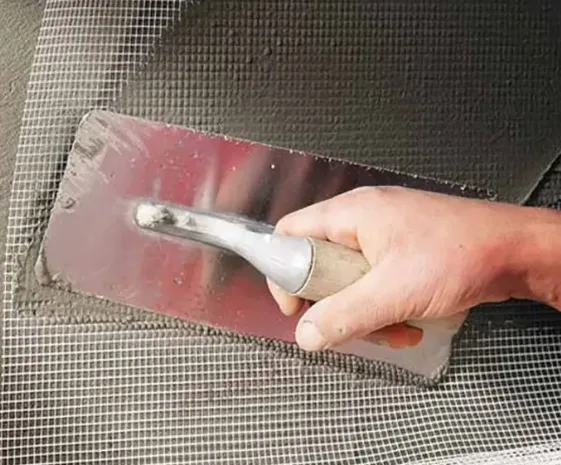
Fiberglass mesh for concrete is an open woven grid of glass filament, usually coated, embedded in a surface layer such as render, screed, repair mortar or an external insulation system. It is a genuinely useful product that is regularly sold for jobs it cannot do, so this article covers both.
What the mesh is
The mesh is woven from continuous glass strands into an open grid, typically 4×4 mm to 10×10 mm, with weights from about 60 to 360 g/m². It is then coated — usually with an alkali-resistant polymer — which does two jobs: it protects the glass from the alkaline environment of cement, and it stabilises the weave so the grid holds its geometry while being worked into a wet layer.
The coating is not cosmetic. Uncoated or poorly coated E-glass in contact with cement is progressively attacked at pH 12.5 to 13.5 and loses strength over years, the same mechanism described in ASTM C1666 for glass fibre in concrete.
What fiberglass mesh for concrete actually does
It reinforces a thin surface layer in tension, distributing stress so that shrinkage and movement produce many fine cracks rather than a few visible ones. It is crack-distribution reinforcement for a coating, not load-carrying reinforcement for a structure.
The applications where it works well:
External render and stucco over masonry or insulation
External thermal insulation composite systems, where the mesh is embedded in the base coat
Repair mortars and levelling layers over cracked substrates
Waterproofing systems, bridging joints and detail changes
Thin overlays where a substrate crack must not reflect through
In all of these the mesh is placed within a layer of a few millimetres to about 20 mm, positioned in the outer third where the tension is.
What it cannot do
This is where the product gets oversold. A surface mesh does not reinforce the body of a slab. It sits in one plane, within a thin layer, near the surface. It does nothing about tension at the bottom of a slab in bending, nothing about post-crack residual strength through a 150 mm section, and nothing about a load path.
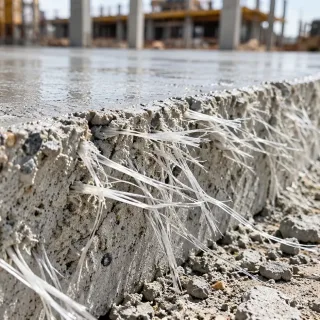
Laying fiberglass mesh for concrete on top of a slab before the pour, or into the surface of one, does not make it a fiber-reinforced slab and is not a substitute for either steel mesh or a macro fiber dose.
Mesh against a fiber dose
Fiberglass mesh | Macro synthetic fiber | |
|---|---|---|
Where it sits | One plane, near the surface | Through the full depth |
Layer thickness | A few mm to ~20 mm | Any structural section |
Role | Crack distribution in a coating | Post-crack residual strength |
Measured by | Tensile strength of the grid | ASTM C1609 residual load |
Using both
They are not competitors. A structure can perfectly well have a fiber-reinforced slab and a mesh-reinforced render on the walls above it. Use the mesh for what it is good at — thin surface layers — and a macro fiber dose for the concrete itself. The fiber range covers the grades, the applications guide covers dosage, and our technical desk will tell you plainly which of the two your detail actually needs.