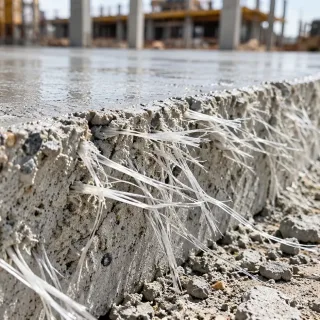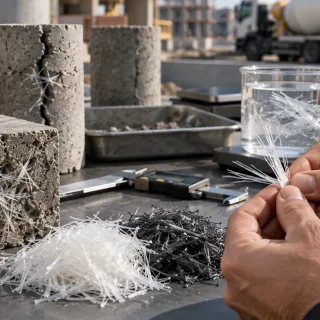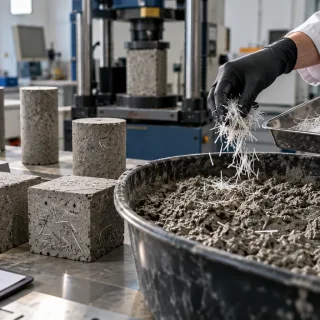
Polyester fiber in concrete appears in many low-cost fiber products, often at a price that looks attractive next to polypropylene. The mechanical data on a fresh specimen supports the price. The long-term chemistry does not, and that is the whole story of this material.
What polyester fiber is
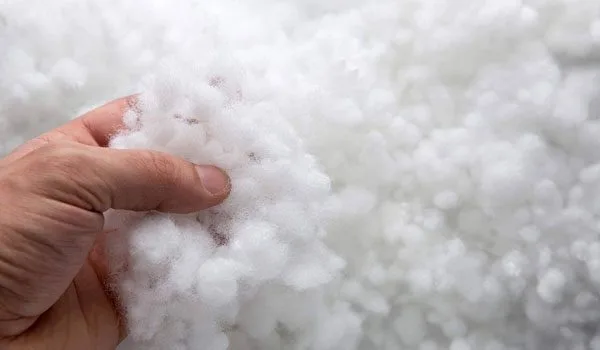
Polyester fiber for concrete is almost always polyethylene terephthalate, PET — the same polymer family as textile fibre and drink bottles. It is supplied as chopped monofilament or fibrillated bundles, in lengths from 6 to about 50 mm, and much of what reaches the construction market is recycled from textile or packaging streams.
Specific gravity is about 1.38, noticeably heavier than polypropylene's 0.91, so a kilogram contains fewer filaments and covers less of the mix.
The mechanical properties are genuinely good
Taken on its own, PET is a capable fibre. Tensile strength is high, elastic modulus is above polypropylene's, and the melting point is around 250-260°C, well above PP's. Bond to the matrix is adequate. If concrete were chemically neutral, polyester would be a reasonable reinforcing fibre and in some ways a better one.
Why polyester fiber in concrete degrades: alkali hydrolysis
Concrete is not neutral, and that is what limits polyester fiber in concrete. The pore solution in hardened cement sits at pH 12.5 to 13.5, and it stays there for the life of the structure.
Polyester is defined by ester linkages in its polymer backbone, and ester bonds hydrolyse under strongly alkaline conditions. The chain is progressively cut, molecular weight falls, and the filament loses tensile strength and becomes brittle. The process is slow, temperature-dependent and cumulative.
This is why polyester fiber in concrete tests well at 28 days and can be substantially degraded years later. A short-term strength test cannot detect a long-term hydrolysis mechanism, which is exactly what makes the material easy to sell and risky to specify.
Polypropylene is a polyolefin with no ester linkage to attack. It is inert in the pore solution and its tensile properties are effectively unchanged over the service life. Our article on polypropylene vs polyester fiber covers that comparison in full.
The recycled-content issue
Much cheap polyester fibre is recycled. That brings a second problem independent of chemistry: inconsistent filament diameter and length, unknown additive and dye history, and variable surface condition. Dispersion and bond then vary from batch to batch, which is difficult to design around and impossible to certify.
Where polyester fiber is acceptable
Being fair to the material: there are applications where the hydrolysis mechanism has time to be irrelevant.
Non-structural screeds and renders with a short design life
Temporary works
Low-alkalinity or polymer-modified systems
Products where the fibre serves a processing purpose rather than a permanent reinforcing one
What it should not be used for is permanent structural crack control in ordinary Portland cement concrete, which is precisely the application it is most often sold into.
What to ask a supplier
If polyester or a blended fibre is offered, ask for long-term alkali resistance data in a cementitious environment — retained tensile strength after extended exposure at high pH, not a fresh tensile figure. Ask whether the polymer is virgin or recycled. And ask which class it is declared under in ASTM C1116 or EN 14889-2.
Every grade in the Polyguard fiber range is 100% virgin polypropylene, with no polyester and no recycled polymer in any grade. The standards page lists the classification and governing test for each, and our technical desk will send the long-term test documentation for the grade your specification names.