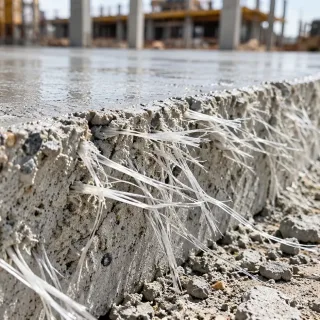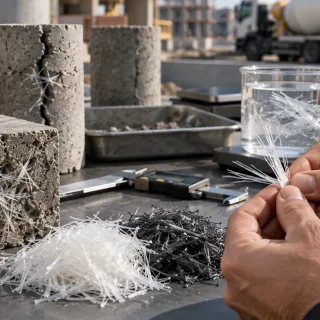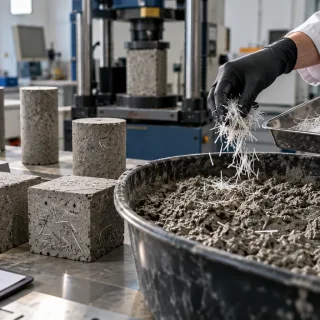
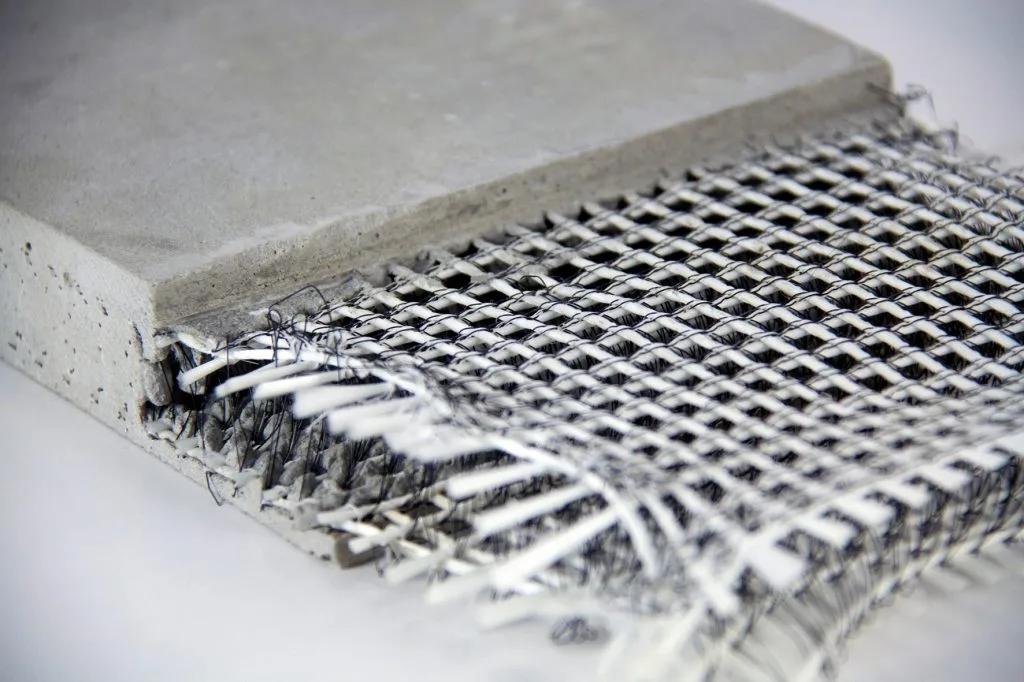
Polyethylene fiber reinforced concrete occupies an unusual position: it produces the most impressive laboratory behaviour of any fiber concrete, and it is used on very few ordinary projects. Both facts have the same cause.
What polyethylene fiber is
The material that matters here is ultra-high-molecular-weight polyethylene, UHMWPE. Its molecular chains are extremely long and, once drawn, highly aligned, which gives tensile strengths in the range of 2,500 to 3,500 MPa — several times that of standard polypropylene macro fiber — at a specific gravity below 1.0.
Ordinary low- and high-density polyethylene is not a structural reinforcing fibre and should not be confused with UHMWPE.
Why it behaves differently: strain hardening
Conventional fiber concrete is strain-softening. After first crack the load the element carries drops, and the fibers limit how far it drops. That residual capacity is the entire engineering benefit.
With a high enough dosage of very strong, well-bonded fine fibre, the behaviour inverts. The section carries more load after first crack than before it. Instead of one crack widening, load transfers along the fibres and forces new cracks to form elsewhere, producing dozens of very fine cracks rather than a few wide ones.
Materials designed to do this are called engineered cementitious composites, ECC, sometimes described as bendable concrete. Polyethylene fiber reinforced concrete and PVA-fibre ECC are the two main routes to it. Tensile strain capacity can reach 3 to 5 percent — hundreds of times that of plain concrete.
Why polyethylene fiber reinforced concrete is rare on site
Cost. UHMWPE fibre costs many times what polypropylene costs per kilogram, and ECC mixes need high fibre volumes, typically around 2 percent by volume. The material cost per cubic metre is not comparable to ordinary fiber concrete.
Mix design sensitivity. Strain hardening only appears within a narrow window of fibre bond, matrix toughness and flaw distribution. ECC mixes usually require fine aggregate only, high binder content and tight quality control. A batching plant set up for ordinary structural concrete cannot simply add the fibre and obtain the behaviour.
Workability. High fibre volumes of fine filament make a stiff, cohesive mix that needs specific placing methods.
Design guidance. Codified guidance is thinner than for steel and macro synthetic fibre, so approval takes longer.
Where it is genuinely used
Seismic retrofit and energy-dissipating structural elements
Bridge deck link slabs, replacing expansion joints
Repair overlays where crack width control is critical
Impact and blast resistant elements
Research and demonstration structures
These share a pattern: high value, small volume, and a performance requirement that ordinary reinforcement cannot meet.
The practical comparison
For a slab on grade, an industrial floor, a tunnel lining or a precast panel, macro synthetic polypropylene at 3 to 7 kg/m³ delivers the residual strength the design needs, measured under ASTM C1609, at a cost the project can carry, in a mix any plant can batch. That is why it, and not polyethylene, is the industry standard for those elements.
Polyethylene fiber reinforced concrete is the right answer to a narrow and demanding question. It is the wrong answer to a warehouse floor.
If your project genuinely needs strain-hardening behaviour, say so and we will tell you plainly that our range is not the material for it. For everything else, the fiber range and the applications guide cover the grade and dosage, and our technical desk will design the dose against your element and loading.