The concrete reinforcing fiber types in use today share one mechanism and differ in almost everything else. This article sorts the families, gives realistic dosages, and says which is right for which element.
The one thing they share
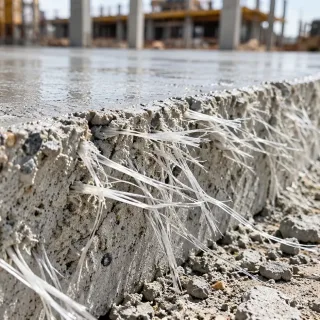
All the concrete reinforcing fiber types below rest on the same physics. Plain concrete is about ten times weaker in tension than in compression. When the tensile capacity is exceeded the section cracks and loses that capacity. Every concrete reinforcing fiber works the same way: filaments crossing the crack are anchored on both sides, so as it opens they carry load across it and the element retains a measurable residual strength.
What differs between the families is stiffness, density, chemical durability and cost — and those differences decide the application.
Macro synthetic fiber
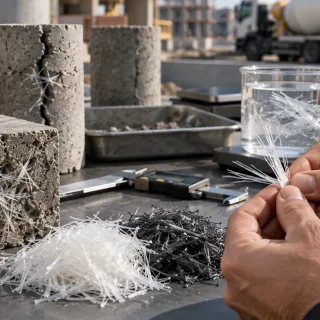
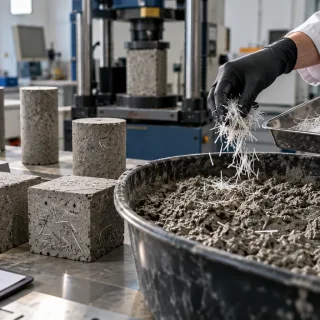
Polypropylene filaments 40 to 54 mm long, embossed or shaped for mechanical anchorage, dosed at 3 to 7 kg/m³. Classified as Class II under EN 14889-2, which is the class permitted to be counted as contributing to load-bearing capacity.
Chemically inert, so no corrosion and no rust bleed; where it replaces the steel entirely, there is no reinforcement for the cover to protect. This is the default for slabs on grade, industrial floors, sprayed linings and precast, and it is the family the rest of this site covers in detail.
Micro synthetic fiber
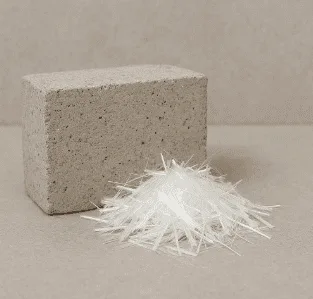
Fine monofilament, 6 to 18 mm, dosed at 0.6 to 1.2 kg/m³. Class Ia under EN 14889-2. It controls plastic shrinkage cracking in the first hours after placing and provides fire spalling protection by melting and relieving vapour pressure.
It is not specified to provide structural post-crack residual capacity. A specification naming Class II macro fiber will not accept Class Ia micro fiber, and vice versa — the two are dosed together where a mix needs both, never substituted.
Steel fiber
Drawn wire, 30 to 60 mm, dosed at 20 to 45 kg/m³. The highest residual strength available at high dosage, because steel's elastic modulus far exceeds any polymer's. The cost is corrosion at any crack reaching the surface, sharp protruding filaments in finished slabs, high rebound in shotcrete, and much heavier logistics. Covered fully in our article on steel fiber for concrete.
Glass fiber
Used mainly in thin architectural sections and glass-fibre reinforced concrete panels rather than as bulk reinforcement. Ordinary E-glass is attacked by the alkaline pore solution, so alkali-resistant grades to ASTM C1666 are required for any permanent application. Excellent for surface finish and detail; not a structural crack-control fiber for slabs.
Natural and other fibers
Cellulose, basalt and various natural fibers appear in research and in some niche products. Cellulose has genuine use in plastic shrinkage control. Basalt is chemically durable but not widely covered by design guidance. Neither is a mainstream choice for the applications this site deals with.
Choosing between the concrete reinforcing fiber types
Element | Sensible choice |
|---|---|
Slab on grade, industrial floor | Macro synthetic, 3-7 kg/m³ |
Sprayed lining, tunnel, slope | Macro synthetic, low rebound |
Precast and facade units | Macro synthetic, no rust bleed |
Plastic shrinkage control only | Micro monofilament |
Fire spalling protection | Micro polypropylene |
Very high residual strength, buried | Steel fiber |
Thin architectural panels | Alkali-resistant glass |
Specifying it properly
Name the performance, not the brand: the fiber class under EN 14889-2 or the type under ASTM C1116, the test method, and the residual strength required at a stated deflection. The standards page explains how those fit together, and the applications guide gives dosage and mixing detail per element.
Send us the element, thickness, exposure and loading and we will return a dosage and a free sample for trial batching. The dosage and cost calculators price that dose against a mesh layer with your own rates.