Decorative mortar is a thin cementitious or polymer-modified finish applied to walls, floors and facades where the surface itself is the architectural product. It is a coating rather than a structural layer, which changes what can go wrong with it and how it is reinforced.
What it is
The base is cement, fine graded aggregate, pigments and a polymer binder, with rheology admixtures that let it be trowelled, sprayed or floated to a controlled texture. Thickness ranges from under a millimetre for a micro-cement finish to 15 or 20 mm for a heavy textured render.
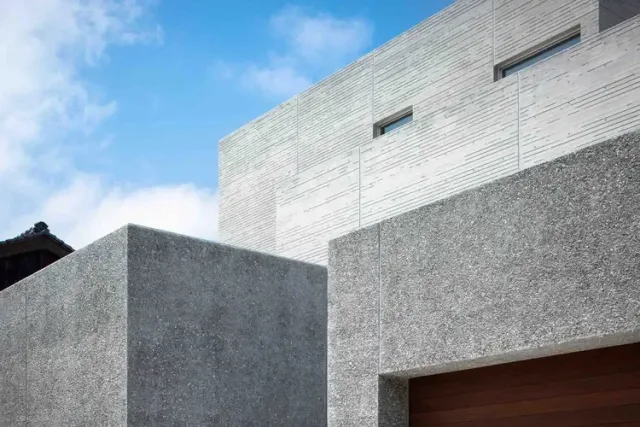
What separates it from ordinary render is that the finish is the point. Colour, texture and the absence of visible cracking are the specification.
Types of decorative mortar
Mineral renders. Cement and lime based, breathable, dimensionally stable, tested for adhesion and durability to standards such as ASTM C1329, well suited to masonry and to historic work where vapour permeability matters.
Acrylic and polymer-modified. Higher polymer content gives better adhesion and flexibility and a wider colour range, at the cost of some breathability. The common choice on insulated facades.
Micro-cement and microtopping. Very fine, applied in coats under a millimetre, giving a seamless jointless surface on floors and walls. Popular in interiors and extremely unforgiving of substrate movement.
Textured and stamped finishes. Heavier build, worked while plastic to give relief, stone effects or exposed-aggregate appearance.
Where it is used
External facades, on masonry or over insulation systems
Interior feature walls and seamless floors
Restoration work matching historic finishes
Retail and hospitality interiors where a jointless surface is wanted
Refurbishment, covering a tired substrate without demolition
The one failure mode that matters
Almost every complaint about decorative mortar is cracking, and almost all of it comes from three causes rather than from the material itself.
Substrate movement reflecting through. A crack or joint in the base will telegraph into a thin finish unless something distributes the stress across it.
Drying shrinkage restrained by the substrate. The finish contracts as it cures while bonded to something that does not.
Thermal cycling. Solar gain on a facade drives daily expansion and contraction the finish must accommodate.
None of these are load problems, which is why structural reinforcement is irrelevant here and crack-distribution reinforcement is everything.
Reinforcing a thin finish
Two tools, used together on demanding work.
An alkali-resistant glass grid embedded in the base coat holds the two sides of a crack together and stops substrate cracks reflecting through — covered in our article on fiberglass mesh for concrete. It must sit in the outer part of the layer, not on the substrate.
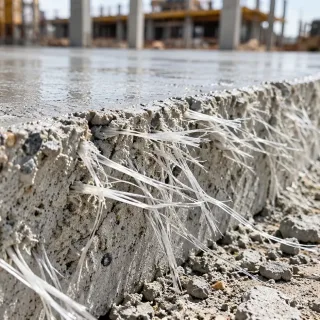
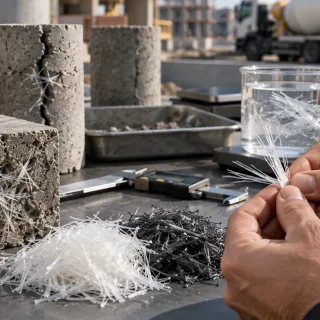
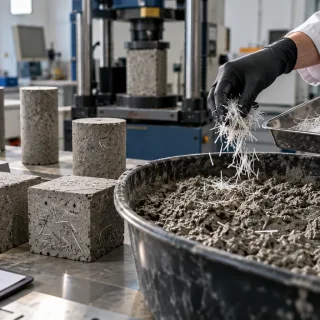
Micro polypropylene fiber dosed into the mix controls the plastic shrinkage cracking that happens in the first hours, before a mesh is contributing anything. Because the filaments are dispersed there is no position to get wrong, and at the fine deniers used in renders they do not show on the finished surface.
Getting it right
Prepare and prime the substrate, keep coat thickness within the manufacturer's range, do not chase movement joints across the finish, and protect it from sun and wind while it cures. Then reinforce for crack distribution rather than for strength.
The Polyguard fiber range includes the micro monofilament grade used in renders and mortars, and our technical desk will recommend a dose for your mix and thickness.