In a precast yard the reinforcement question is not the one a structural engineer usually asks. The precast concrete rejection rate is set by units that were never overloaded in service — they were damaged during demoulding, stacking, transport or lifting. A macro fiber dose is aimed squarely at that, and the commercial case is a loss rate rather than a load capacity.
What the precast concrete rejection rate is actually made of
Demoulding. The unit is young, its strength is at its lowest, and it is being pulled out of a mould with suction on one face. Thin sections and detailed profiles crack here more than anywhere else.
Handling and stacking. Support points during storage are rarely the support points in the design, so the unit sees bending in directions it was never checked for.
Transport. Road vibration and dynamic loads on a unit restrained at two points.
Lifting and installation. Lifting stresses, wind, and the moment before the unit is fixed.
Conventional reinforcement is sized for the in-service condition. It is often doing very little at the moment the damage happens.
How fiber reinforced precast concrete answers it
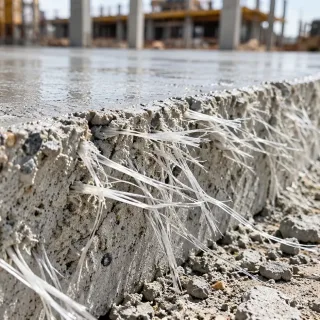
Macro synthetic fiber is distributed through the whole section, so it is present at every face and edge — including the thin ribs, returns and arrises where mesh cannot practically be placed and where handling damage starts.
Once a microcrack forms, filaments crossing it carry load across it, so the crack stays tight instead of propagating. In a demoulding event that is the difference between a hairline the yard accepts and a crack that rejects the unit.
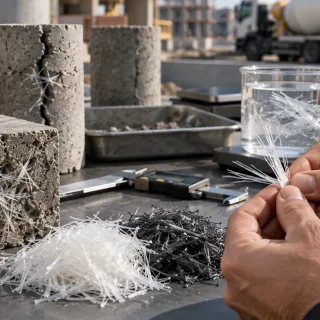
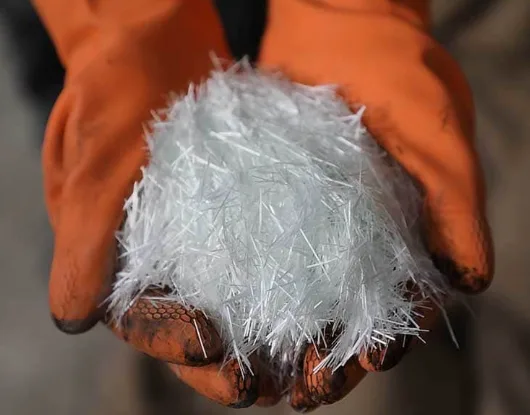
Typical dosage for precast and facade work is 2 to 5 kg/m³ of a 40 mm macro grade, and the performance is measured under ASTM C1609.
No rust bleed on an exposed face
For architectural precast this is often the decisive argument. Steel near the surface of a facade panel rusts wherever a crack or a thin cover lets moisture in, and the stain appears on the visible face of a building that may have been sold on its appearance. Polypropylene is chemically inert in the pore solution and has no corrosion mechanism at all, so fiber reinforced precast concrete stays clean for the life of the building.
The same property removes the cover requirement, which is what makes genuinely thin sections practical.
What changes in production
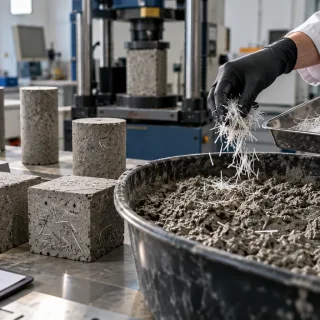
Less than most yards expect. Fiber is added at the batching plant and mixed at full speed for the specified time. There is no mesh to cut, no cages to fabricate for non-structural units, no cover blocks to position, and no reinforcement store to manage.
The usual adjustment is workability: the mix will need checking on a trial batch, and that is exactly what a trial is for. We attend the first trial, check dispersion and adjust with the mix designer.
What it does not replace
Fiber reinforced precast concrete does not change this: structural precast — beams, hollowcore, columns, load-bearing wall panels — keeps its designed reinforcement and prestressing. Fiber addresses handling and crack control, not calculated bending capacity. Any supplier suggesting otherwise for a structural unit is not worth listening to.
Measuring whether it worked
The number to watch is the precast concrete rejection rate per production run, before and after, on the same unit type. That is a figure a yard already tracks, and it is the honest test of whether the dose paid for itself.
Send us the unit type, section thickness, demoulding age and handling sequence and we will return a dosage with a trial-mix plan and a free sample. The cost calculators set that dose against your own rates. See the precast and facade page, the fiber range, and the standards page for classification and test detail.