Thermal fiber mesh is the term used for reinforcement placed in layers that move because of temperature rather than load: underfloor heating screeds, insulation base coats, and toppings exposed to daily thermal cycling. The reinforcement question there is genuinely different from a structural slab, which is why it has its own name.
Why thermal movement cracks a layer
Concrete and screed expand and contract with temperature at roughly 10 microstrain per degree Celsius. Over a 30 metre bay a 20°C swing is about 6 mm of movement. If that movement is restrained — by the substrate, by a bonded edge, by a doorway — the restraint turns into tension, and tension cracks the layer.
An underfloor heating screed is the clearest case. It is heated from within, cycles daily through the heating season, is usually thin, and is often laid over insulation that gives it very little to hold on to. It is a layer designed to move, on a base that resists it.
What thermal fiber mesh does about it
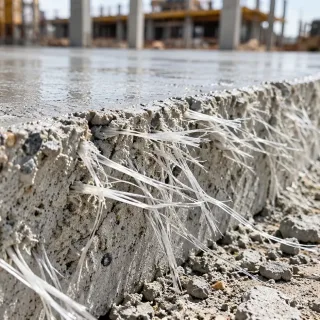
The mesh does not stop the movement, and nothing will. It distributes the resulting tension so the layer cracks in many fine cracks instead of a few wide ones, and it holds the two sides of each crack together so the screed stays a continuous plate rather than separate islands.
Typical products are woven glass grids with an alkali-resistant coating, or welded polymer grids, in weights around 60 to 160 g/m². The coating matters: uncoated E-glass is attacked by the alkaline pore solution of cement, the mechanism covered in ASTM C1666.
Where it is used
Underfloor heating screeds, laid above the pipes in the upper part of the screed
Bonded and unbonded toppings over insulation
External insulation base coats on facades exposed to solar gain
Thin repair overlays where a substrate crack must not reflect through
Roof screeds and terraces with large daily temperature swings
Position matters more than product
The most common failure with thermal fiber mesh is not the wrong mesh, it is the right mesh in the wrong place. A grid lying on the insulation at the bottom of a screed does almost nothing: the tension is in the upper part of the section. It should sit in the upper third, above the heating pipes, held there while the screed is placed — not thrown down and walked on.
This is exactly the weakness a dispersed fiber dose does not have, because there is no position to get wrong.
Mesh or fiber for a heated screed?
Both work, and they work differently.
A mesh holds a large plate together across a crack and is the traditional answer for a big continuous bay — the calculators will price either option with your own rates. A micro or macro synthetic fiber dose is distributed through the full depth, cannot be misplaced, and additionally controls the plastic shrinkage cracking that happens in the first hours — before any heating is switched on and before a mesh is doing anything at all.
For most heated screeds the practical answer is a fiber dose for early-age and distributed crack control, with movement joints at the correct spacing doing the real work of accommodating thermal movement. No reinforcement of either kind substitutes for joints in the right places.
Specifying it
Give us the screed thickness, the bay size, whether it is bonded, floating or heated, and the expected temperature range. We will return a dosage and grade, or say plainly that a mesh is the better answer for that detail. The fiber range lists the grades and the applications guide covers mixing and placing.