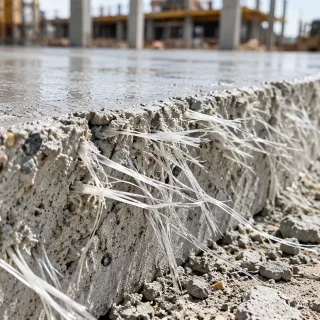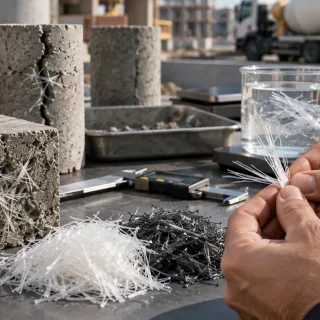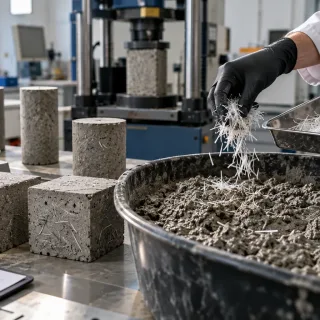
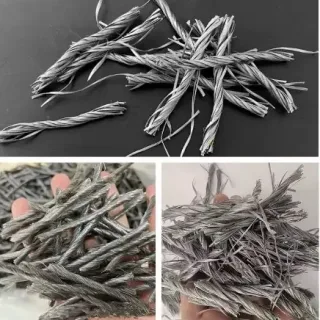
Synthetic fibers are not one product with one behaviour. Micro fibers are dosed to control early-age cracking and, in the right grade and dosage, can help reduce explosive-spalling risk in fire; Class II macro fibers are engineered to give measurable post-crack capacity in work such as industrial floors, shotcrete and some precast units. Choosing the wrong group is the most common buying mistake.
Ask about synthetic fiber uses in concrete and you will get two unhelpful answers: a list of everything, or a claim that it replaces reinforcement. Neither is true. This article separates the applications where it is now standard practice from the ones where it is not the right material.
What it actually does
Plain concrete carries tension until the matrix reaches its limit, then cracks and loses that section. Add macro synthetic fiber and the behaviour after first crack changes: filaments crossing the crack are anchored on both sides and transfer load across it, so the element keeps a measured residual capacity.
That residual capacity, measured under ASTM C1609, is the entire engineering benefit. Everything below follows from it.
Synthetic fiber uses in concrete that are standard practice
Slabs on grade and industrial floors. The largest application. A fiber dose at 3 to 7 kg/m³ replaces a crack-control mesh layer where the design allows, and removes an entire trade from the critical path before the pour.
Sprayed concrete. Tunnel linings, slope stabilisation and mine support. Mesh fixing overhead is slow and dangerous; fiber is dosed at the mixer.
Precast and facade units. Thin sections that must survive demoulding, stacking and lifting. No corrosion means no rust bleed on an exposed architectural face.
Water-retaining and marine works. Chloride and sulfate exposure, where steel needs cover it frequently does not get.
Asphalt. A short fiber dosed at the plant to resist rutting and reflective cracking — see the asphalt page.
Fire-rated concrete. Micro polypropylene melts early and can help reduce explosive-spalling risk by creating additional pathways for vapour-pressure relief; suitability and dosage depend on the mix and the fire design.
Typical dosage
Application | Fiber | Dosage |
|---|---|---|
Industrial floor, slab on grade | Macro, 54 mm | 3-7 kg/m³ |
Shotcrete, tunnel | Macro, 48 mm | 4-9 kg/m³ |
Precast, facade | Macro, 40 mm | 2-5 kg/m³ |
Asphalt | Short, 20 mm | 0.05-0.3% by mass |
Plastic shrinkage, fire | Micro, 6-18 mm | 0.6-1.2 kg/m³ |
These are starting points. The real dose comes from the element thickness, exposure class and loading — see the applications guide.
Where it is not the answer
Being clear about this is more useful than a longer list of benefits.
Designed structural reinforcement. Beams, suspended slabs, columns, anything carrying calculated bending moments. Synthetic fiber replaces crack-control reinforcement, not structural steel.
Very high residual strength requirements. Where a buried, unexposed element needs performance beyond what a practical polymer dosage delivers, steel fiber remains the right material.
Compensating for other defects. None of the synthetic fiber uses in concrete above fix a poor mix, an unprepared subgrade, joints in the wrong place or inadequate curing.
Micro and macro are not interchangeable
Micro monofilament is Class Ia under EN 14889-2 and controls early-age cracking. Macro fiber is Class II and may be counted in a design. A specification naming one will not accept the other. The standards page sets out the classification and the governing test for each grade.
Send us the element and loading and we will return a dosage, a grade and a free sample — or tell you plainly that fiber is not the right answer for that element. The cost calculators price the dose against a mesh layer with your own rates.