
Polypropylene is the most widely used polymer in concrete reinforcement, and the reason is narrow: it is chemically inert in the cement pore solution, it is light enough to disperse well, and it melts at the right temperature for fire protection. This article sets out the polypropylene fiber applications that matter on real projects, with the grade and dosage for each.
First, the two families
Almost every mistake in this area comes from treating micro and macro fiber as one product.
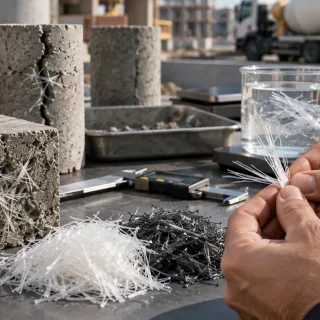
Micro monofilament is 6 to 18 mm, dosed at 0.6 to 1.2 kg/m³, and classified Class Ia under EN 14889-2. It controls plastic shrinkage cracking and provides fire spalling protection. It is not specified to provide structural post-crack residual capacity.
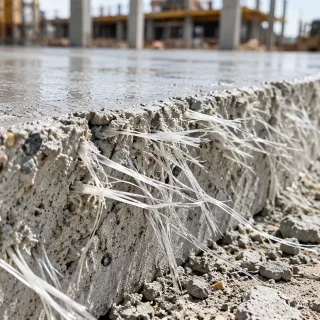
Macro fiber is 40 to 54 mm, embossed or shaped for anchorage, dosed at 3 to 7 kg/m³, Class II. It delivers measurable post-crack residual strength under ASTM C1609, which is what allows it to replace a crack-control mesh layer.
A specification naming one will not accept the other. Where a mix needs both behaviours they are dosed together.
Industrial floors and slabs on grade
The largest single application. Racking legs and forklift wheels apply concentrated loads all day, and a mesh layer sitting in one plane only reinforces where it happens to be. Macro fiber at 3 to 7 kg/m³ is distributed through the full depth and works wherever the crack forms.
The commercial case is installed cost rather than material cost: the mesh, the cutting, hauling, tying and chairs, and the programme days before the pour can start. Details on the industrial flooring page.
Shotcrete, tunnels and slope stabilisation
Fixing mesh overhead is the slowest and least safe part of a tunnelling cycle. Fiber goes in at the mixer, so the lining is reinforced the moment it leaves the nozzle. Polypropylene also produces lower rebound and less nozzle wear than steel fiber, which is why sprayed concrete has moved substantially in this direction. Specifications here are usually written in joules of energy absorption from the ASTM C1550 round panel test. See shotcrete and tunnel.
Precast and architectural units
Thin sections have to survive demoulding, stacking, transport and lifting — a sequence of handling stresses that has nothing to do with the in-service load. Because polypropylene cannot corrode, facade panels stay free of rust bleed for the life of the building, which is often the reason it is specified over steel fiber for exposed work.
Asphalt and pavement
A shorter fiber, around 20 mm, dosed at the asphalt plant at 0.05 to 0.3 percent by mass. It holds the binder film and resists rutting and reflective cracking on heavily loaded surfaces: bus lanes, port aprons, industrial yards.
Fire-rated concrete: polypropylene fiber applications nothing else covers
One of the polypropylene fiber applications where nothing else does the job as simply. In a fire, free water in the concrete turns to vapour faster than it can escape, and the section spalls explosively. Micro polypropylene melts at around 160-170°C, leaving capillary channels that relieve the pressure before damage occurs. This is one of the mitigation methods recognised in Eurocode 2 Part 1-2 for tunnel and structural concrete.
Water-retaining and marine structures
Tanks, canals, treatment plants and jetties expose reinforcement to chloride and sulfate. Polypropylene is inert to both, so there is no corrosion mechanism and, where no steel remains in the section, no reinforcement for the cover to protect. Covered on the water structures page.
Choosing the dose
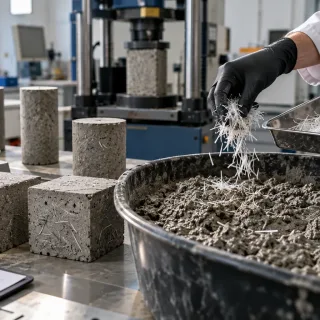
Across all of these polypropylene fiber applications the input is the same: element thickness, subgrade, exposure class and loading. From those we calculate the residual strength the design needs and return a dosage in kg/m³ with the matching grade, plus a free sample for trial batching before any production order.
The fiber range lists the six grades, and the standards page explains the classification and governing test for each. To price a dose against a mesh layer with your own rates, use the dosage and cost calculators, or send us the element and loading for a designed dosage and a free trial sample.