Steel fiber for concrete is the oldest of the fiber reinforcement families and still the benchmark that synthetic fiber is measured against. This article covers what it is, where it genuinely outperforms, and where the industry has moved away from it — written by a manufacturer of the competing product, so the limits of our own material are stated too.
What steel fiber is
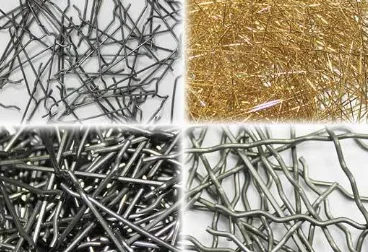
Steel fibers are short lengths of drawn wire, typically 30 to 60 mm long, with hooked ends, crimped profiles or flattened sections that anchor them into the cement matrix. Dosages usually run from 20 to 45 kg/m³ — an order of magnitude heavier than synthetic fiber, because steel's specific gravity is about 7.85 against polypropylene's 0.91.
The mechanism is identical to synthetic macro fiber: once the concrete cracks, fibers bridging the crack transfer load across it, so the element keeps residual capacity. What differs is the stiffness, the density and the corrosion behaviour.
Where steel fiber for concrete genuinely wins
High residual strength at high dosage. Steel has a much higher elastic modulus than any polymer. Where a design demands very high post-crack strength — heavily loaded industrial floors, some tunnel linings, precast segments carrying real structural load — steel fiber reaches performance levels that synthetic fiber cannot match at a practical dosage.
Established design codes. Steel fiber has a longer history in design guidance, and some authorities' documents are still written around it. If a specification names steel fiber and the checking engineer will not accept an equivalent, that settles the question regardless of the technical merits.
Very thick sections. Here steel fiber for concrete keeps its edge: In mass concrete and heavy segments, the weight penalty matters less and the stiffness advantage matters more.
Where it loses
It corrodes. This is the decisive limitation. Any fiber intersecting a crack at the surface is exposed to water, chloride and carbonation. The result is rust staining on exposed faces, and in aggressive exposure a progressive loss of the reinforcing filament itself. On water-retaining structures, marine works, treatment plants and anything with an architectural finish, this rules it out.
Surface safety and finishing. Steel fibers protruding from a finished slab are sharp. They cut hands and tyres, they complicate power floating, and they make the surface unpleasant to work on. Contractors dislike them for good reason.
Handling and logistics. At 20 to 45 kg/m³ against 3 to 7 for macro synthetic, the tonnage moved per pour is very different. Steel fiber also balls more readily at the mixer if dosing is careless.
Pump and spray behaviour. In shotcrete, steel fiber causes higher rebound and more nozzle wear than synthetic. This is why tunnel and sprayed concrete work has moved substantially toward macro synthetic.
How the two are measured
Both are judged by the same tests, which makes an honest comparison possible. ASTM C1609 loads a beam past first crack and records the residual load at defined deflections. For sprayed concrete, ASTM C1550 measures energy absorption on a round panel, and tunnel specifications are commonly written in joules from that test.
Ask for the curve, at the dosage you intend to use, for whichever material is offered. A general claim without a test report is not a comparison. Our standards page sets out which test governs which application.
Choosing between them
A reasonable rule: if the design needs very high residual strength and the element is buried, unexposed and not in aggressive conditions, steel fiber remains a legitimate choice. If the concrete is exposed, architectural, in contact with water or chloride, sprayed overhead, or finished by hand, macro synthetic is the better engineering answer and usually the cheaper installed one.
For the installed-cost side of the same decision, the fiber cost calculators price a fiber dose against a mesh layer with your own rates. Where the requirement sits between the two, send us the specification clause. We will tell you plainly whether a Polyguard grade meets it — or that steel fiber is the right material for that element and we are not the supplier for it.