Reinforcing concrete with fibers means distributing millions of short filaments through the mix so that reinforcement exists everywhere in the pour rather than in one plane. It is not a new idea, but the materials have changed enough in the last two decades that the economics are now different from what most specifiers remember.
The mechanism, in one paragraph
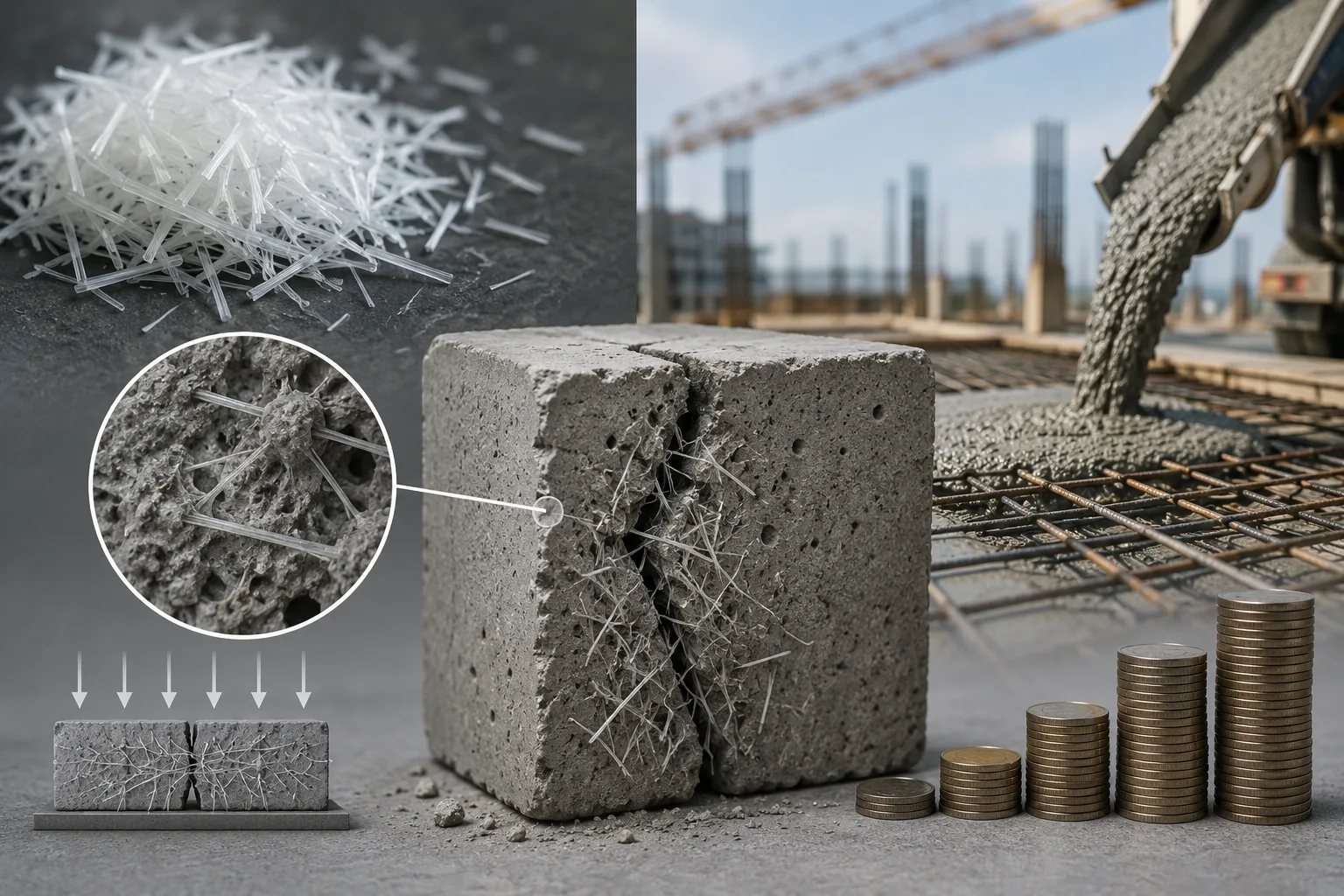
Plain concrete carries load until the tensile capacity of the matrix is reached, then splits and loses that section. Add macro synthetic fiber and the behaviour after first crack changes: filaments crossing the crack are anchored in the concrete on both sides, so as the crack opens they stretch and transfer load across it. The element keeps a defined residual capacity. This post-crack capacity is the entire engineering case for reinforcing concrete with fibers.
Micro versus macro: not interchangeable
Two families exist and a specification that names one will not accept the other.
Micro fiber is fine monofilament, typically 6 to 18 mm, dosed around 0.6 to 1.2 kg/m³. It controls plastic shrinkage cracking in the first hours and improves fire spalling behaviour. It is not specified to provide structural post-crack residual capacity.
Macro fiber is a structural filament, 40 to 54 mm, embossed or shaped to anchor into the matrix, dosed at 3 to 7 kg/m³. Under ASTM C1609 it delivers measurable residual strength, which is what permits it to replace crack-control mesh where the design allows.
Where a mix needs both, the two are dosed together rather than substituted for one another.
Where reinforcing concrete with fibers fits
The applications where reinforcing concrete with fibers is standard practice, not an experiment:
Industrial floors and slabs on grade carrying racking and forklift traffic
Sprayed linings in tunnels and slope stabilisation, where fixing mesh overhead is the slowest and least safe part of the cycle
Precast and architectural units that must survive demoulding, stacking and lifting
Pavements and hardstandings, including asphalt layers with a fiber dosed at the plant
The applications guide covers the dosage and mixing detail for each of these.
The economics, honestly
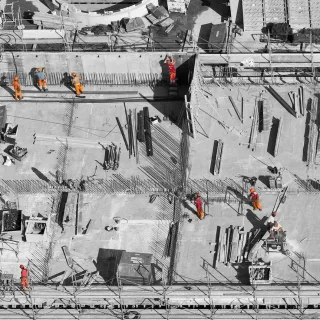
Fiber almost never wins on material cost per cubic metre alone. It wins on installed cost, and only when you count the whole package: the mesh itself, cutting, hauling, placing, tying, chairs, the labour standing on the slab, the crane time, and the programme days lost while all of that happens before the pour can start.
On a slab on grade the removal of a mesh layer typically takes a day or more off the cycle and removes a trade from the critical path. On a tunnel lining the effect is larger, because mesh fixing overhead is both slow and the highest-risk activity in the sequence.
Two secondary effects matter on long-life assets. Synthetic fiber does not corrode, so there is no rust bleed on exposed faces and, where no steel remains in the section, no reinforcement for the cover to protect. And the reinforcement cannot be misplaced, because there is no placement step to get wrong.
Run the numbers with your own rates in the cost calculators rather than trusting a general claim.
The limits
Synthetic fiber is not a replacement for designed structural reinforcement. Beams, suspended slabs, columns and anything carrying calculated bending moments still need steel. The standards page sets out which class of fiber may be counted in a design and which may not. Fiber replaces crack-control reinforcement, not structural reinforcement, and any supplier who blurs that line is not doing you a favour.
Tell us the element, thickness, exposure and loading and we will come back with a dosage, a grade and a trial-mix plan — or say plainly that fiber is not the right answer for that element.