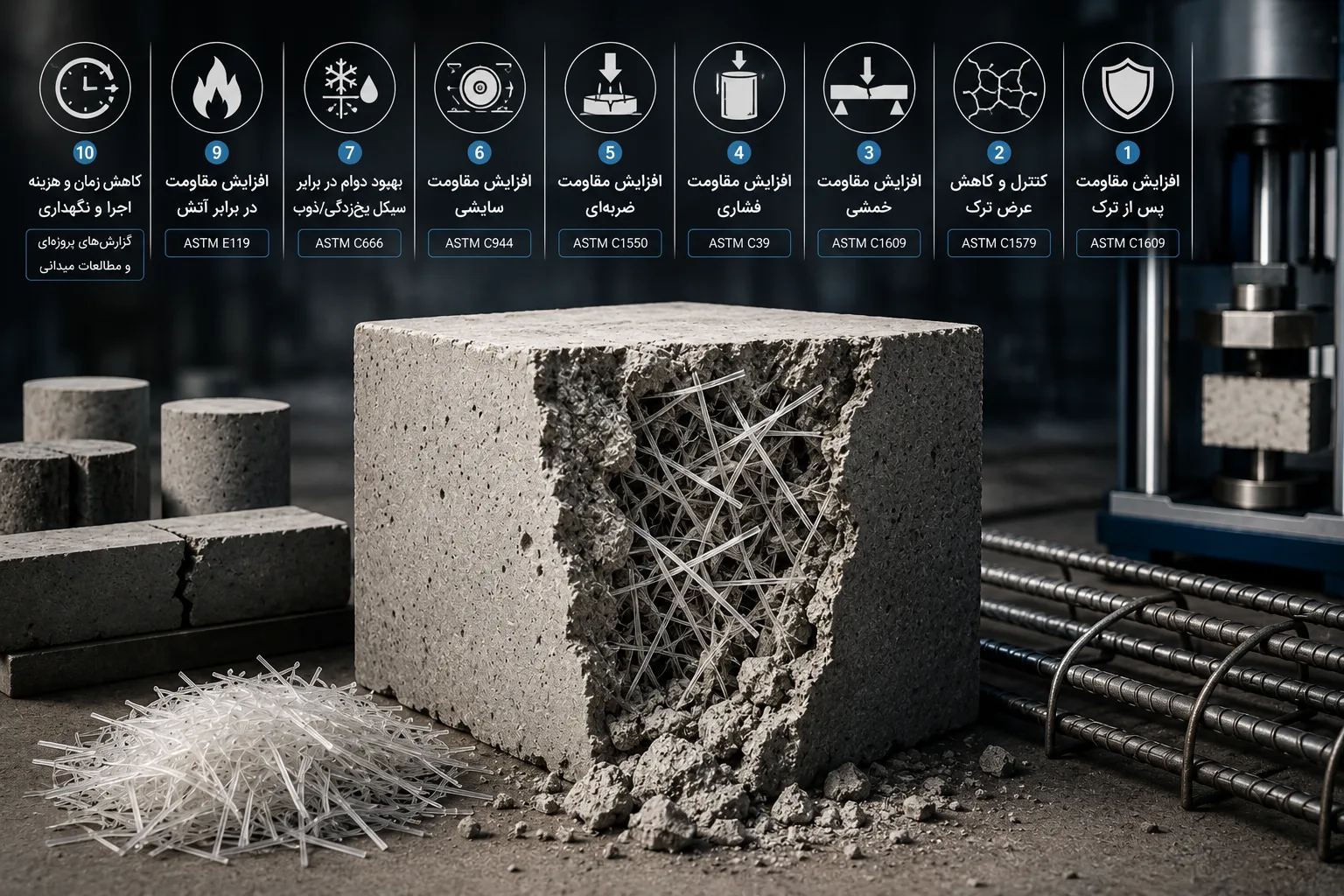
Most lists of the benefits of synthetic fiber in concrete are marketing. This one names the test method or the site mechanism behind each claim, and ends with the things fiber does not do.
1. Measurable capacity after the crack
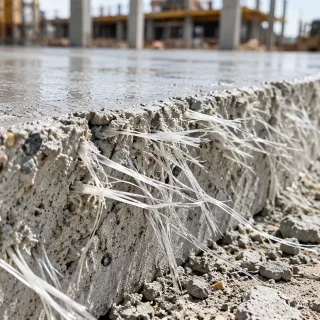
The central item on any honest list of the benefits of synthetic fiber. Under ASTM C1609 a beam is loaded past first crack and the load it still carries is recorded at defined deflections. That residual strength is what lets a fiber dose replace a crack-control mesh layer. Ask any supplier for this curve for the grade and dosage you are considering.
2. It cannot corrode
Polypropylene is chemically inert to chloride and sulfate. There is no rust, so no expansive corrosion product forcing the cover off, and no rust bleed staining an exposed face. On water-retaining structures, marine works and architectural facades this is the benefit that decides the specification.
3. No steel cover to get wrong
Steel needs cover it frequently does not get. Where fiber replaces the steel entirely, there is no reinforcement for the cover to protect; where steel remains, its cover requirement is unchanged. The reinforcement cannot be misplaced, walked down during the pour, or left short at an edge.
4. Reinforcement through the full depth
Mesh sits in one plane. Fiber is distributed through the whole section, so it acts wherever the crack forms rather than only where the sheet happens to be.
5. Early-age crack control
Micro monofilament at 0.6 to 1.2 kg/m³ reinforces the surface during the first hours, when the concrete has almost no tensile strength and plastic shrinkage cracking happens.
6. A trade off the critical path
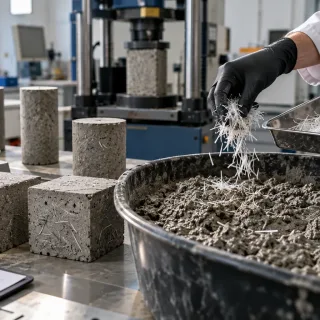
The mesh sequence — cut, haul, place, tie, chair — happens before the pour can start. Fiber goes in at the batching plant. On a tunnel lining, where mesh is fixed overhead, this is also the single largest safety improvement available.
7. Fire spalling behaviour
Polypropylene micro fiber is widely specified as one mitigation measure against explosive spalling in fire-exposed tunnel and structural concrete, and is one of the methods recognised in Eurocode 2 Part 1-2. The fiber melts and leaves capillary channels that relieve vapour pressure.
8. Lower permeability in service
Narrower, better-distributed cracking means fewer pathways for water and aggressive ions. On a tank or a canal lining that translates directly into service life.
9. Simpler logistics
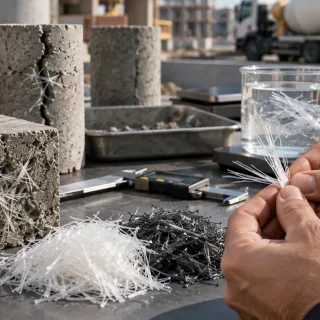
Fiber arrives in bags and is dosed at the plant. No storage yard for mesh sheets, no offcuts, no crane time, no waste to remove.
10. Lower installed cost, when counted properly
Fiber rarely wins on material cost per cubic metre. It wins when the mesh, the labour, the plant, the waste and the programme days are all in the comparison. The cost calculators run that comparison with your own rates.
Limits on the benefits of synthetic fiber
It does not replace designed structural reinforcement in beams, suspended slabs or columns. It does not fix a poor mix, an unprepared subgrade, badly placed joints or inadequate curing. And micro and macro fiber are not interchangeable — a Class Ia micro fiber cannot be substituted where a Class II macro fiber is specified.
The standards page explains the classification, and the fiber range gives the grade and dosage for each application. Send us the element and loading for a dosage recommendation and a free trial sample.